
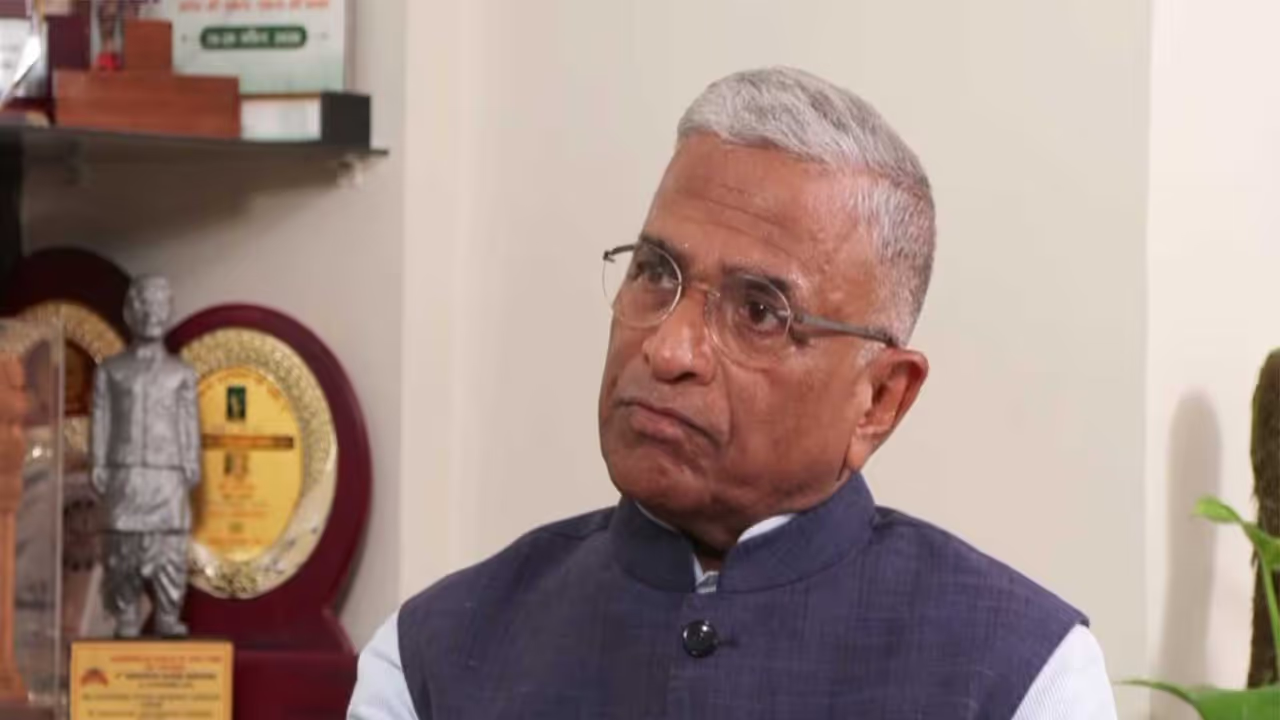
Rajya Sabha Deputy Chairman Harivansh states the world is amazed at India's progress since 2014, highlighting its rapid economic growth, infrastructural transformation, and resilience despite global crises, contrasting it with the pre-2014 era.
India's Economic Progress Since 2014
With India continuing to be the fastest-growing major economy and registering a high growth rate amid geopolitical tensions in different parts of the world, Rajya Sabha Deputy Chairman Harivansh on Sunday said that the world is amazed at the pace of India's progress since 2014.
In an interview with ANI, he said that India has seen rapid transformation in its infrastructure and referred to the BJP-led government's vision of making India a developed country by 2047. He said India was considered among the "Fragile Five" economies before 2014, but has since made significant progress in several areas. PM Modi-led NDA government came to office in 2014.
Answering a query about the 12 years of BJP-led government, he said it is vital to remember the past to get a perspective of the present and noted that before 2014, there were violations along the LoC and several border areas had poor infrastructure. "If certain major nations do not want India to progress, there are only two reasons for it. There has been rapid economic growth since 2014, which is not child's play... The rest of the world is amazed at the pace of India's progress since 2014. Look at the transformation in our infrastructure and our economic growth--all achieved despite two major global crises. Where were we before 2014 and where we are now, people show know"
Harivansh said some people might be envious of India's fast progress after 2014 and its march ahead as it met the challenge of the COVID-19 crisis and the supply chain disruptions. He cited the Vande Bharat trains, expansion of 5G technology, hydrogen train and developments in the space sector as examples of India's growing capabilities. Harivansh also pointed to India's ability to develop major infrastructure and technological projects at comparatively lower costs, saying such achievements demonstrated the country's growing capabilities. He said Prime Minister Narendra Modi, in his Independence Day address, had laid emphasis on maintaining global standards of products to boost exports. He said children should be apprised of the progress made.
Role of States in Manufacturing
Asked about the manufacturing not picking up in its contribution to the GDP, Harivansh said many factors are related to the states. "Law and order is in the hands of the state, land policy is in the hands of the state, industrial policy is in the hands of the state, education is in the hands of the state, health is in the hands of the state. The states that are working with good policies on these things are progressing very rapidly," he said.
On the Opposition's Role
He also said it is the role of opposition to ask questions of the government. "If the government fails to deliver on its promises, whose responsibility is it to hold it accountable in the eyes of the people? It is the opposition's responsibility; is the opposition fulfilling that role effectively?" he asked.
On Paper Leaks and Student Protests
Answering another query, Harivansh noted that the issue of paper leaks was not new but has been there for decades and said that everyone recognised the pain behind the protests in the national capital last month and government showed sensitivity and accepted the demands. He said that students should consider the need for systemic reforms in governance across the states. He expressed concern over the abusive language in Delhi by a few protestors during the protest against the NEET-UG paper leak and said things said about Prime Minister Narendra Modi "bodes ill for our country".
"This issue of paper leaks has been going on for 25, 30, or even 40 years. A government in Uttar Pradesh fell because it tried to stop cheating in exams. The current Defence Minister was a minister there at the time... Why is it that a committee under the Prime Minister's leadership has been formed to address the root cause only now? Why wasn't this done back in the 1960s, when the systemic flaws were already becoming apparent?... I urge students to look beyond just education and consider the need for similar systemic reforms in governance across the states," he said
"Everyone recognised the pain behind the student movement, and I must commend the government for its sensitivity. They immediately accepted all the demands, for which I am grateful... However, one aspect of that movement caused me deep anguish as an Indian. The slogans, the abusive language, and the things said about the Prime Minister. Such conduct bodes ill for our country," he added.
Harivansh on Delimitation
Answering a query related to the delimitation, he said it was an exercise mandated by the constitution and asked how long it can be postponed. "... If you speak of upholding the Constitution, note that the delimitation process mandated by it has been postponed twice. Either come together to introduce a new constitutional provision regarding delimitation and decide collectively. Otherwise, how long will you keep postponing what is enshrined in the Constitution?... I am a proponent of the Constitution... You cannot simply keep deferring something that is part of the Constitution and glorify such indecisiveness," he said.
The delimitation bill linked to women's reservation was defeated in Parliament in the budget session.
Concerns Over Parliamentary Disruptions
Asnwering another query, Harivansh said that the country has made rapid progress over the past decade. "If certain major nations do not want India to progress, there are only two reasons for it. There has been rapid economic growth since 2014, which is not child's play... The rest of the world is amazed at the pace of India's progress since 2014. Look at the transformation in our infrastructure and our economic growth--all achieved despite two major global crises..."
He wondered if the opposition was effectively playing its role to hold the government accountable. "If the government fails to deliver on its promises, whose responsibility is it to hold it accountable in the eyes of the people? It is the opposition's responsibility; is the opposition fulfilling that role effectively?" he asked.
Harivansh expressed deep disappointment over the repeated disruptions in the monsoon session of Parliament, during which the opposition parties resorted to constant sloganeering over their demands. He said that while there is constant invoking of the Constitution and copies of it being carried around, "what is the nature of our actual conduct".
Twelve bills were passed in the monsoon session of Parliament amid opposition protests. While there was brief debate on bills in the Rajya Sabha, the bills were mostly passed without any debate in the Lok Sabha amid the din by the opposition parties over their demands.
"While official data indicates the volume of work accomplished--or the lack thereof--the situation represents an attempt to undermine the credibility of Parliamentary democracy, render it ineffective and untrustworthy, and sow seeds of doubt among the public and society regarding their elected representatives. It is an attempt to dismantle parliamentary democracy itself," he said.
Harivansh said he was speaking as a concerned citizen. "I am speaking as a concerned citizen of this country. I have been a journalist for a long time and politics has been my passion. I joined the JP movement as a student and then entered politics. Then I have been a Member of Parliament for the last 12 years. As an MP, I am perhaps the first person who, even after becoming Deputy Chairman, sits continuously in the proceedings of Parliament and has hardly ever been absent after becoming Deputy Chairman," he said.
Answering a query, Harivansh said it is the responsibility of both the treasury benches and the opposition to ensure the smooth running of Parliament. "The responsibility lies equally with the government and the opposition, and if even one side is determined to stall proceedings, we witness scenes like the ones we saw... We constantly invoke the Constitution and carry copies of it around, but what is the nature of our actual conduct?" he asked.
The monsoon session of Parliament saw low productivity in both Lok Sabha and Rajya Sabha over opposition demands, including a statement by Home Minister Amit Shah over "police action against protestors" in the national capital on July 20. The two Houses saw repeated adjournments, with the Chair repeatedly urging opposition members to allow normal proceedings. The disruptions were also witnessed during the Question Hour. The government later said that it is ready for debate on the students' protest and the Home Minister will reply to the but the Congress and other opposition parties did not agree to the offer. The monsoon session of Parliament began on July 20 and ended on August 13. (ANI)
(Except for the headline, this story has not been edited by Asianet Newsable English staff and is published from a syndicated feed.)
