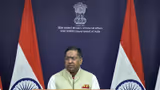
The historic 1960 Indus Waters Treaty (IWT) is facing an unprecedented legal and diplomatic stalemate as India firmly maintains its boycott of the Permanent Court of Arbitration (CoA) at The Hague, dismissing its proceedings and recent awards as “illegally constituted” and legally void.
New Delhi: The historic 1960 Indus Waters Treaty (IWT) is facing an unprecedented legal and diplomatic stalemate as India firmly maintains its boycott of the Permanent Court of Arbitration (CoA) at The Hague, dismissing its proceedings and recent awards as “illegally constituted” and legally void.
India maintains its longstanding position
Rejecting the award issued by the Court of Arbitration, the Ministry of External Affairs spokesperson, Randhir Jaiswal said: “The illegally constituted so-called Court of Arbitration (CoA) has, on 15 May 2026, issued what it termed an award concerning maximum pondage supplemental to the award on issues of general interpretation of the Indus Waters Treaty.”
“India categorically rejects the present so-called award, just as it has firmly rejected all prior pronouncements of the illegally constituted CoA.”
Related Articles

The decades-old treaty, brokered by the World Bank, splits the six trans-boundary rivers of the Indus basin: India enjoys unrestricted rights over the Eastern Rivers (Sutlej, Beas, and Ravi), while Pakistan receives the bulk of the Western Rivers (Indus, Jhelum, and Chenab).
However, intense geopolitical friction has unraveled this delicate arrangement.
The Dispute over Parallel Tracks
The core of the legal breakdown stems from Pakistan’s unilateral decision to bypass the treaty’s structured, graded dispute resolution mechanism.
The IWT mandates a single-track process: first, resolution via the bilateral Permanent Indus Commission; second, a World Bank-appointed Neutral Expert for technical differences; and third, a Court of Arbitration for complex legal disputes.
In 2016, Islamabad aggressively pushed for a CoA, while India simultaneously requested a neutral expert to assess technical parameters.
In a highly unusual move, the World Bank accommodated both demands simultaneously. New Delhi vehemently protested this parallel track, pointing out that simultaneous processes on identical technical matters risk contradictory outcomes, completely undermining the treaty's architectural integrity.
India’s Stand on the CoA New Delhi has adopted a severe stance against the CoA. The Ministry of External Affairs (MEA) has repeatedly stated that India does not recognize the legal existence of the court.
Consequently, New Delhi has completely boycotted all hearings in The Hague, maintaining that any “awards” or declarations issued by the panel are entirely per se void. Instead, India has directed its complete compliance toward the neutral expert mechanism, actively participating in its site visits and proceedings, which it considers the only legally authorized track under the treaty's provisions.
Jaiswal stated: “India has never recognised the establishment of this so-called CoA. Any proceeding, award, or decision issued by it is null and void.”
Geopolitical Escalation: Treaty in Abeyance
The cross-border water conflict reached a tipping point following a severe terrorist attack in Pahalgam. Exercising its rights as a sovereign nation under international law, India formally placed the Indus Waters Treaty in “abeyance.” New Delhi has made it clear that it will no longer remain bound by the data-sharing or meeting obligations of the treaty until Pakistan credibly and irrevocably ceases its support for cross-border terrorism.
Furthermore, India has issued official notices demanding a comprehensive modification and renegotiation of the 65-year-old pact, citing drastically changed demographic, environmental, and technological factors that require a complete overhaul of South Asia's most prominent water sharing framework.
On Saturday, Jaiswal further added that India’s decision to hold the Indus Waters Treaty in abeyance remains in force.
The River That Outlasted Empires The Indus system is ancient. It nourished one of the world’s earliest civilisations – the people of Mohenjo-daro and Harappa, who built cities with drainage systems while much of the world still lived in mud huts.
For millennia, the rivers flowed indifferently across the subcontinent, carving valleys, feeding plains, and defying the borders that human ambition would one day draw across them.
When the British partitioned India and Pakistan in 1947, they divided the land along religious lines, but they forgot, or perhaps chose not to bother, to divide the rivers.
The headwaters of the Indus and its six major tributaries – the Jhelum, Chenab, Ravi, Beas, and Sutlej – lay mostly in India, but the farmlands they irrigated, the canals they fed, the populations that depended on them – those lay mostly in Pakistan.