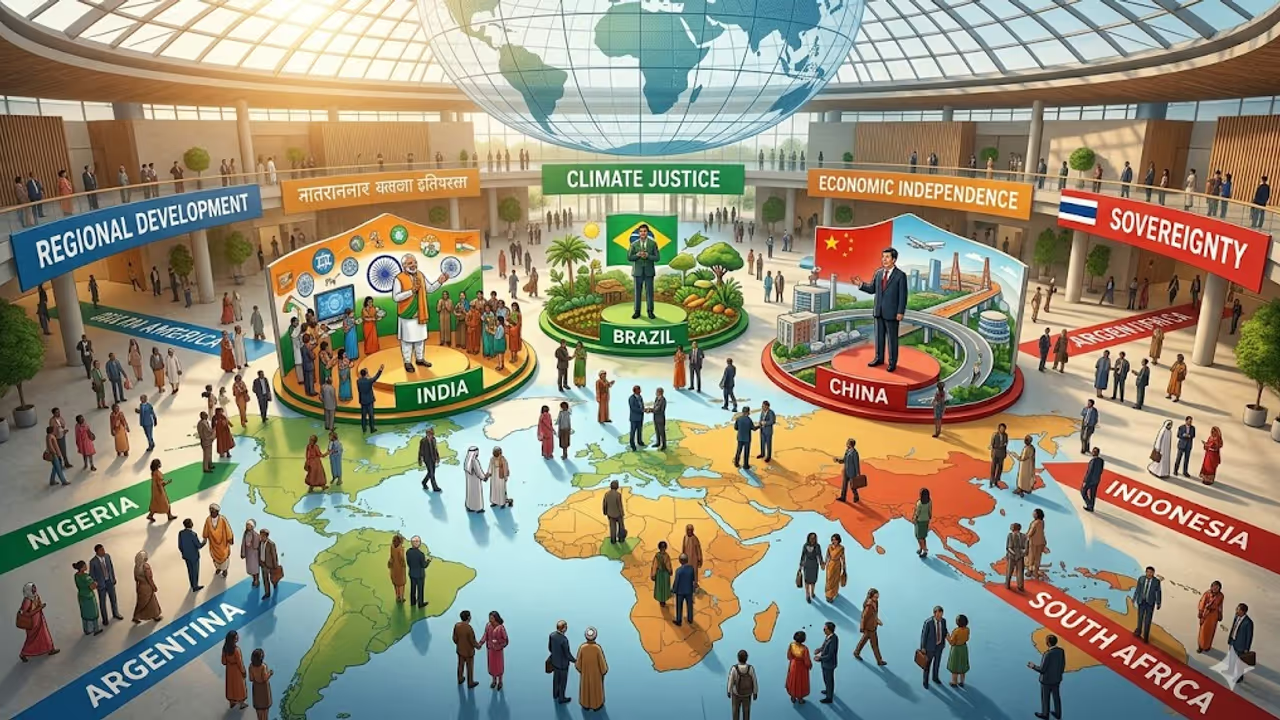
The term 'Global South' is widely used in global politics, but it does not represent one single group with one clear leader. It refers to developing countries mainly in Asia, Africa and Latin America. India, Brazil and China each try to represent these nations in different ways. However, the Global South has no formal structure.
These days, the words "Global South" are heard almost everywhere. World leaders use it in big international meetings, prime ministers mention it in their speeches, and even policy papers are full of it. The way people speak about it, you would think the Global South is like one big family of countries, all sitting together, all wanting the same things. But the real picture is not so simple.
In simple words, the Global South means the developing and poorer countries of the world, mostly in Asia, Africa and Latin America. These nations are not part of the rich Western club like America and Europe. The idea of these countries coming together and not depending on any one superpower sounds powerful, especially today when the world feels unstable, with wars, trade tensions and climate troubles all happening at once. But one important question is becoming louder day by day. Who actually speaks on behalf of the Global South?
In recent years, India has taken a strong step forward in playing this role. During its G20 presidency, India organised special meetings called "Voice of the Global South," where it invited many developing nations to share their problems. By doing this, India is showing that it wants to be a leader for these countries whose voices are often ignored in big global decisions. This is not just about India's own interests. It is about giving a platform to those countries who usually do not get a chair at the main table.
Related Articles

But India is not alone in this race. Brazil also wants to be seen as a major voice, especially on topics like fair development and climate justice. When global talks happen on money, environment and poverty, Brazil tries to speak for poorer nations. China is also doing the same thing but in its own style. It uses big infrastructure projects, loans, and groups like BRICS to build its image as a friend and leader of developing nations.
All three countries, India, Brazil and China, agree on one point. They believe the Global South can be led by a few major powers. But when we look closely, this belief becomes hard to accept fully. The reason is simple. The Global South is not one single group with one single opinion.
Unlike formal organisations such as the United Nations, the Global South has no office, no rulebook, and no proper system of representation. It is just a broad idea built on shared history, like the experience of colonialism, and political identity. The countries inside it have very different needs.
For some, the biggest worry is development, meaning better roads, jobs, money and access to technology. For others, the main concern is sovereignty, meaning the freedom to take their own decisions without pressure from big powers. This difference came out very clearly during the Russia-Ukraine war. Many Global South countries refused to pick a side. Some criticised Russia, but many stayed quiet because they needed cheap energy and trade ties. So if these countries cannot agree on one war, how can one nation claim to represent all of them?
Even during Cold War days, the Group of 77, which was an old version of this idea, was always divided. Today also, the meaning of Global South changes depending on who is using it. Indonesia uses it to talk about trade and regional growth. South Africa uses it to demand reforms in global institutions like the IMF and World Bank, where rich nations still hold most power. India uses it to push for fairness, while China uses it to challenge Western dominance.
This flexibility is exactly why the term has become so popular. Any country can fit its own meaning into it. But the same flexibility creates a big problem. If the Global South itself has no fixed boundary, then no single country can honestly claim to speak for everyone inside it.
Still, the idea matters. It gives weaker nations a common language to express their frustrations about inequality and unfair global rules. It sometimes helps them join hands on issues like climate finance and vaccine access.
But the truth is plain. Claiming to lead the Global South is much easier than actually representing it. The Global South is less like a united army and more like a noisy marketplace, where many voices are bargaining, competing, and shouting at the same time. And that reality is not going to change anytime soon.
(Girish Linganna is an award-winning science communicator and a Defence, Aerospace & Geopolitical Analyst. He is the Managing Director of ADD Engineering Components India Pvt. Ltd., a subsidiary of ADD Engineering GmbH, Germany.)
Disclaimer: The opinions expressed are solely those of the author and do not reflect the views or stance of the organization. The organization assumes no responsibility for the content shared.