
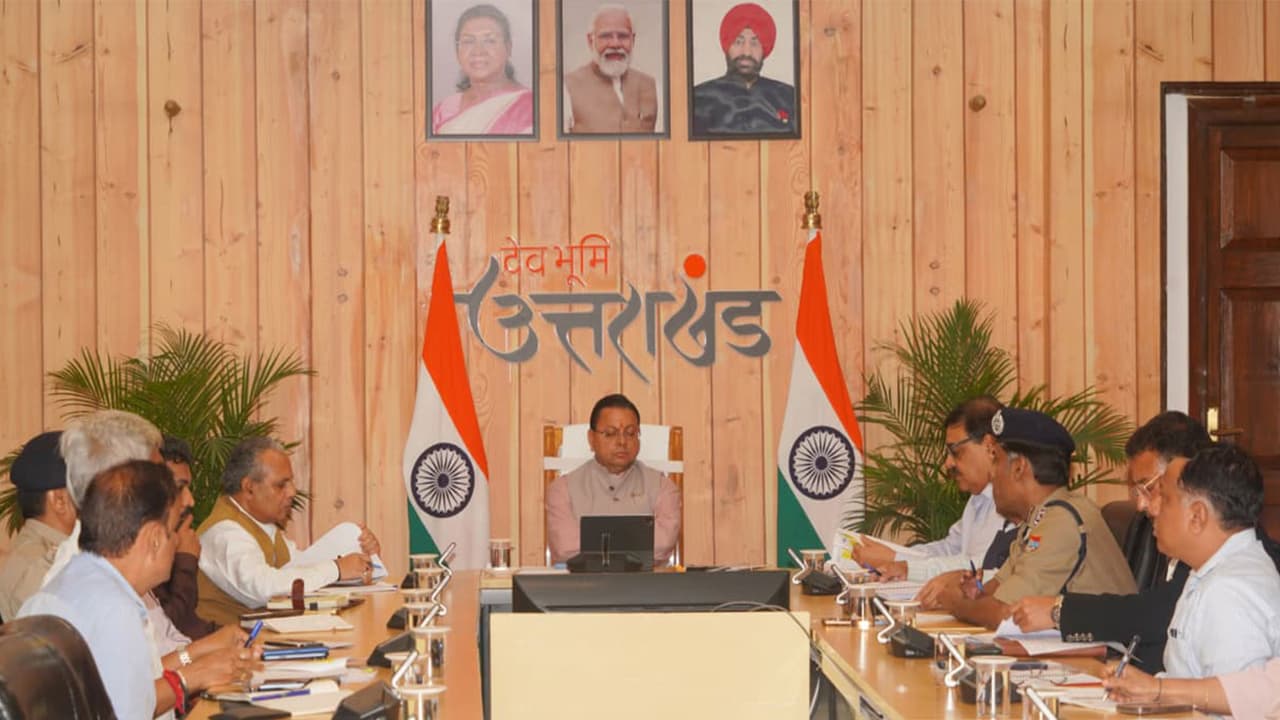
Uttarakhand CM Pushkar Singh Dhami chaired a high-level meeting to review monsoon preparedness, the Char Dham Yatra, and dengue prevention, directing officials to be on 24x7 alert and warning that negligence in public safety will not be tolerated.
Uttarakhand Chief Minister Pushkar Singh Dhami on Friday chaired a comprehensive review meeting at the Chief Minister's residence with officials from all districts to assess the prevailing monsoon situation, heavy rainfall, Char Dham Yatra, dengue prevention measures, and disaster preparedness across Uttarakhand.
During the meeting, the Chief Minister made it clear that public safety is the government's highest priority and that negligence, complacency, or laxity at any level will not be tolerated. He directed officials to move beyond review meetings and conduct regular field inspections to ensure effective implementation of all arrangements on the ground. He directed all departments and district administrations to remain on 24x7 alert throughout the monsoon season. He emphasised that there should be no delay in relief and rescue operations during any disaster or emergency and directed District Magistrates to immediately report every major incident to the Chief Minister's Office and the State Emergency Operations Centre while ensuring timely relief and rehabilitation.
Char Dham Yatra Review
Reviewing the Char Dham Yatra, the Chief Minister sought district-wise updates on road conditions, landslide-prone areas, pilgrim movement and arrangements at the four shrines. He said the pilgrimage was closely linked to the faith of millions as well as Uttarakhand's economy and stressed that safety, smooth traffic movement, healthcare, drinking water, sanitation and overall management should remain top priorities.
Officials informed the meeting that more than 44.65 lakh pilgrims have undertaken the Char Dham Yatra so far this year. Dhami said the large turnout reflected people's faith in Uttarakhand and stressed that every pilgrim should return home with a safe and satisfactory experience.
Disaster Preparedness and Response
Equipment and Technology Deployment
The Chief Minister directed departments to pre-position JCBs, Pokland machines, technical teams and other equipment at landslide-prone locations to facilitate immediate road clearance. He also asked officials to make effective use of GPS and modern communication systems in vulnerable areas.
Inter-Departmental Coordination
Dhami instructed all departments, including the NDRF, SDRF, Police, Health, Public Works, Power, Drinking Water, and Food and Civil Supplies departments, to work in complete coordination. He said electricity, drinking water and communication services disrupted due to heavy rainfall or landslides should be restored on priority and additional teams deployed wherever necessary. He also directed officials to ensure adequate stocks of food grains, medicines, fuel and other essential commodities in remote and sensitive areas well in advance so that local residents do not face shortages if roads are blocked.
Protection of Vulnerable Groups
Emphasising the protection of vulnerable groups, including pregnant women, senior citizens, persons with disabilities and critically ill patients, the Chief Minister instructed district administrations to shift pregnant women in vulnerable areas to safer locations or medical facilities in advance wherever necessary. He also said helicopter services would remain on standby in sensitive regions for emergency rescue and relief operations.
Dengue Preparedness
Reviewing dengue preparedness, Dhami directed urban local bodies and gram panchayats to regularise fogging, anti-larval spraying, sanitation drives and waterlogging clearance. He also instructed the Health Department to ensure adequate availability of testing kits, medicines, blood, hospital beds and medical personnel across health facilities.
Further Directives for Enhanced Response
The Chief Minister further ordered safety audits of bridges during the monsoon, intensive cleaning of drains to prevent waterlogging and the development of alternative communication systems in remote areas to ensure uninterrupted disaster response. He also directed all District Magistrates to conduct regular field visits, ensure adherence to the "Golden Hour" principle during rescue operations and strengthen coordination with public representatives, NGOs and local organisations to improve disaster response at the grassroots level. (ANI)
(Except for the headline, this story has not been edited by Asianetnews Editorial staff and is published from a syndicated feed.)