
Tripura CM Manik Saha announced the govt's success in bringing the primary school dropout rate to zero in 2025-26. The state plans to establish residential schools, is implementing the ULLAS literacy program, and will open Balvatikas in 2,048 schools.
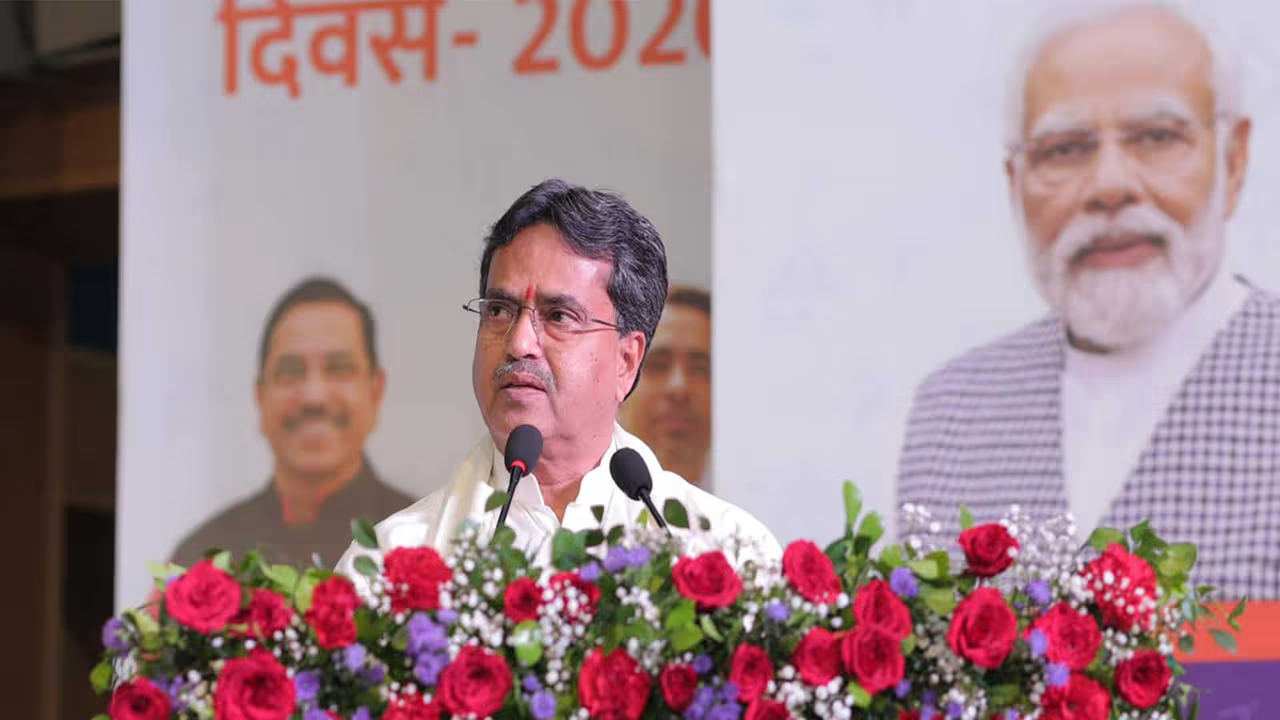
Tripura Chief Minister Manik Saha said that with consistent efforts to strengthen foundational literacy in all primary schools, the governemnt was successful in bringing the dropout rate to zero per cent in 2025-26 and further committed to reducing this dropout rate to a minimum within the next 3-4 years. According to the Chief Minister's Office, Saha said this while addressing the International Literacy Day & ULLAS Mela in New Delhi.
New Residential Schools to Tackle Low Enrolment
Saha said that in order to tackle the problem of low enrolment in government schools in remote and rural areas, the government is planning to establish state-of-the-art Residential Schools on the pattern of Eklavya Model Schools by merging/clubbing schools with very low enrolment.
Empowerment Through Literacy: The ULLAS Program
“Our Prime Minister Narendra Modi believes that education and literacy are the foundations of a developed and strong India. The Prime Minister desires every child to gain knowledge, skills, values and opportunities to build a bright future so as to build Viksit Bharat by 2047. Literacy is not merely the ability to read and write; it is a powerful means of empowerment, dignity, confidence and social transformation. Tripura has been implementing ULLAS, i.e. Understanding Lifelong Learning for All in Society – Nav Bharat Saaksharta Karyakram, since May 2022,” he said.
Innovative Learning Initiatives
He said that during 2026, several innovative best practices have been undertaken under ULLAS. The State has undertaken innovative best practices for neo-learners, including Financial Literacy, where learners are taught to use cheque books, deposit forms and banking services. Also, the State is taking up innovative initiatives such as Experiential Market Learning, where everyday buying, selling and price comparison are used to strengthen literacy and numeracy. Also, the State Government is ensuring rapid awareness of Health and Hygiene with practical demonstrations of proper hand washing, sanitation and personal cleanliness among the masses and neo-learners.
Significant Reduction in Dropout Rates Achieved
The Tripura CM said that as per the UDISE+ (Unified District Information System for Education Plus), the dropout rate at the primary level (Grade I-V) during the year 2013-14 was 2.21 in the State. “With our consistent efforts to strengthen foundational literacy in all our primary schools, our Government was successful in bringing the dropout rate to Zero % in 2025-26. Similarly, in Secondary Schooling (Classes 9th and 10th), the dropout rate in 2013-14 was 25.51 in Tripura. Our Government was also successful in reducing this dropout rate significantly to 10.40% in the year 2025-26. We are further committed to reducing this dropout rate to a minimum within the next 3-4 years. I would again like to mention that our Government has been trying our level best to improve the transition rate in our schooling ecosystem,” he said.
Aligning with National Education Policy 2020
Saha further informed that recently, as per the mandate of the National Education Policy 2020, the State Government has given approval for the establishment of the Board of Open Schooling and Examination in Tripura. “To better focus on the quality of education in remote and rural areas, DMs & Collectors of the Districts have been given responsibility for their respective districts.
Also, as per the mandate of the National Education Policy, we will be opening Balvatika for one year of pre-school education for children from the age of 5 to 6 years in all 2,048 primary schools of our State within the next two years. The objective is to ensure that when the child goes to Class 1, he/she must be proficient in the basic learning competencies. We are working simultaneously on the development of school infrastructure, digital education, skill development, girls' education, inclusive education and improvement of the quality of education,” he added.
(Except for the headline, this story has not been edited by Asianet Newsable English staff and is published from a syndicated feed.)