CENJOWS DG Maj Gen Ashok Kumar (Retd) explains India’s plan to merge Army, Navy, and Air Force education branches into a Tri-Service Education Corps and create three joint military stations, aiming to boost jointness and operational readiness.
New Delhi: Taking a step forward to enhance jointness and integration among the Indian armed forces, the country’s top leadership has approved the creation of joint military stations and the establishment of a single tri-service education corps by merging the education branches of the Army, Navy, and Air Force.
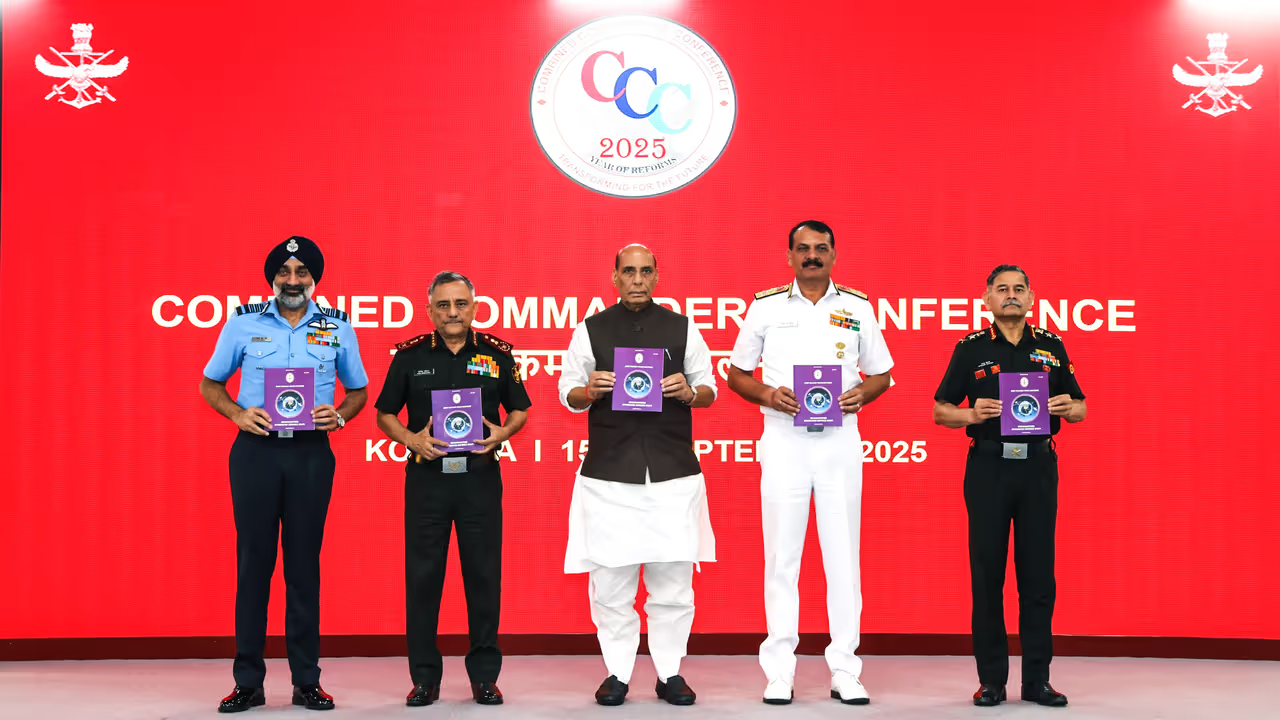
The decisions were taken on the last day of Combined Commanders’ Conference in Kolkata.
Informing about the decisions, the the Headquarters (HQ), Integrated Defence Staff (IDS) in a post on X said, "On the final day of the Combined Commanders' Conference (CCC) 2025, decision by all the Chiefs and Commanders for merging of education branches of three services to form single Tri-Services Education Corps was announced."
Related Articles

"The decision on formation of three Joint Military Stations was also announced," HQ-IDS said.
Integration for Future-Ready Armed Forces
Asianet Newsable English spoke with Major General Ashok Kumar (Retd), Director General of the Centre for Joint Warfare Studies (CENJOWS), to get insights into the implications of the newly approved decisions by India’s top military leadership.
CENJOWS is a tri-service think tank dedicated to promoting jointness and synergy to strengthen India’s integrated national power.
“Jointness, integration and theaterization were the intended aims for restructuring the Indian military, however, jointness and synergy were prerequisites to operationalization of the theatre commands,” Maj Gen Asho Kumar (R) said.
In an effort to make the Indian armed forces – Indian Army, Indian Navy and Indian Air Force – future ready, the CENJOWS DG said around 200 areas have been identified for integration of the forces.
“This approach also helped us in an exceptional performance during Op Sindoor.”
Joint Military Stations: A Long-Overdue Move
Stating that the creation of the military stations as common for all the three services was long overdue, Ashok Kumar said: “In fact, the time has come to declare all lands, infrastructure and stations as common stations. A pragmatic policy can be evolved in the best interest of all the stakeholders.”
A total of three joint military stations will be established across the country. However, no locations have been revealed as of now.
“During Combined Commanders Conference, the decision to have a tri-services Education set up is a step to actualize one facet of integration besides optimization of resources, both in terms of infrastructure and manpower. This will result in a setup which is much more professional as compared to their individual profiles.”
The education branches of the forces have generally been entrusted with the responsibility of enhancing the educational standard of the troops, and its cadres is posted at subareas (garrisons), headquarters, training centres, units, establishments, sainik schools, military schools, colleges, and selection centres.
The military stations are dedicated geographical areas housing equipment and personnel, and their families, where they live and train.
Defence Minister Highlights “JAI” Mantra
A day ago, while addressing the commanders, Defence Minister Rajnath Singh called for focusing on the mantra of “JAI (Jointness, Aatmanirbharta and Innovation)” given by Prime Minister Narendra Modi in the inaugural session of the conference on September 15, highlighting that the country’s defence sector is centered around modernisation, operational readiness, technological superiority and credible deterrence.
He batted for deeper engagement with the industry and academia in developing future-ready technologies.
Underscoring the importance of jointness and synergy among the Armed Forces as well as with other agencies, in line with the whole of nation approach, Rajnath Singh terming it as “essential” to deal with future challenges.
He mentioned about the creation of Tri-Service Logistics Nodes and Tri-Service Logistic Management Application to promote integration and jointness in the defence sector, while also highlighting the attention being paid to greater civil-military fusion.