
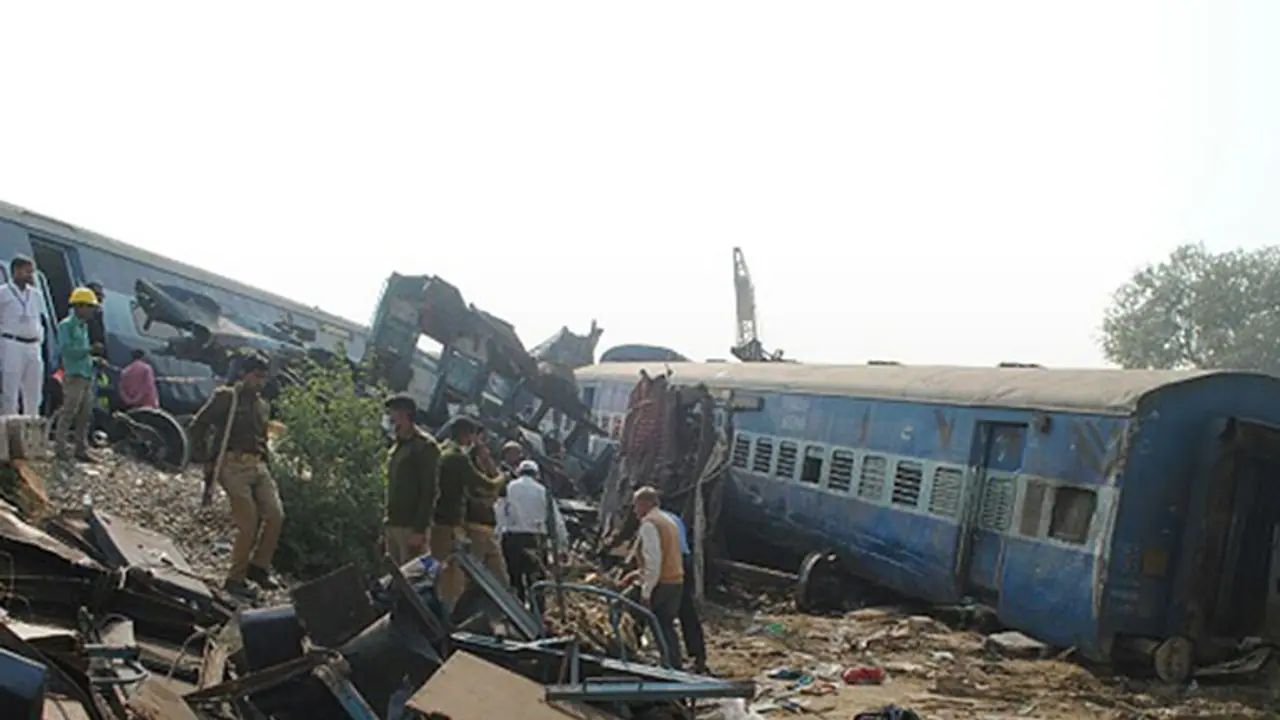
Three people have been arrested by Bihar police for allegedly sabotaging railway tracks for the ISI. A Mumbai man claimed he was approached by a gang providing training to sabotage tracks. The ISI provided a Nepali operative with ₹30 lakh to derail trains in India.
The Bihar police on January 17 arrested three people for their alleged involvement in sabotaging railway tracks to derail trains, including the Patna-Indore Express accident near Kanpur that killed 150 people in November. The trio, who were arrested from the district of East Champaran, which borders Nepal, reportedly claimed that they were associated with a gang that had ties to Pakistan’s Inter Services Intelligence (ISI).
The development is significant as it comes at the same time as the Mumbai Police and Central security agencies have announced that they are investigating the possible existence of a gang in Bihar that provides training to sabotage railway tracks. Police officials in Mumbai told The Indian Express that a native of Uttar Pradesh, Vasant Kumar, had informed them in late December that he was approached by a gang that imparted training to damage railway tracks, which would also include compensation of up to ₹70,000.
Providing details to The Indian Express, the police officials said Kumar claimed to have been taken to a location between Varanasi and Allahabad for training. This involved methods to remove track keys using hammers and loosen track joint plates using iron rods. Two people who were with Kumar claimed that they had carried out an operation near Kanpur station in November (possibly referring to the Patna-Indore accident) for which they received ₹70,000 each.
Referring to the arrests in East Champaran, Bihar police officials told The Hindu that the ISI had paid a Nepali operative ₹30 lakh to carry out train derailments in India. The operative, Braj Kishore Giri, has been arrested by Nepali police. Giri had reportedly provided ₹3 lakh to two Bihari villagers to carry out a train derailment in Ghorasahan, which lies close to the border with Nepal, in October. When the attempt failed, Giri allegedly killed the duo.
The possibility of the ISI running such a train derailment network, while alarming, is not surprising. Given the importance of the Railways to India’s economic and strategic needs and the poor level of security present at most rail facilities, derailing tracks is a “low-risk, high-reward” approach for the ISI to keep India bleeding.
Furthermore, the crucial role played by criminal networks in Nepal and the border regions of Uttar Pradesh and Bihar can’t be ignored. That Nepal has long been a preferred hub for the ISI is an open secret. In recent years, the ISI has also attempted to capitalise on rising anti-India sentiment, in addition to exploiting corrupt business practices and legal loopholes.
The paucity of economic opportunities and poor education in northern parts of Uttar Pradesh and Bihar helps create a ready “pool” of recruits for criminal networks that are being exploited by the ISI. In addition to the need to radically boost security for the Railways (which will be no easy task), providing more livelihood options in these regions is imperative if the ISI’s derailment network is to be destroyed.
