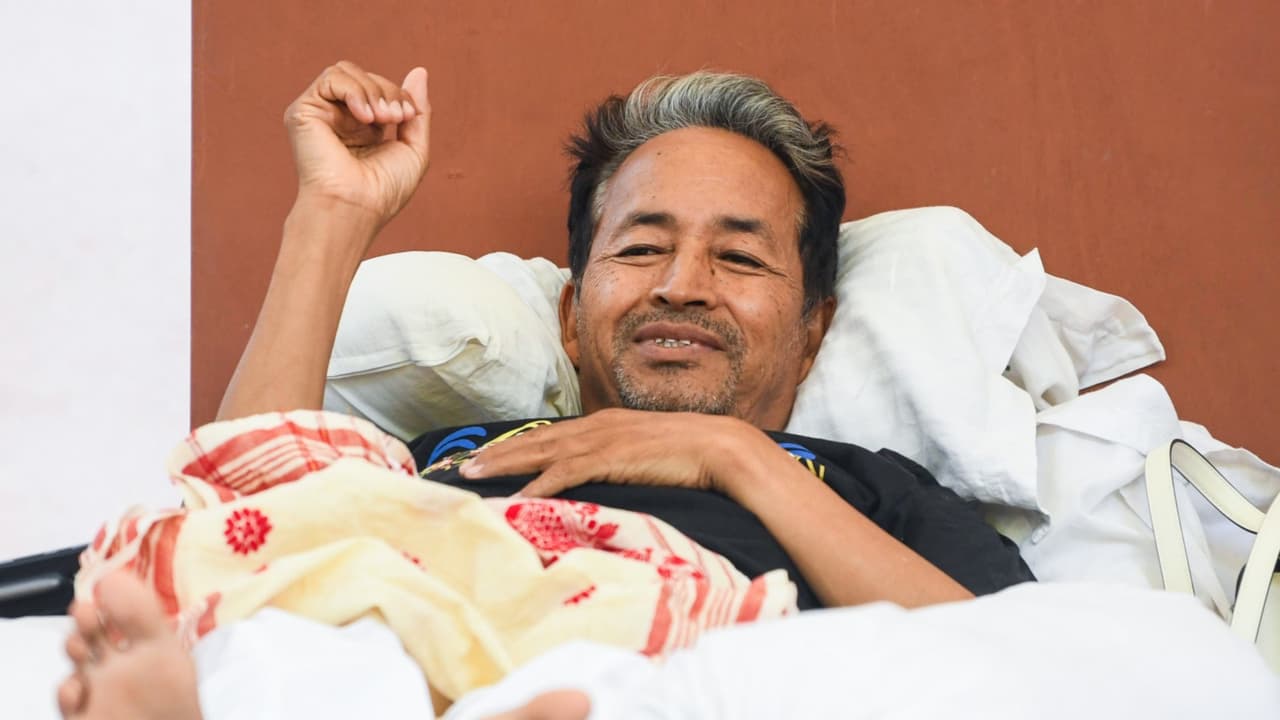
The Delhi HC observed that shifting activist Sonam Wangchuk to a hospital due to his fast was not arbitrary and didn't infringe his liberty. The court denied his plea for a private hospital transfer, citing his dangerously deteriorating health.
The Delhi High Court on Sunday observed that the government's decision to shift climate activist Sonam Wangchuk from the site of his fast to Safdarjung Hospital, in view of his deteriorating health, could not prima facie be termed arbitrary and did not infringe his personal liberty, as the step was taken to protect his life. The Court also found no grounds to grant interim relief seeking his transfer from Safdarjung Hospital to a private hospital of his choice.
Plea for Private Hospital Transfer
Justice Mini Pushkarna made the observations while hearing a petition filed by Wangchuk's wife, Gitanjali J Angmo, seeking directions to shift him to Medanta Hospital, Gurugram. She had contended that Wangchuk was being kept in Safdarjung Hospital without his or his family's consent and argued that, since he was not under detention, he could not be confined to the government hospital against his wishes. The Union Government opposed the plea, submitting that Wangchuk's health had deteriorated significantly after his prolonged fast and that the decision to move him to Safdarjung Hospital was taken in view of his worsening vital parameters. The Court was also provided with his medical records and heard submissions from doctors of Safdarjung Hospital and AIIMS, who are monitoring his condition.
Court Cites Deteriorating Health
The High Court noted that Wangchuk had been fasting for nearly 17 to 18 days and referred to an earlier order of a Division Bench dated July 16, which had directed that his health be monitored daily and that all necessary medical intervention be undertaken to prevent further deterioration. The Court observed that the government shifted him to the hospital in compliance with those directions and because of his perilous medical condition.
'Dangerously Low' Vitals
The Court further recorded that Wangchuk's sugar and sodium levels were below the normal range and that his potassium levels were stated to be dangerously low, posing a risk of life-threatening complications. It also noted the government's submission that intravenous fluids had not been administered because Wangchuk had not consented to the treatment.
Personal Liberty Argument Addressed
Observing that doctors at Safdarjung Hospital were closely monitoring Wangchuk and administering only those medicines and oral electrolytes for which he had given consent, the Court held that it could not be said that any force was being used against him or that his bodily autonomy was being violated. The Court also addressed the argument that Wangchuk was a free citizen and not under detention. It was observed that merely taking him from the protest site to a hospital, considering his vulnerable medical condition caused by prolonged fasting, did not prima facie amount to an infringement of his personal liberty. The Court added that since Wangchuk had not voluntarily admitted himself to any medical facility despite his deteriorating health, the government was under a bounden duty to take measures to ensure his well-being, reiterating that every life is precious and deserves protection.
No Interim Relief Granted
The High Court further took note of the government's statement that Wangchuk's wife, brother and brother-in-law have been granted unrestricted 24x7 access to meet him and that a separate room has been provided for family members, an arrangement described as unprecedented compared to the normal visiting-hour policy for other patients. Holding that no case for interim relief was made out at this stage, the Court directed the Union to file its status report within three days and listed the matter for further hearing on July 24.It also observed that while Wangchuk may choose whether to cooperate with medical intervention, the ultimate assessment of his medical condition and decisions regarding treatment would rest with the medical team, which must continue monitoring his vitals and act in accordance with strict medical protocols to safeguard his life. During the hearing, the Additional Solicitor General also assured the Court that Wangchuk's medical reports would be shared with his family, and the Court recorded the statement. (ANI)(Except for the headline, this story has not been edited by Asianet Newsable English staff and is published from a syndicated feed.)