
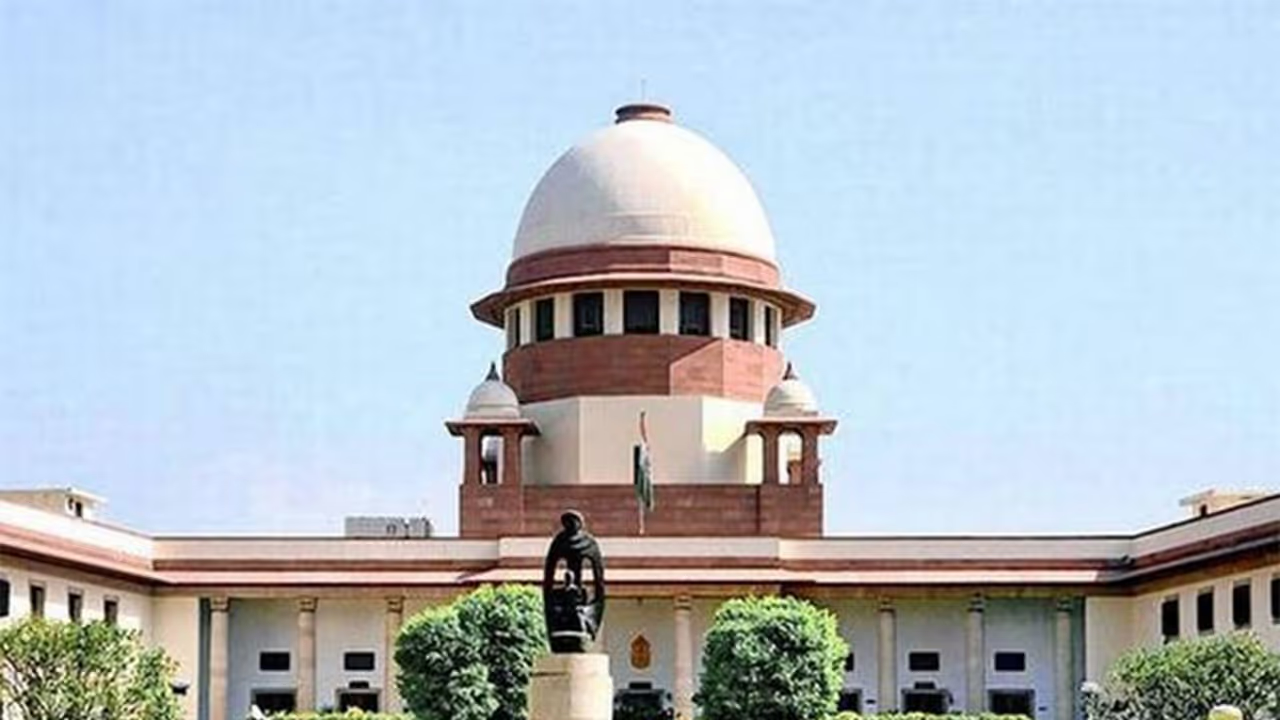
A PIL by Ashwini Kumar Upadhyay in the Supreme Court seeks regulation of all educational and religious institutions for kids under 14. It demands mandatory registration and challenges the scope of minority rights under Article 30 of the Constitution.
A Public Interest Litigation has been filed by Ashwini Kumar Upadhyay before the Supreme Court of India, seeking comprehensive directions to the Union and State governments to regulate all institutions imparting education or religious instruction to children below the age of 14 years. The plea, moved under Article 32 of the Constitution, opens with a set of key prayers urging the Court to ensure mandatory registration, recognition, supervision, and monitoring of such institutions nationwide.
Plea Questions Scope of Minority Rights Under Article 30
The petitioner has also sought a declaration that Article 30 does not grant any special or additional rights to minorities beyond what is already guaranteed under Article 19(1)(g). According to the plea, Article 30 is only a reiteration of the general right to establish educational institutions and must be interpreted within the same constitutional limitations.
Further, the petition asks the Court to clarify that institutions imparting religious instruction for the purpose of promoting religion fall strictly within the scope of Article 26, which governs religious affairs, and not under Articles 19 or 30. It also seeks a ruling that the phrase "educational institutions of their choice" under Article 30 should be confined to secular or professional institutions, excluding religious educational establishments.
Unregulated Institutions Affecting Child Welfare
The plea states that the issue came to light after the petitioner visited several districts along the Uttar Pradesh border, where numerous unregistered and unrecognised institutions were allegedly found operating. It claims that such institutions are proliferating across the border areas of the country without any effective oversight or regulatory mechanism.
Highlighting concerns over children's welfare, the petition contends that the absence of regulation in these institutions adversely affects the right to quality education guaranteed under Article 21A. It points to the lack of standardised curricula, qualified teachers, and institutional accountability, arguing that these deficiencies undermine both educational standards and child safety.
A significant aspect of the plea revolves around constitutional interpretation. The petitioner argues that Articles 25 and 26 exclusively govern matters of religion, and therefore, any institution imparting religious instruction, whether wholly or partially, must be regulated under Article 26. Extending the protection of Article 30 to such institutions, the plea submits, leads to a flawed interpretation and creates an imbalance between minority and non-minority institutions.
Call to Define 'Minority'
The petition also draws attention to the absence of a clear legal definition of "minority" in India and seeks directions for the Centre to lay down objective criteria for its identification. It asserts that the lack of defined parameters has resulted in arbitrary classification, allowing even large communities to claim minority status and avail constitutional benefits.
State's Constitutional Duty Emphasised
Emphasising that children are particularly vulnerable, the plea stresses that the State has a constitutional duty to ensure a safe and regulated educational environment. It argues that monitoring all institutions dealing with children is not optional but a mandatory obligation flowing from constitutional provisions relating to education, welfare, and child protection.
(Except for the headline, this story has not been edited by Asianet Newsable English staff and is published from a syndicated feed.)