
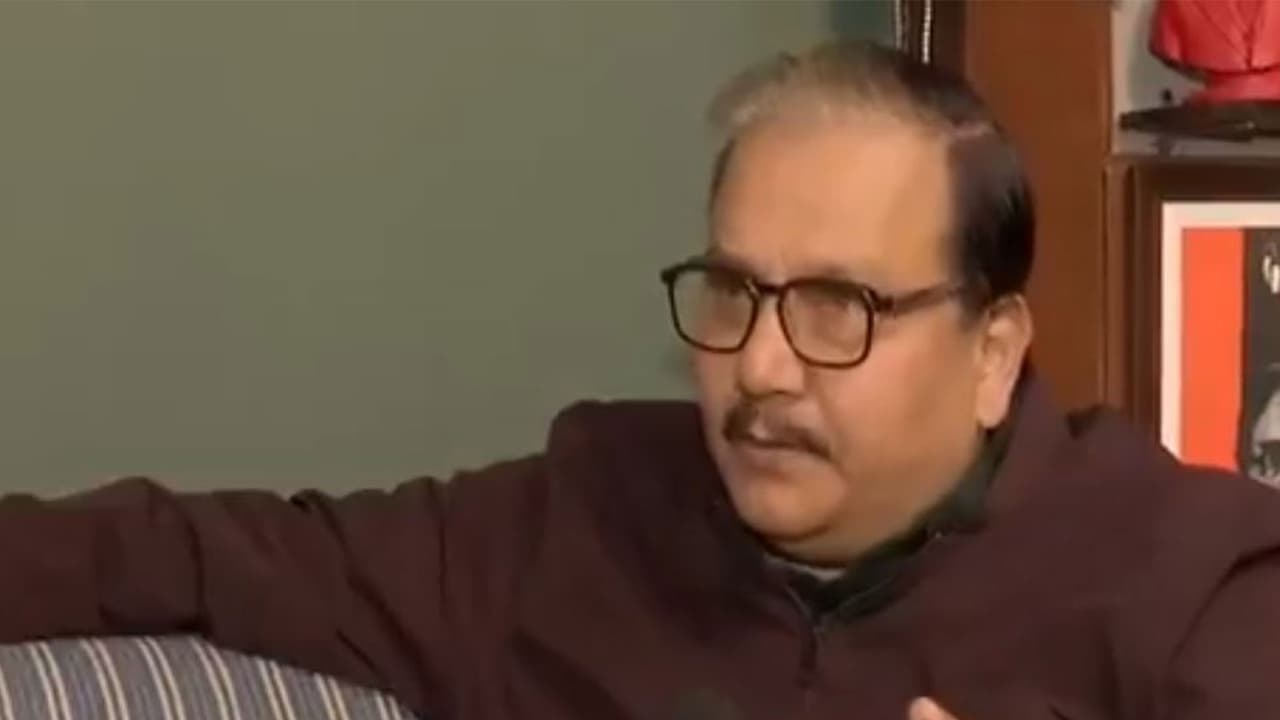
RJD MP Manoj Jha condemned the US military operation in Venezuela that captured President Maduro, terming it 'bullying' and an 'open attack'. He invoked India's historical non-aligned foreign policy and principles of sovereignty.
RJD MP Manoj Jha on Sunday condemned the US operation in Venezuela, calling it an "open attack" on a sovereign nation. Speaking with ANI, he termed US actions on the Latin American country as "bullying" and compared it with the "feudal societies" mindset. He criticised the lack of provocation and questioned the US's actions, citing India's past stance on international law and sovereignty. "This is the kind of bullying we used to see in feudal societies. You attacked a country without any provocation... The truth is, this is an open attack against a sovereign nation, and the whole world should be concerned about this because no international law permits this...," Jha told ANI.
US Operation and Justification
The US military launched a targeted operation in Venezuela (codenamed Operation Absolute Resolve) on January 3, 2026, capturing President Nicolas Maduro and his wife, Cilia Flores. The Trump administration claimed Maduro was involved in drug trafficking and had rigged the 2024 election. The US had previously imposed sanctions on Venezuela and offered a $50 million bounty for Maduro's arrest. The US government, under President Trump, justifies the intervention as a security necessity rather than a resource grab. The primary official reasons include: narco-terrorism charges, national security and migration crisis. The US indicted Nicolas Maduro and other high-ranking officials for allegedly leading a "narco-terrorist" conspiracy to flood the US with cocaine. Washington also claims the Maduro government has become a "criminal enterprise" that destabilises the Western Hemisphere by harbouring terrorist groups and facilitating human trafficking. Moreover, the US administration cites the mass exodus of millions of Venezuelans as a "border security" issue for the United States.
Jha Cites India's Historical Foreign Policy
Jha further emphasised that India's foreign policy has consistently upheld principles, solidifying its stance against joining power blocs and advocating an independent foreign policy, which is crucial for global diplomacy, regardless of the government in power. "In 1952, 1954, and 1957, whenever something happened in the world, we weren't as prosperous then, but we firmly stated our position... Regardless of which government was in power, our foreign policy never equivocated on these matters," added the RJD MP.
In the 1950s, India emerged as a prominent moral voice on the global stage. Under the leadership of Prime Minister Jawaharlal Nehru, the country championed "Non-Alignment," positioning itself as a mediator between the Cold War superpowers (the US and USSR). While 1952 was a landmark year for India's internal democracy, it also cemented India's reputation as a neutral global player. India successfully conducted its first General Election (1951-52). On the global stage, this was hailed as the "largest experiment in democracy" in history, proving that universal adult franchise could work in a developing, largely illiterate nation. India took a leading role at the United Nations to resolve the Korean War. In late 1952, India submitted a crucial resolution on the exchange of Prisoners of War (PoWs). Although initially rejected by the Soviet bloc, the proposal eventually became the basis for the 1953 ceasefire agreement.
1954 is perhaps the most significant year for Indian diplomacy in the 1950s, as it defined the country's foreign policy framework for decades. India articulated the Panchsheel principles with China, emphasising mutual respect for sovereignty, non-aggression, and non-interference.
In 1957, the UN General Assembly unanimously accepted the Panchsheel tenets, embedding them into international relations frameworks.
Owaisi Urges Action, Jha Dismisses Comparison
Jha's statement comes after AIMIM chief Asaduddin Owaisi urged Prime Minister Narendra Modi to follow the US example and bring back those responsible for the 26/11 Mumbai terror attacks. Owaisi cited the recent US military strike on Venezuela, where President Nicolas Maduro was captured, as an example of how countries can take bold action against terrorism. "Today we heard that US President Donald Trump's forces captured Venezuelan President Nicolas Maduro and took him from his country to America. If US President Donald Trump can abduct Venezuelan President Nicolas Maduro from his own country, then you (Prime Minister Modi) can also go to Pakistan and bring back the mastermind of the 26/11 terrorist attacks to India," he said.
"This is not the occasion for this. The question is about Venezuela," said Jha. (ANI)
(Except for the headline, this story has not been edited by Asianet Newsable English staff and is published from a syndicated feed.)