
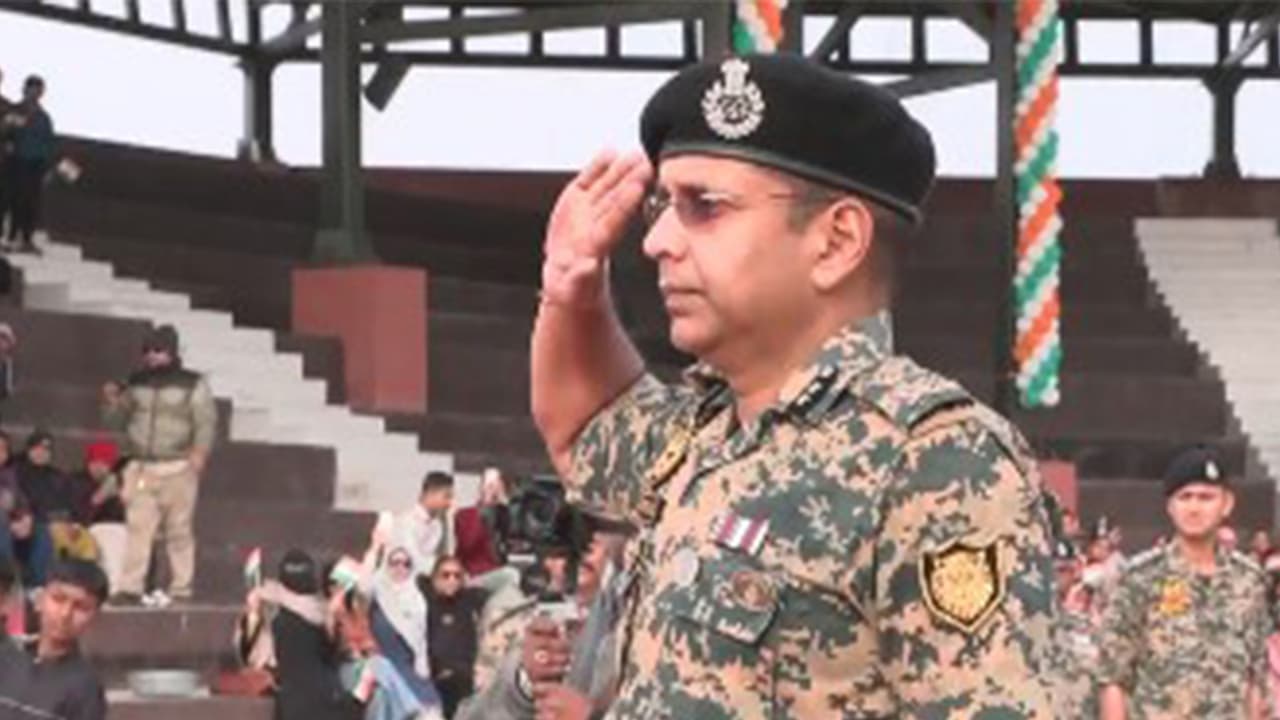
BSF celebrated the 77th Republic Day on the India-Pakistan border in Gujarat. In New Delhi, PM Modi paid homage at the National War Memorial, and President Droupadi Murmu presided over the grand parade on Kartavya Path, showcasing military might.
Inspector General (IG) of the Border Security Force of Gujarat Frontier Abhishek Pathak on Monday unfurled the National flag as BSF celebrated the 77th Republic Day on the India-Pakistan border in Gujarat's Nadabet. India celebrates its Republic Day today, as the nation comes together to mark the adoption of the Constitution and showcase its rich cultural and military heritage.
Grand Celebrations in New Delhi
Prime Minister Narendra Modi laid a wreath at the National War Memorial at the historical India Gate. Present alongside the PM were the Defence Minister Rajnath Singh, the Chief of Defence Services General Anil Chauhan, the Chief of Army Staff General Upendra Dwivedi, the Chief of Air Staff Air Chief Marshal APS Singh and the Chief of Naval Staff Admiral Dinesh Tripathi. President Droupadi Murmu presided over the grand celebrations on Kartavya Path in New Delhi. The President of the European Council, Antonio Costa, and the President of the European Commission, Ursula von der Leyen, also attended as the Chief Guests.
Paramilitary Contingents March on Kartavya Path
Further, police and paramilitary contingents marched along Kartavya Path as part of the ceremonial parade in the national capital, highlighting the role of central forces in internal security and border management. The formation was led by the Central Reserve Police Force (CRPF) Brass Band, commanded by Inspector Shamsher Lal. The band, comprising 100 personnel, played "Desh Ke Hum Hain Rakshak".
Central Reserve Police Force (CRPF)
It was followed by the CRPF marching contingent, which, for the first time, was led by Women Assistant Commandants Simran Bala and Surabhi Ravi, with 248 personnel taking part. Raised in 1939 as the Crown Representative's Police, the CRPF received the President's Colour in 1950. The force currently has 248 battalions with over 3.30 lakh personnel and is deployed in Jammu and Kashmir, the North-East, and Left Wing Extremism-affected areas. It also plays a role in election security. The CRPF have received 2,543 gallantry and service medals, while 2,271 personnel have lost their lives in service. Its motto is Service and Loyalty.
BSF Camel Contingent
The marching contingent was the Camel Contingent of the BSF under the command of Deputy Commandant Mahendra Pal Singh Rathore, mounted on his camel Chetak. Marching in front of the saluting base the regal camels of the BSF, followed by the iconic Camel Mounted Band. The contingent comprised three SOs and 50 Camel Riders, presenting a spectacular blend of discipline and tradition.
Indo-Tibetan Border Police (ITBP)
The parade also featured the Indo-Tibetan Border Police (ITBP) Band, led by Band Master ASI Devindra Singh, followed by the ITBP marching contingent commanded by Assistant Commandant Pagar Janardhan Kalu, comprising three officers and 144 personnel. The ITBP guards the 3,488 km Indo-China border and operates in high-altitude regions. It is also involved in internal security, disaster response and protection of key installations. The force has undertaken multiple mountaineering expeditions, including ascents of Mount Everest, according to a Ministry of Defence release.
Delhi Police Contingent
Following them was the Delhi Police Marching Contingent, a 17-time winner of the Best Marching Contingent award. The contingent was led by Assistant Commissioner of Police Anant Dhanraj Singh, IPS. The Red Safa-clad jawans of the Delhi Police marching contingent, consisting of one ACP, 03 inspectors, 44 Head Constables, and 100 Constables, include only those who are over 6 feet tall. This elite group of towering individuals reflects the pride and grandeur of the force.
Significance of Republic Day
Republic Day marks a defining milestone in India's national journey. It marks the day the Constitution of India came into force on January 26, 1950, formally establishing the country as a 'Sovereign Democratic Republic'.
(Except for the headline, this story has not been edited by Asianet Newsable English staff and is published from a syndicated feed.)