
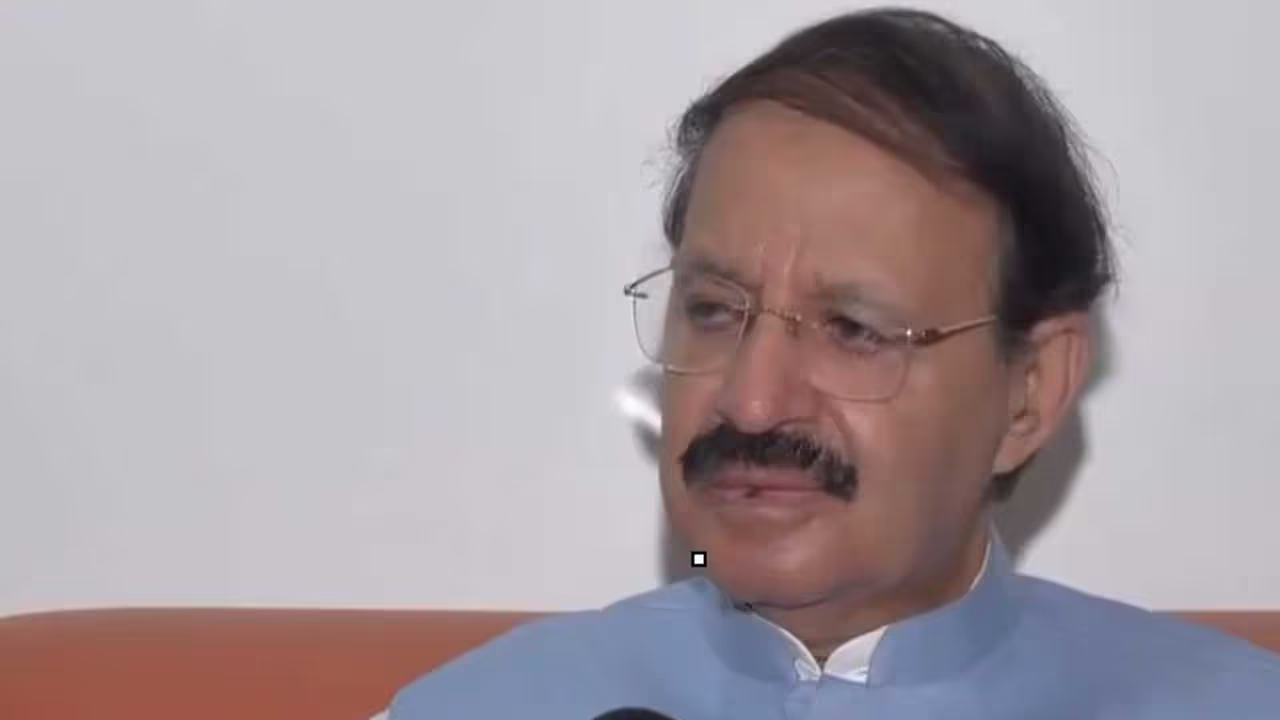
Congress' Rashid Alvi questioned the diplomatic win of the BRICS' New Delhi Declaration, arguing that condemning the Pahalgam terror attack without naming the perpetrators or sponsor states fails to deliver a meaningful diplomatic outcome.
Congress Questions Diplomatic Impact of BRICS Declaration
Congress leader Rashid Alvi on Sunday questioned the diplomatic impact of the New Delhi Declaration adopted at the 18th BRICS Summit hosted by India, after member states condemned cross-border terrorism and specifically mentioned the Pahalgam terror attack.
Expressing scepticism over the text of the resolution, the senior Congress leader, while talking to ANI, argued that a condemnation without naming the perpetrators or sponsor states fails to deliver a meaningful diplomatic outcome. "The Delhi Declaration that has been issued condemns terrorism and the Pahalgam incident, but does it state anywhere who carried out the Pahalgam attack? Does it mention anywhere who is perpetrating terrorism globally? There is no mention of that... No one would support terrorism, but the question is, who is doing it?... What is the point of a declaration where one cannot even identify who is committing the theft?... That's why this is not a diplomatic win at all," he said.
New Delhi Declaration Hailed as 'Major Diplomatic Win'
The New Delhi Declaration, adopted unanimously on the opening day of the 18th BRICS Summit in September 2026, is being seen as a major diplomatic win for India, with the bloc explicitly condemning the April 22, 2025 Pahalgam terror attack and taking a unified stand against cross-border terrorism.
On April 22, 2025, terrorists attacked tourists in Pahalgam, Jammu and Kashmir, killing 26 people and injuring several others. Indian agencies traced the attack to Pakistan-backed operatives. In response, India launched Operation Sindoor on May 7, 2025, targeting terror infrastructure in Pakistan and Pakistan-occupied Jammu and Kashmir.
The Declaration titled "Building for Resilience, Innovation, Cooperation and Sustainability" contains some of the strongest counter-terror language adopted by BRICS so far. Leaders called for zero tolerance towards terrorism in all forms, stating that all terrorist acts are criminal and unjustifiable. Member states were urged to reject double standards in countering terrorism. The text targets cross-border movement of terrorists, terror financing and safe havens. It called for joint action against all UN-designated terrorists and entities. Concerns were flagged over illicit financial flows, money laundering, cyber fraud and cross-border scam networks used to fund extremist activities.
China's Consensus Seen as Significant
China joining the consensus on India-centric terror language, even without naming Pakistan, is seen as significant, coming ahead of talks between PM Modi and President Xi Jinping. Unlike the recent SCO meetings where consensus on Pahalgam could not be reached, BRICS managed to adopt a joint condemnation. The stance aligns with similar condemnations earlier made by groupings like the Quad.
(Except for the headline, this story has not been edited by Asianet Newsable English staff and is published from a syndicated feed.)
