
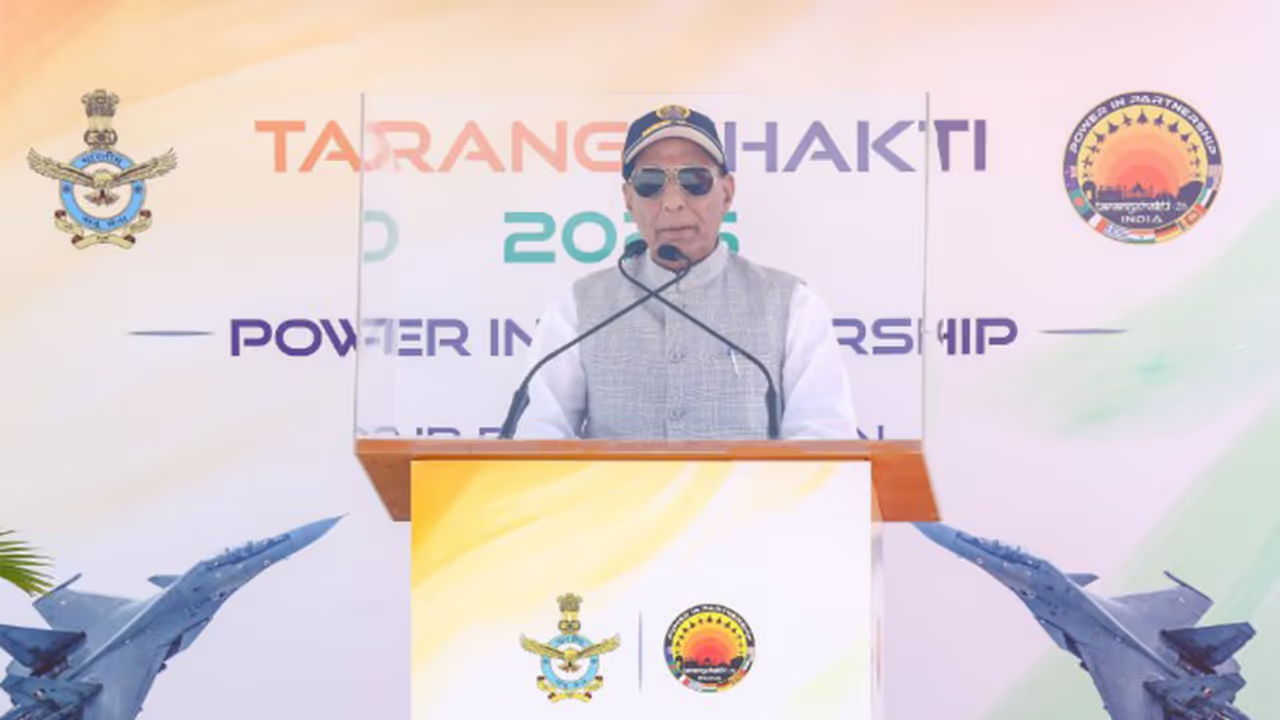
Defence Minister Rajnath Singh participated in the Tarang Shakti-2026 multinational air exercise in Jodhpur, stressing the need for self-reliance in defence and highlighting the changing, complex nature of modern warfare.
Defence Minister Rajnath Singh on Saturday participated in the Tarang Shakti-2026 multinational air combat exercise in Rajasthan's Jodhpur and highlighted the importance of producing weapons for the nation and how modern warfare is changing.
Showcase of Indigenous Air Power
During the exercise, the Indian Air Force's Sarang Helicopter Display Team showcased an impressive aerial formation with precision and coordination.
India's indigenous Light Combat Aircraft (LCA) Tejas showcased its aerial capabilities during the Tarang Shakti-2026 Air Combat Exercise. The homegrown fighter jet highlights the country’s growing self-reliance in defence manufacturing, demonstrating its agility.
India's indigenous Light Combat Helicopter (LCH) 'Prachand' was also showcased. A powerful symbol of Atmanirbhar Bharat, the homegrown combat helicopter showcases India’s growing defence manufacturing capabilities, technological advancements and presence in the aerospace sector.
Rajnath Singh Addresses Multinational Partners
The Defence Minister congratulated the Indian Air Force and individuals, institutions, and organisations that contributed to the success of the complex multi-national air exercise. "I also extend a warm welcome and my sincere appreciation to all the participating nations, your leadership and your crew members. You came to India, flew with us, trained with us, and shared your operational experience. Your presence has added great value to this exercise, and I hope you will carry back with you not only memories of India, but also new professional insights and a deeper understanding of our capabilities and perspectives," he said while addressing the event.
The Evolving Landscape of Modern Warfare
He emphasised that modern warfare is getting more complex with new technological changes, expansion of weapon domains and addition of new elements, stating that, "It is no longer confined to land, sea, and air. It now spans space, cyber, the electromagnetic spectrum, and the information domain. Surprise and deep uncertainty have become the new normal. Accompanied with these is the rising influence of non-state actors on the battlefield. Critical trade routes, vital sea-lanes, and vulnerable chokepoints are actively being weaponized."
Singh further highlighted that unmanned systems and drones have also contributed to altering the speed, scale, and character of operations. "Artificial intelligence is reshaping decision support. Electronic warfare demands absolute spectrum control. Long-range precision weapons have radically expanded the battlespace," he said.
He said that the future of the military will be defined by "speed of sensing, understanding, deciding, and acting" and less by the number of platforms.
'Atmanirbhar Bharat': A Strategic Imperative
Singh further emphasised that India is constantly monitoring the developments taking place around the world and their implications. "Speed, precision, information, and integration are now the true defining attributes. Added to the uncertainties and unpredictability coming from the mind-boggling speed of technological changes in the defence sector is the geo-political flux the world finds itself today. We are facing a situation where the older established world order is fast disappearing, while the shape of future order is yet to emerge. In light of this volatile security environment, a perpetual state of high alertness is demanded from every responsible nation. India is continuously monitoring developments in our region and beyond, along with their broader strategic implications," he said.
"India under the visionary leadership of PM Narendra Modi, realised years ago that the coming times would test the resilience of national security in unexpected ways and manners. We anticipated the forthcoming upheavals and disruptions and we decided to insulate ourselves from them. We understood a hard reality of modern statecraft: in times of crisis, no nation can sustain long-drawn-out wars unless it is capable of producing its own weapons and critical technologies. This led us to adoption of Atma-nirbharta or self-reliance in defence as the national policy," he added.
Developing Domestic Capabilities and Global Partnerships
Defining India’s vision of Atma-nirbhar Bharat, he said that it does not mean isolation from the world but rather "developing the domestic capacity to design, develop, manufacture, maintain, and upgrade critical defence technologies."
He said that India is developing capabilities not only for its own requirements, but with the potential to contribute to trusted global defence supply chains. He said indigenous programs such as the Tejas fighter aircraft, the nation's expanding capability to design and manufacture helicopters, ranging from the Dhruv, Rudra, and Prachand to the LUH, the Akash air defence system, AESA radars, electronic systems, and a growing range of unmanned and aerospace technologies demonstrate the increasing depth of that capacity. "And looking ahead, our flagship Advanced Medium Combat Aircraft — the AMCA program — paves the way for India to master fifth-generation stealth fighter technology. Crucially, our push now extends to advanced aero-engine development and co-production, aiming to master the most complex pillar of aviation technology. Our ambition is not limited to manufacturing equipment. It is to design, innovate, integrate, and deliver," he said.
Singh added, "We are aware that no nation can afford to operate in isolation. Critical technologies, resilient supply chains, operational inter-operability and trusted partnerships are becoming increasingly important elements of national power. For India, therefore, building strong indigenous capabilities must go hand in hand with meaningful cooperation with trusted partners. We must be capable of acting independently when required, while also being able to operate effectively with others when our interests and responsibilities converge."
Future Implications and Learnings
On the Tarang Shakti-2026 multinational air combat exercise, he said,"The exercise may conclude today, but its learning must not end today. It should find its way into our training, our tactics, our technology, our doctrine and our future capability development."
(ANI)
(Except for the headline, this story has not been edited by Asianet Newsable English staff and is published from a syndicated feed.)