
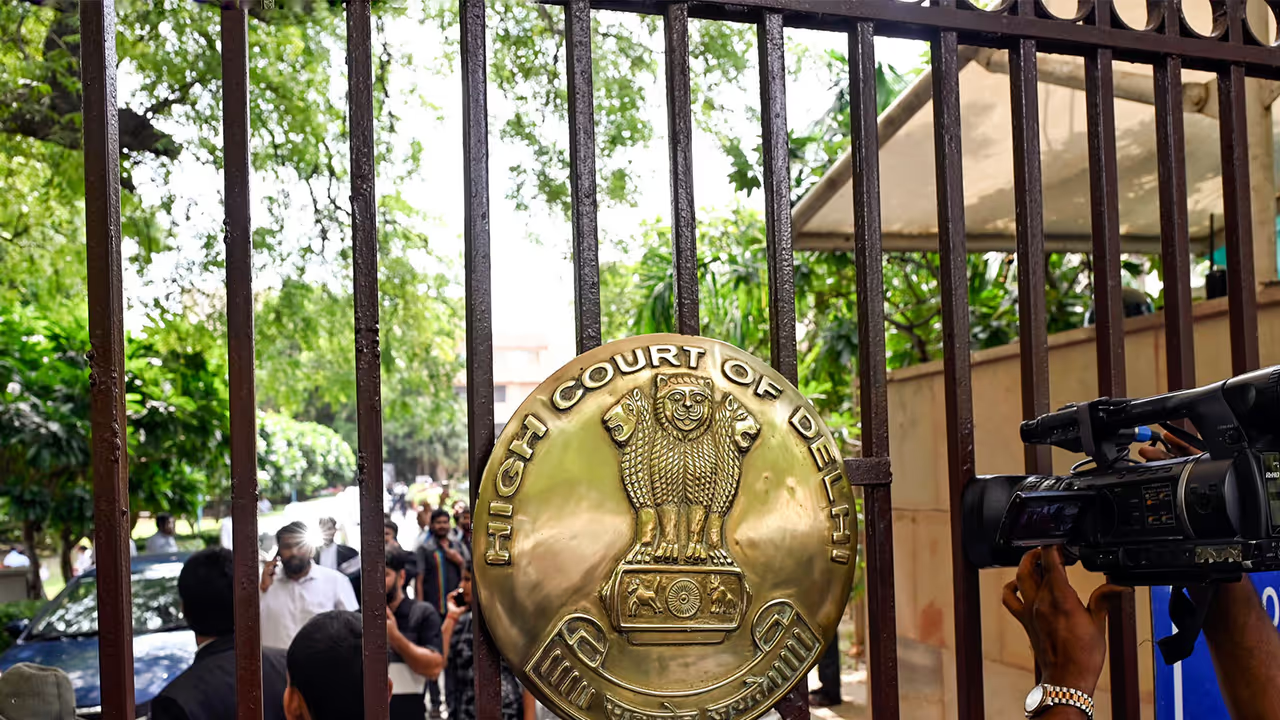
The Delhi High Court dismissed a media company's plea to restore its Gmail account, ruling that a private company's email service is a commercial activity, not a public function. Therefore, it is not amenable to writ jurisdiction under Article 226.
The Delhi High Court has held that a private company’s provision of email services does not, by itself, make it amenable to writ jurisdiction, even when an account is important to the user’s business, while dismissing a petition by a media company seeking restoration of access to its Gmail account.
Court's Stance on Public Function
Justice Amit Mahajan said the nature of the function performed by a private entity, rather than its popularity or reach, is the decisive factor in determining whether a writ petition can be maintained against it under Article 226 of the Constitution.
The court observed that the provision of email services is a commercial activity and that the suspension or disabling of an account on security grounds does not, without additional circumstances, amount to the discharge of a public duty. “The decisive consideration thus is the nature of the function and not merely the size or reach of the entity concerned,” the court said in its October 8 order.
Media Company's Petition
The court was hearing a petition filed by Janta Live Press Network Pvt Ltd and its director against Google LLC and Google India Pvt Ltd. The petitioners sought directions to verify their original account recovery credentials and restore full access to their Gmail account.
The company operates a media business under the name Janta Live News, including a YouTube news channel. According to the petition, the Gmail account was allegedly accessed without authorisation by third parties on July 20, 2026. Google subsequently disabled the account, citing “unusual activity”. The company’s director approached Google Support through his personal email account, explaining the circumstances and requesting restoration of access. However, no response was received, the petitioners claimed. They subsequently lodged a formal complaint with the Cyber Police Station, but the account remained inaccessible.
Petitioner's Arguments
Before the High Court, the petitioners argued that a writ petition could be maintained against Google because it performs a public function. They relied on an earlier Delhi High Court judgment, XYZ v. Union of India and connected matters, as well as the Information Technology Act, 2000, and the Information Technology (Intermediary Guidelines and Digital Media Ethics Code) Rules, 2021.
High Court's Detailed Judgment
The court, however, distinguished the earlier judgment, noting that it dealt with informational privacy and the continued availability of judicial records bearing individuals’ names in online search results. The petitioners in that case had sought de-indexing of the records and masking of personal identifiers, alleging disproportionate and continuing harm to their reputation. In the present matter, the court said the relief sought was different, as the petitioners were seeking restoration of access to an email account.
Justice Mahajan observed that although a writ petition under Article 226 can, in appropriate circumstances, be maintained against a private body, the exercise of such jurisdiction depends on whether the entity performs a public function. Referring to the legal principles governing public functions, the court noted that these may include functions similar to those performed by the State in its sovereign capacity, services outsourced by the State, or activities closely connected with the State’s obligations towards public welfare.
However, the court held that providing email, hosting or other digital services does not automatically bring a private entity within that category. It also rejected the argument that the account’s importance to the petitioners’ media operations altered the nature of Google’s activity. The court noted that email services are available through various independent providers and are not monopolised by Google.
The High Court further clarified that statutory obligations relating to grievance redressal and intermediary compliance do not automatically make every dispute involving an account restriction, a security incident or an alleged failure of customer support a matter involving a public function.
Acknowledging the petitioners’ grievance, the court made it clear that the issue before it was whether the relief could be granted through a writ petition, rather than whether the complaint itself deserved attention. It concluded that the petitioners had failed to establish the existence of a public function in the legal sense required to invoke Article 226 of the Constitution. (ANI)
(Except for the headline, this story has not been edited by Asianet Newsable English staff and is published from a syndicated feed.)