
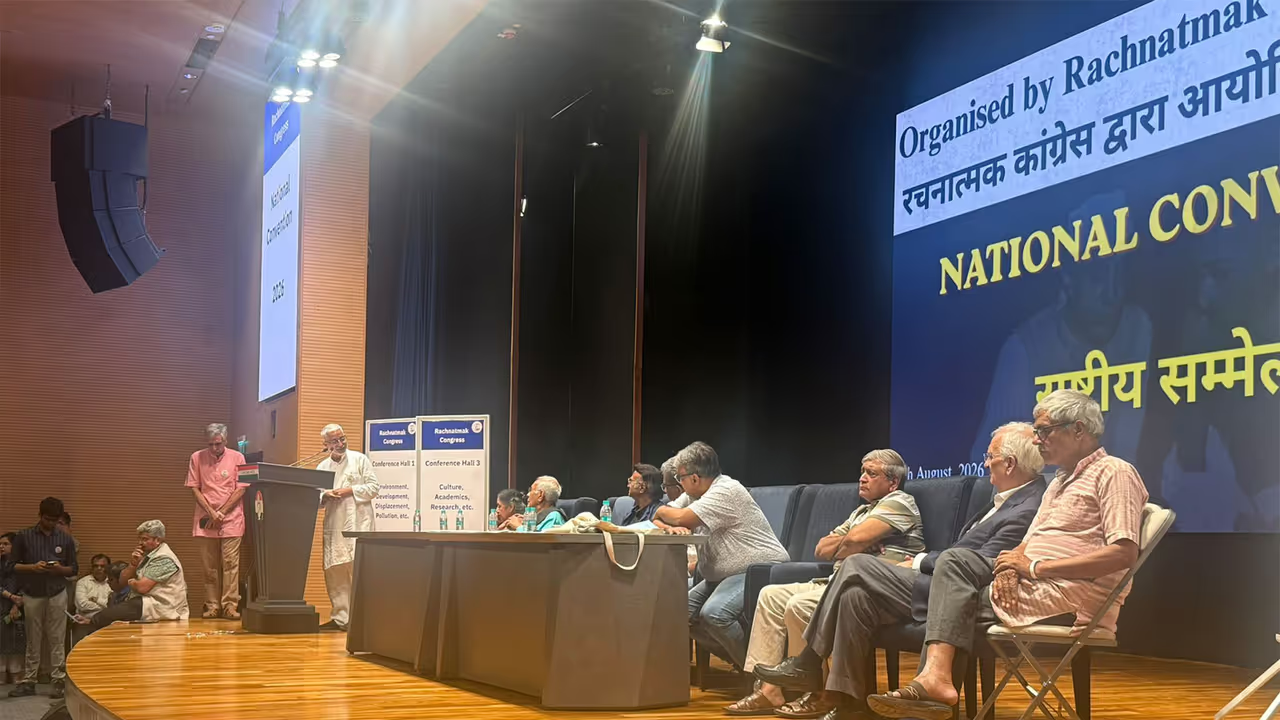
The Rachnatmak Congress convention in New Delhi focused on the disconnect between people and power, addressing inequality, unemployment, and environmental issues. Participants criticized government policies and called for deliberate policy changes.
The two-day National Convention of Rachnatmak Congress began on August 12 at Indira Bhawan in the national capital, bringing together social organisations, social workers, activists, educators, academicians, artists, community representatives and concerned citizens from across the country.
According to a press release, the day-long deliberations focused on the growing disconnect between ordinary people and those in power, and the urgent need to address inequality, unemployment, environmental degradation, education and concerns of marginalised communities.
Key Themes and Deliberations
In keeping with the Rachnatmak Congress approach of dialogue and conversation, invitees expressed their views and gave suggestions on broad themes including Economy, Employment, Poverty and Inequality; Environment, Development, Displacement and Pollution; Social Sector, including Education, Health, Justice and Rights; and Culture, Academics and Research, the release said.
Economy, Poverty and Inequality
The participants stressed that inequality, unemployment and poverty must be understood as interconnected problems with common causes.
According to the release, speakers said current government policies were increasing inequality and poverty and argued that these outcomes could be reversed through deliberate policy changes aimed at reducing inequality and improving overall economic welfare, the release said.
Education and health were highlighted as two of the most critical policy areas. An invitee said both sectors remained in a poor state due to chronically inadequate public spending, while public schools were closing, government institutions were being wound down and the number of government health centres was declining.
The release said a key question raised was why the government claimed it lacked resources for adequate spending and employment generation. One solution suggested was a significant expansion of government employment. It was pointed out that approximately 90 lakh government vacancies remained unfilled.
Participants also raised concerns over the tax system, arguing that the rich pay lower effective tax rates than ordinary citizens, while tax avoidance by wealthy individuals, large companies and multinationals further affects public finances. The speakers called for tax and spending policies to move together, including expanding public enterprises and increasing public employment in education, health and other essential sectors.
Another invitee linked social problems, including communal tensions and the politics of hatred, to underlying economic policy failures. The speaker said the deliberate creation of an "enemy", particularly targeting Muslims, was used to distract attention from people's economic hardships.
The release said participants contrasted wealth distribution during the earlier planning period with the present situation. It stated that between 1947 and 1980, the richest one per cent held roughly 4-5 per cent of total wealth, while according to the 2026 World Inequality Report, the top one per cent now holds around 40 per cent of India's total wealth.
Environmental Concerns Highlighted
Environmental concerns were also raised with particular urgency. An invitee from Assam highlighted the impact of illegal mining in the Northeast and said four districts, including Sivasagar and Seraikhowa, were facing severe man-made disasters. The speaker warned that environmental damage would not remain confined to the Northeast and called for collective responsibility in protecting the environment, the release said.
Another participant highlighted large-scale destruction of forests in Chhattisgarh and Odisha and raised concerns over pollution of the Mahanadi caused by industrial waste from steel, cement and power plants and coal mines. The condition of the Hirakud Dam was also discussed.
A scuba diver from the Andaman and Nicobar Islands said approximately 90 per cent of coral was already bleaching and facing death, with direct consequences for fishermen. The speaker said around 50 lakh fishermen could potentially be affected and called for stronger scientific research and infrastructure in India.
Social Issues and Calls for Action
The convention also raised concerns over homelessness, inadequate shelter facilities, occupational health and safety of sandstone-mining workers, shortage of research laboratories and equipment, and the exclusion of homeless people from SIR and official enumeration processes.
On education, participants emphasised the Right to Education and expressed concern over the direction of the National Education Policy. Speakers called for door-to-door and school-to-school outreach and raised concerns over the selective presentation of history in NCERT and state board textbooks, particularly regarding medieval history, Dalits and Dr BR Ambedkar.
The release said participants also called for stronger grassroots organisation, effective use of social media and greater communication between organisations and ordinary citizens. An activist proposed the model of "1 Gaon, 1 Samasya, 1 Samadhan" as a practical grassroots approach.
Convention's Approach and Conclusion
The convention urged participants to convert discussions into concrete shared programmes and strengthen organisational linkages from the Gram Panchayat level upwards. The discussions will continue on August 13 at Mavlankar Hall, New Delhi, according to the press release.
Speakers said the convention itself demonstrated that the issues being discussed went beyond the interests of any single political party. The open format, which allowed both panellists and audience members to speak, was welcomed as a democratic and inclusive practice.
The convention concluded the first day's discussions with a call to convert the deliberations into concrete programmes, strengthen organisational networks from the Gram Panchayat level upwards and ensure greater accountability from those in power. The discussions will continue on Thursday at Mavlankar Hall in New Delhi, where further sessions of the two-day convention are scheduled. (ANI)
(Except for the headline, this story has not been edited by Asianet Newsable English staff and is published from a syndicated feed.)