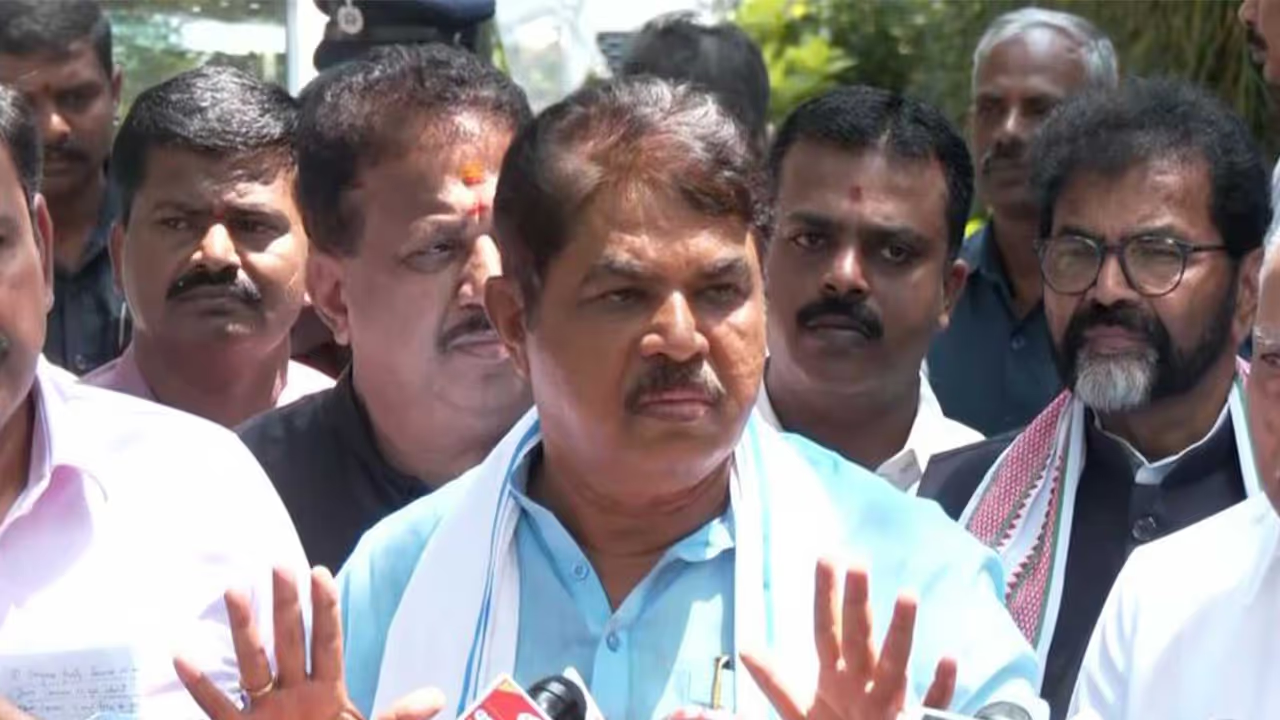
Karnataka BJP leader R Ashok challenged Congress to dissolve their governments in four states and face fresh polls, accusing the party of questioning democratic processes and EVMs only after suffering electoral defeats across the country.
R Ashok Challenges Congress to Face Fresh Elections in Ruled States
Leader of Opposition in Karnataka Assembly R Ashok on Saturday accused the Congress of questioning the credibility of Electronic Voting Machines (EVMs), the Special Intensive Revision (SIR) exercise and the Election Commission only after electoral defeats, challenging the party to dissolve the assemblies of the four states where it is in power and face fresh elections.
Addressing a press conference here, Ashok alleged that the Congress was adopting double standards on democratic institutions and electoral processes, claiming that the party accepts election results when it wins but questions the system when it loses. "When Congress loses elections, its leaders suddenly remember that EVMs are faulty. When they win, everything is fine," he said sarcastically.
BJP's Stand on Democracy and Electoral Integrity
Ashok said the Bharatiya Janata Party (BJP) was conducting a nationwide public awareness campaign to protect democracy, uphold constitutional ideals and safeguard the unity and integrity of the country. However, he alleged that the Congress was misleading people by portraying democracy as being in danger whenever it faces electoral setbacks.
Claiming that the Congress had lost more than 59 Assembly elections between 2014 and 2025, Ashok said the party had failed to accept the people's verdict and was instead blaming the Election Commission and voter lists for its defeats. He attributed the party's electoral performance to a lack of public confidence in Rahul Gandhi's leadership and said the Congress would have no political future unless it changed its leadership.
He pointed out that the Congress accepts the fairness of elections in states where it is in power, including Karnataka, Telangana and Himachal Pradesh, but raises questions about the electoral process, voter lists and the Election Commission when it loses elsewhere.
Arguments Regarding the SIR Exercise
Ashok further argued that the Congress had suffered more than 59 Assembly election defeats even before the SIR exercise began and that blaming the revision process for its electoral losses was therefore unjustified. He said voters were no longer willing to vote merely by looking at Rahul Gandhi's face and reiterated that a leadership change was necessary for the party to regain electoral support.
On the SIR exercise, Ashok accused the Congress of creating confusion among voters without presenting clear statistics to establish that their voting rights had been illegally taken away. He questioned how many people in Karnataka had officially filed appeals alleging that their names had been wrongly removed from the electoral rolls and asked the Congress to identify the complainants. He said people whose names were missing from voter lists or who required corrections still had the opportunity to file appeals.
Explaining the purpose of the SIR exercise, Ashok said it was intended to identify deceased voters, people who had shifted residences and those registered at multiple places. He also referred to Congress leader Kapil Sibal's remarks about problems in electoral rolls, arguing that removing the names of deceased persons and duplicate registrations was a necessary exercise. "What is wrong in identifying and removing fake and duplicate voters? Should the names of the dead be kept in the list? Should fake voters be given an opportunity?" he questioned.
Citing figures from Karnataka, Ashok claimed that the names of approximately 24.17 lakh deceased voters had been removed from electoral rolls in the state, while around 7.14 lakh duplicate voter registrations had been detected and deleted. He said such measures should be welcomed rather than opposed.
Addressing Voter Turnout and Constitutional Principles
Referring to the constitutional principle of equality in voting rights, he said the ideal was "one vote for the President of India and one vote for the ordinary citizen". He maintained that no individual should be allowed to exercise voting rights in two different places and that the SIR exercise was aimed at preventing such irregularities.
Ashok also raised concerns about voter registration patterns in Bengaluru, pointing out that the average voter turnout in the city over the past 20 years had remained between 45 and 48 per cent, while rural areas recorded turnout of around 80 to 90 per cent. He said several reasons had previously been cited for the low turnout in Bengaluru, but irregularities in voter lists were now also coming to light.
Referring to the Padmanabhanagar Assembly constituency, he said it had approximately one lakh voters. He added that Bengaluru had a substantial population of people who had settled in the city from Andhra Pradesh, Tamil Nadu, Maharashtra and other states. According to him, some might have retained their voting rights in their native places while also registering in Bengaluru, with some choosing to vote in their hometowns. Questioning the Congress's opposition to the removal of such registrations, Ashok said implementing the constitutional principle of one person, one vote was the responsibility of the Election Commission.
Criticism of Congress's Stance on Election Results
Referring to the recently concluded Legislative Council elections, Ashok said the National Democratic Alliance (NDA) had won all four seats, despite the elections being conducted through ballot papers. He questioned the Congress's allegations about EVM manipulation, arguing that if the party believed electoral irregularities were taking place through EVMs, it should have performed better in elections conducted using ballot papers.
Ashok said Congress leaders had themselves earlier predicted that they would win two seats while the BJP would secure the remaining two. However, the NDA eventually won all four seats. "What do they say now after the results? Congress has lost even on the ballot paper. Congress has now received a hard blow even on the ballot," he remarked sarcastically. He alleged that questioning EVMs, SIR and voter lists had become a habit for the Congress whenever it lost elections, while the party had no objections when it emerged victorious.
Reacting to Congress president Mallikarjun Kharge's suggestion that the Lok Sabha should be dissolved and fresh elections held, Ashok challenged the Congress to first dissolve the legislative assemblies of the four states governed by it and seek a fresh mandate. "Before advising us, let Congress dissolve the assemblies of the four states it rules and face elections. After winning there, it can advise Prime Minister Narendra Modi to hold elections," he said.
Questioning the party's position, he added, "What justice is there in saying 'no elections when we win, the system is wrong only when we lose'?"
Concerns Over Protests and Democratic Values
On the proposed Congress protest against the Election Commission on November 1, Ashok said political parties had the democratic right to protest, adding that the BJP had also organised several agitations in the past. However, he cautioned against threats of violence and disturbances on the lines of Nepal and Bangladesh, saying such actions were against democratic principles and would not find public support. He said several organisations and communities had also expressed opposition to holding the protest on November 1 and alleged that the Congress was displaying stubbornness despite appeals to reconsider the date.
Ashok further accused the Congress of losing faith in constitutional institutions, pointing out that the party had repeatedly questioned the functioning of the Income Tax Department, Enforcement Directorate, Central Bureau of Investigation, Election Commission and even the judiciary. "When any problem arises in the country, there are courts to find a solution. But for Congress, the Income Tax Department is wrong, the Enforcement Directorate is wrong, the CBI is wrong, the Election Commission is wrong, and finally even the courts are wrong. Then which constitutional institutions are right in Congress's view?" he asked.
He urged the Congress to introspect instead of blaming institutions for its electoral defeats, and referred to the party's history during the Emergency imposed in 1975, when opposition leaders, judges and journalists were jailed. Recalling his own experience during the Emergency, Ashok said he had been imprisoned at Bengaluru's Central Jail and had personally witnessed the hardships faced by people when democratic rights were suppressed. "Should we learn lessons on democracy from such a Congress today?" he asked.
Final Remarks on Political Agenda and Future
Ashok also alleged that the Congress lacked a political agenda and an independent identity, while referring to allegations surrounding the influence of external forces, including claims of funding from the United States. He said a party that claimed a history of 120 years was now struggling to preserve its political existence. Referring to Mahatma Gandhi's contribution to the freedom struggle, Ashok said his role could never be forgotten and recalled that Gandhi had wished for the Congress party to be dissolved after Independence. He said the present condition of the party was being closely watched by the people.
Targeting Congress leaders over their criticism of Prime Minister Narendra Modi, Ashok alleged that they had resorted to personal attacks because they were unable to politically counter him. He said Modi had earlier been mocked over his background as a tea seller and criticised over the pakoda issue, and alleged that Congress leaders were now making personal remarks about his father. Ashok said the Prime Minister had been elected by the people of the country and not by the Congress party, adding that the same democratic mandate had brought Karnataka Chief Minister Siddaramaiah and Deputy Chief Minister D.K. Shivakumar to power. He said political opposition should not become an excuse for personal attacks and that respect must be shown to leaders elected through the people's votes.
Concluding his remarks, Ashok said the country's priority should be to protect the Constitution, respect the people's mandate, preserve democracy and safeguard national unity and integrity. He said the BJP's public awareness campaign was being conducted across the country, including Karnataka, with these objectives. Describing the Congress's proposed protest as an attempt to protect its own political existence rather than democracy, Ashok said the party had reached a difficult position. "Today Congress is in the ICU. It has reached a situation where it is beating its chest to save its political existence," he said. He added that a party which had lost the confidence of the people could not revive its political fortunes through protests against constitutional institutions. "I am placing all these facts before the people of the state today," Ashok said. (ANI)
(Except for the headline, this story has not been edited by Asianetnews Editorial staff and is published from a syndicated feed.)