
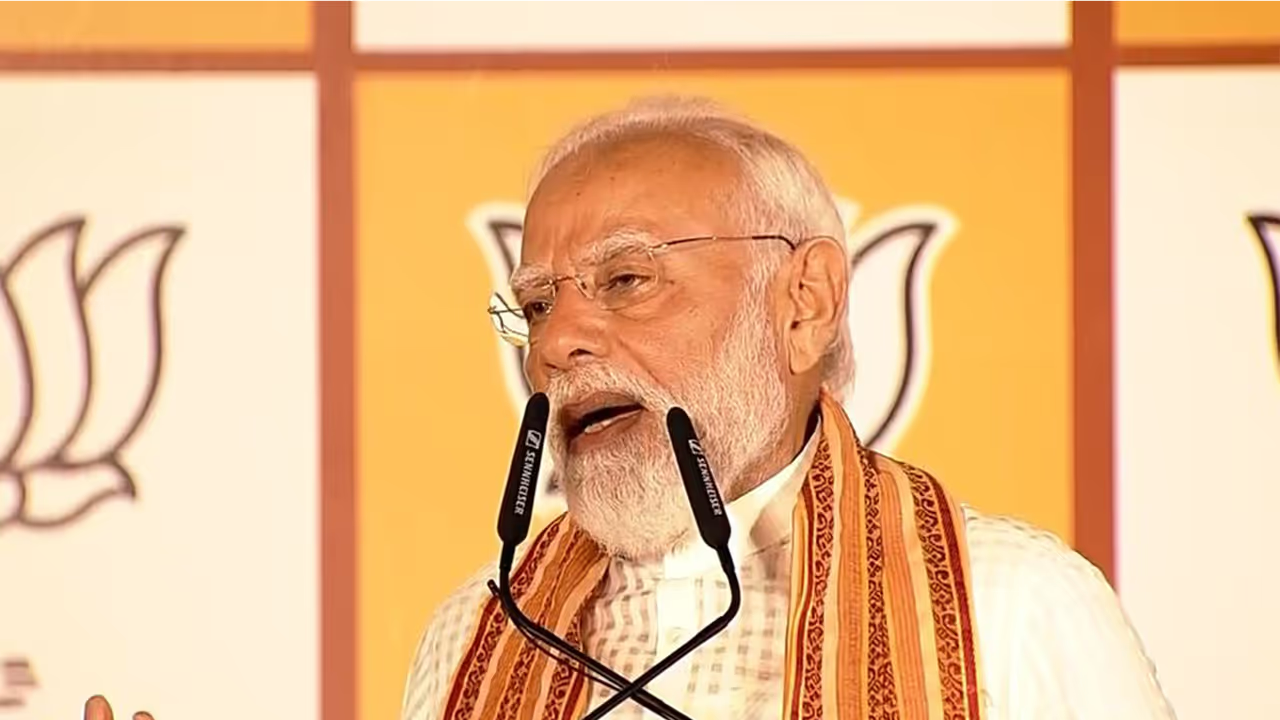
PM Modi declared a 'new chapter' for West Bengal after BJP's win, linking it to party founder Syama Prasad Mookerjee. He said the victory fulfils a historic struggle that began during India's Partition to keep Bengal a part of the nation.
The political landscape of India shifted on Monday as Prime Minister Narendra Modi declared a "new chapter" for West Bengal. While the victory was won in the polling booths of the present, the rhetoric of the day looked back nearly eighty years to the man whose ideological DNA remains the bedrock of the Bharatiya Janata Party (BJP), Dr Syama Prasad Mookerjee.
In a victory speech charged with emotion, PM Modi invoked Mookerjee's soul, suggesting that the election results were the final fulfilment of a struggle that began during the Partition of India. "Today, as a BJP worker, another thought keeps coming to my mind. The soul of Shyama Prasad Mookerjee must be at so much peace today. Mookerjee fought a major battle to keep West Bengal a part of India. The dream he envisioned of a strong and prosperous Bengal had been waiting to be fulfilled for decades. Today, on May 4, 2026, the people of Bengal have given us, the BJP workers, that opportunity. A new chapter has been added to Bengal's destiny. From today, Bengal is free from fear. It is filled with the confidence of development," he said.
Mookerjee's Legacy and BJP's Ideological Roots
To understand why the BJP views a win in West Bengal as a spiritual homecoming, one must look at Mookerjee's pivotal role in the mid-20th century. In 1947, as the partition of India became inevitable, Mookerjee famously campaigned against the "United Bengal" plan that might have seen the entire province join Pakistan. He argued that if India were to be divided on religious lines, the Hindu-majority areas of Bengal must remain with India.
After resigning from Jawaharlal Nehru's cabinet in 1950 over the Liaquat-Nehru Pact, Mookerjee sought to create a political alternative. He turned to M.S. Golwalkar, the second Sarsanghchalak of the RSS, for support. In 1951, with the blessing and organisational "pracharaks" (volunteers) of the RSS, Mookerjee founded the Bharatiya Jana Sangh. This organisation was the direct predecessor of the modern-day BJP, which was later formed in 1980.
His slogan, "Ek desh mein do Vidhan, do Pradhan aur do Nishan nahi chalenge" (One country cannot have two constitutions, two leaders, and two flags), was the driving force behind the 2019 abrogation of Article 370. He championed the idea that Indian identity is rooted in its civilizational heritage, a core tenet of the RSS's Hindutva philosophy. He envisioned a Bengal that was an industrial and intellectual powerhouse, free from the "fear" that the BJP claims characterised the state's later decades under Left and TMC rule.
For the BJP, the victory in Bengal is more than just seats in the Assembly; it is the ultimate validation of the mission started by Mookerjee in 1951. By winning in the land of their founder's birth, the party claims to have finally completed the "historic battle" for the soul of Bengal.
A 'Historic, Unprecedented' Day
Earlier, PM Modi lauded the BJP's strong performance in the West Bengal assembly polls and NDA's victories in Assam and Puducherry and said the "day is historic, unprecedented".
"Today is a historic day. It is unprecedented. When years of efforts turn into success, the happiness that is seen on the faces of people is the same happiness that I see on the faces of BJP workers across the country today," he said.
"As a party worker, I share the joy of every BJP worker. Today is a special day in many ways. It marks the announcement of a bright future for the country. This is a day of trust. Trust in India's great democracy. Trust in the politics of performance. Trust in the spirit of 'Ek Bharat Shrestha Bharat'," he added.
Counting of votes was taken up today for assembly polls in Assam, West Bengal, Keralam, Tamil Nadu and Puducherry. BJP has also improved its performance in Keralam. (ANI)
(Except for the headline, this story has not been edited by Asianet Newsable English staff and is published from a syndicated feed.)