
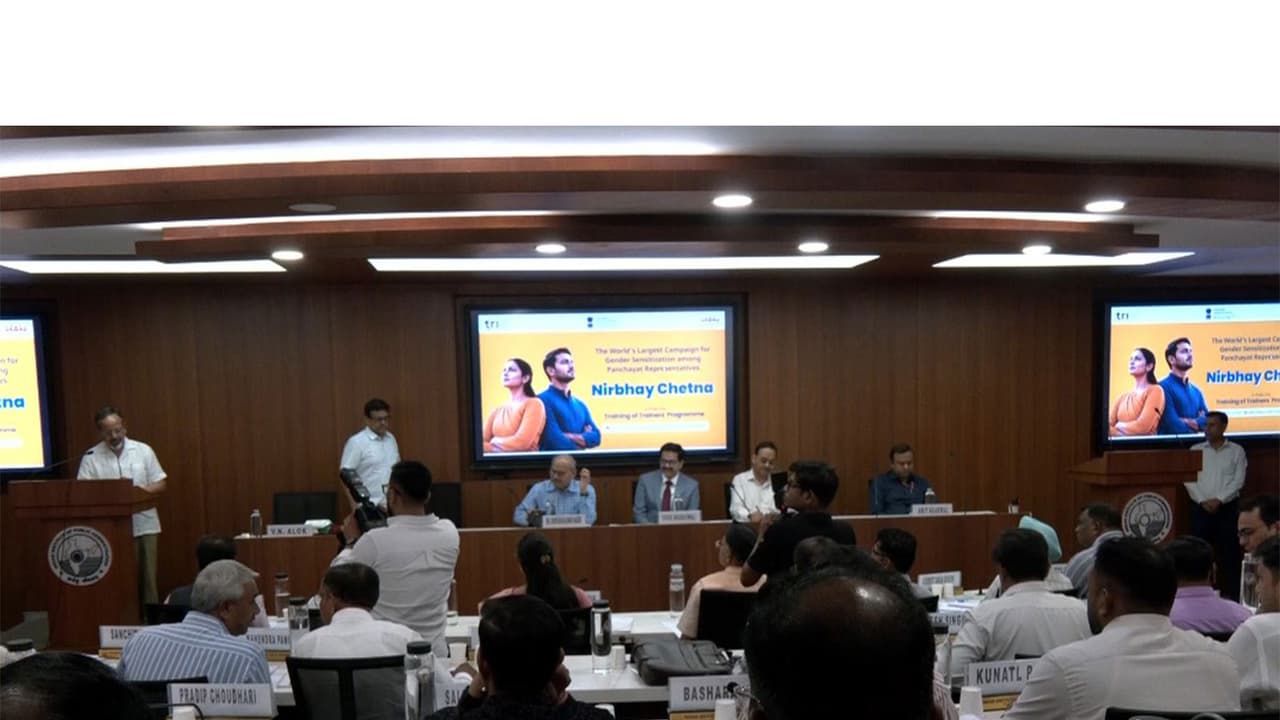
Panchayati Raj Ministry Secretary Vivek Bharadwaj emphasized women's safety for 'Viksit Bharat', launching 'Nirbhay Chetna' to sensitize men. The initiative targets 17.5 lakh male PRI members to promote gender equality at grassroots level.
Noting that Panchayati Raj Institutions play a key role in strengthening awareness and access to justice at the grassroots level, Panchayati Raj Ministry Secretary Vivek Bharadwaj has laid thrust on the safety and empowerment of women to realise the goal of 'Viksit Bharat'.
'Nirbhay Chetna': Sensitising Men at Grassroots Level
Addressing a programme on 'Nirbhay Chetna', a national initiative aimed at sensitising men towards women-related issues, including the safety, security, dignity, and empowerment of women, Vivek Bharadwaj also pitched for greater participation of women in the workforce. The Ministry of Panchayati Raj has launched Nirbhay Chetna, a national initiative aimed at sensitising men towards women-related issues, including the safety, security, dignity, and empowerment of women.
Implemented under the Nirbhaya Fund as a flagship component of the broader Nirbhay Raho programme, it is being recognised as one of the largest gender-sensitisation initiatives in the world.
The Nirbhay Chetna initiative seeks to bring gender equality to the centre of grassroots governance by engaging more than 17.5 lakh Male Elected Representatives (MERs) of Panchayati Raj Institutions across the country. Through a structured and sustainable training framework supported by 28,500 Master Trainers at the State, District and Block levels, Nirbhay Chetna aims to create long-term institutional and social change in rural India.
At the heart of the initiative is the belief that Panchayats are not merely administrative bodies but the most influential democratic institutions in rural communities.
Training of Trainers (ToT) Programme
To operationalise the programme, the Ministry is conducting a Training of Trainers (ToT) Programme from June 17 to 19 in the national capital. It aims to promote gender-responsive governance and create a nationwide network of trainers capable of driving behavioural and institutional change at the grassroots level.
'Country's Development Not Possible Until Women Are Safe'
Bhardwaj talked of government's initiatives for women's empowerment including increase in maternity leave and 'Har Ghar Nal Se Jal'. He said women are making their presence felt across domains in a bigger way including in top administrative services. He said change is coming and more change is needed.
"Many of us perhaps want change at a faster pace, there was a passion and energy in everyone's words. It's true that until women are safe, the country's development is not possible," he said.
Bhardwaj noted that China has more participation of women in workforce compared to India "If women enter the workforce in larger numbers, production will increase, productivity will increase, and the country will move forward," he said.
He also referred to data from the National Health Family Survey about women facing mistreatment and said the problem would be bigger as many women tend not to report such incidents faced in domestic environment. "I am not even talking about the other atrocities committed against them," he said.
He also referred to instances of 'pradhan pati' (husbands of elected female representatives acting on their behalf) and said the Ministry has not turned a blind eye to it.
The Three Pillars: Chetna, Netri, and Drishti
Nirbhay Chetna forms one of the three pillars of the Ministry's comprehensive Nirbhay Raho programme. The second pillar, Nirbhay Netri, will provide legal literacy and leadership training to more than 14.5 lakh women elected representatives, enabling them to participate more effectively in governance and advocate for women's rights. The third pillar, Nirbhay Drishti, focuses on strengthening village-level safety infrastructure through the installation of CCTV cameras across villages in all States and Union Territories.
A Collective Responsibility for Social Change
Arpit Kumar, Assistant Secretary, Ministry of Panchayati Raj (MoPR), said Panchayati Raj Institutions are not only institutions of local self-government but also important agents of social transformation. "As the tier of government closest to the people, Panchayats have a unique role in fostering inclusive development, strengthening community participation, and promoting social change at the grassroots level. The initiative that brings us together is founded on a simple yet powerful belief that ensuring the safety, dignity, and empowerment of women is a collective responsibility."
He said sustainable change can only be achieved when all sections of society actively participate in creating an environment of equality, respect, and opportunity. Through this Nirbhaya Fund-supported initiative, the Ministry seeks to engage men as partners in advancing gender equality and building safer communities.
Aradhana Chauhan, Assistant Secretary, MoPR, said when there is talk about women's safety, dignity, and empowerment, "our focus is often on schemes, programmes, and their outcomes. But this training provides us an opportunity to go a little deeper and understand how our thinking, our perceptions, and societal expectations influence our behaviour".
"This training is not about blaming anyone; it gives an opportunity to reflect on the perspective and behaviour of all of us. The initiative is very important is because it is being anchored through the Panchayati Raj Institutions," she said..
Amit Agrawal, Joint Secretary, MoPR, said that real transformation occurs when individuals are encouraged to reflect on their beliefs, attitudes, and behaviour. "We recognize that issues related to gender, social norms, and patriarchy are deeply embedded in society and often operate unconsciously. Addressing such issues requires more than awareness; it requires introspection and a willingness to examine our own assumptions," he said.
Anirban Ghose, MD, Transform Rural India, said the foundation of India's democracy is the Panchayats.
Transformative Training and Future Vision
Officials said that together, the three components of Panchayati Raj Ministry represent a holistic approach to women's safety and empowerment--building awareness among men, strengthening the leadership capacity of women representatives and improving physical safety infrastructure in rural areas. They said that panchayat leaders shape local priorities, social norms and governance outcomes and by sensitising male representatives to issues of gender equality, women's rights, safety and leadership, the programme seeks to transform them into active allies in building safer and more inclusive communities.
The training module, titled 'Panchayat Leaders for Gender Justice,' is among the first structured programmes in India designed specifically for male elected representatives, they said.
Moving beyond conventional classroom learning, it adopts an experiential and participatory approach involving role-plays, simulations, dialogue, community analysis and action-planning exercises, the officials said, adding that participants are encouraged to critically examine gender stereotypes, social norms and traditional perceptions of masculinity while exploring pathways for positive behavioural change.
They said that over a three-day learning journey, participants will gain a deeper understanding of concepts such as gender, power relations, shared responsibility, inclusive leadership and positive masculinity. The programme also seeks to equip them to integrate gender perspectives into Panchayat planning, budgeting, service delivery, Gram Sabha functioning and institutional decision-making.
Officials said that a distinctive feature of Nirbhay Chetna is its emphasis on linking personal transformation with institutional transformation. They said the programme highlights that gender-responsive governance requires not only policy interventions but also changes in attitudes, leadership styles and decision-making processes. Participants are encouraged to adopt more participatory and collaborative approaches that promote women's safety, leadership and equal participation in public life.
The initiative also focuses on practical governance outcomes. Panchayat representatives are trained to recognise and respond to gender-based violence, understand relevant legal provisions and support systems, create safer public spaces and strengthen women's participation in local governance. Action plans developed during the training address local priorities related to safety, education, health, livelihoods and social inclusion.
By fostering awareness, empathy, accountability and leadership among Panchayat representatives, Nirbhay Chetna aims to create a multiplier effect extending far beyond those directly trained. As trusted community leaders, elected representatives can influence families, institutions and entire communities, helping build Panchayats that are safer, more inclusive and more equitable for women and girls.
Officials said that through Nirbhay Raho, the Ministry of Panchayati Raj envisions a future where every woman in rural India can live without fear, participate confidently in public life and fully realise her rights and aspirations and Nirbhay Chetna represents a significant step towards turning that vision into reality. (ANI)
(Except for the headline, this story has not been edited by Asianet Newsable English staff and is published from a syndicated feed.)