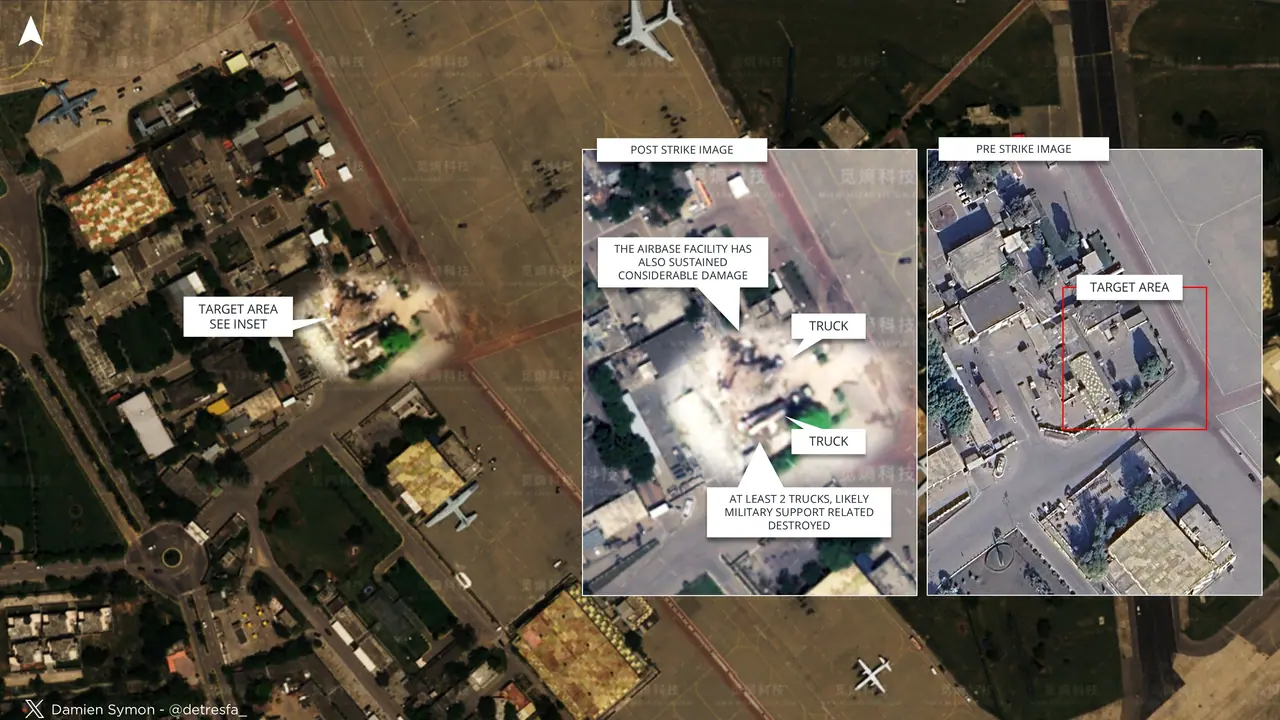
Satellite imagery confirms India’s precision strikes under Operation Sindoor crippled key Pakistan Air Force bases, showcasing a new era of strategic dominance.
In a major revelation bolstering India’s bold military response under Operation Sindoor, satellite imagery has confirmed significant structural damage to multiple Pakistan Air Force (PAF) bases following precision strikes carried out by the Indian Air Force on May 10. The images, released by Indian and foreign satellite intelligence firms, showcase the effectiveness and accuracy of India’s strikes, signaling a seismic shift in the regional military balance.
The satellite visuals, released by Indian space analytics firm KawaSpace and China-based MizazVision, confirm that India not only penetrated Pakistani airspace with pinpoint accuracy but also crippled key air assets and infrastructure across vital PAF installations — including Bholari, Jacobabad (Shahbaz), Sargodha, and the strategic Nur Khan Airbase near Rawalpindi.
Bholari Air Base: Precision Strike Wipes Out Hangar
Related Articles

Imagery from KawaSpace confirms that PAF Base Bholari, located in Sindh, suffered a devastating strike, likely from an Indian Air-Launched Cruise Missile (ALCM), with speculation pointing to the use of BrahMos. A heavily damaged hangar is clearly visible in the imagery, with scattered debris and structural collapse. The proximity of the destroyed structure to the runway suggests the hangar may have housed quick reaction assets or high-value aerial platforms.
Jacobabad (Shahbaz) Air Base: Hangar Hit, ATC Suspected Damaged
Another precision strike was carried out on PAF Base Shahbaz in Jacobabad, again captured by KawaSpace satellite imagery. A hangar on the base’s main apron appears to have taken a direct hit, with suspected secondary damage to the Air Traffic Control (ATC) building.
Nur Khan Airbase: Strike Disables Support Infrastructure
China-based satellite intelligence firm MizazVision released images confirming damage at Nur Khan Airbase, located in Chaklala, Rawalpindi — a highly strategic base close to Pakistan’s military command structure. The Indian strike here was targeted at support infrastructure and ground vehicles, suggesting a surgical approach focused on logistics paralysis rather than structural obliteration.
Sargodha Airbase: Runway Targeted
KawaSpace also shared imagery of PAF Base Sargodha, a key northern air command facility. While details remain under analysis, the visuals point to runway damage, likely aimed at crippling sortie generation capability.
These revelations come amid strong statements from Indian government sources that Operation Sindoor is not over and that Pakistan must accept the new strategic reality. The precision and scale of the strikes underline India’s technological edge, intelligence superiority, and doctrinal shift from reactive to proactive deterrence.
As a top Indian source declared earlier: “The situation worsened for Pakistan in every round; they lost to India in every round of the battle. After our strikes on Pakistan air bases, Pakistan has realised they are not in this league. A clear message was given by India — no one is safe, it is the new normal.”
India's Operation Sindoor: What transpired
In a bold pre-dawn operation on May 7, the Indian Armed Forces launched Operation Sindoor, striking nine terrorist infrastructure sites across Pakistan and Pakistan-occupied Jammu and Kashmir (PoJK). The operation was a direct retaliation to the April 22 terror attack in Pahalgam, Jammu and Kashmir, which claimed the lives of 26 civilians, including one Nepali national.
Following the strikes, tensions escalated rapidly between India and Pakistan, leading to intense cross-border shelling. Indian forces responded with retaliatory fire as areas along the Line of Control were placed on high alert, and blackouts were observed during incoming attacks from across the border.
In a dramatic development, both countries agreed to a cessation of hostilities on May 10, after US President Donald Trump took to his Truth Social platform to announce a brokered ceasefire between India and Pakistan.
However, the truce was short-lived. Just hours after the agreement, India reported a violation of the ceasefire when its air defence systems intercepted Pakistani drones near Srinagar, amid ongoing blackouts in the region.
Addressing a special media briefing, Foreign Secretary Vikram Misri termed the breach a serious violation of the understanding reached earlier in the day. “India takes a very serious note of these violations,” he said.
On Sunday, Prime Minister Narendra Modi chaired a high-level meeting at his residence at 7, Lok Kalyan Marg, New Delhi, to assess the evolving situation. The meeting was attended by Defence Minister Rajnath Singh, External Affairs Minister S. Jaishankar, and the chiefs of the Army, Navy, and Air Force. National Security Advisor Ajit Doval and Chief of Defence Staff General Anil Chauhan were also present.