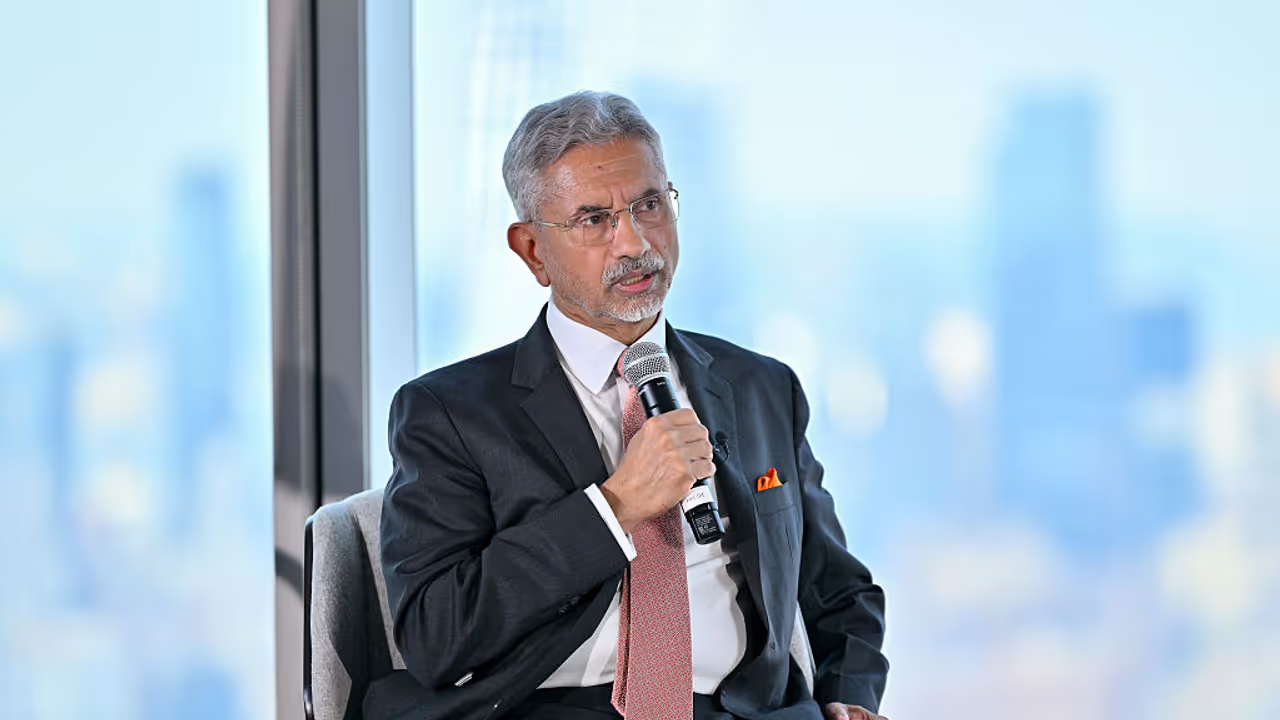
Speaking in Parliament, India’s External Affairs Minister S Jaishankar had noted that Pakistan had actively lobbied to prevent TRF’s mention during UNSC deliberations. Earlier, the United States had designated TRF as a terrorist organisation.
New Delhi: In a major diplomatic victory for India, a report from the United Nations Security Council (UNSC) has said that The Resistance Front (TRF) had claimed responsibility for the Pahalgam terror attack and "published a photograph of the attack site”. The report, prepared by the Sanctions Committee, also said that the attack could not have happened without the support of Pakistan-based Lashkar-e-Tayyiba (LeT).
UNSC made these observations in the 36th report of the Analytical Support and Sanctions Monitoring Team concerning ISIL (Da’esh), Al-Qaeda and its associates. It mentions the April 22 Pahalgam terror attack in which 26 civilians were killed, saying "five terrorists attacked a tourist spot in Pahalgam, in Jammu and Kashmir”.
“The attack was claimed that same day by The Resistance Front (TRF), who in parallel published a photograph of the attack site,” PTI quoted the report as saying.
Related Articles

The United Nations report highlighted conflicting assessments among member states regarding the April 22 Pahalgam terror attack. While one country asserted that the incident could not have occurred without the backing of Lashkar-e-Taiba (LeT), and maintained that TRF was closely linked to or even synonymous with LeT, another country disagreed, characterizing LeT as “defunct” and rejecting any such association.
The report also observed ongoing instability in regional dynamics, cautioning that terrorist networks might exploit these fragile conditions. Significantly, earlier this month, the United States officially designated The Resistance Front (TRF) as both a Foreign Terrorist Organization (FTO) and a Specially Designated Global Terrorist (SDGT).
Following the Pahalgam attack, the United Nations Security Council (UNSC) issued a press statement on April 25 condemning the violence and calling for accountability for those behind the attack. However, the final statement omitted any reference to TRF, a move reportedly influenced by Pakistan’s diplomatic efforts to remove the group’s name. Speaking in Parliament, India’s External Affairs Minister S Jaishankar noted that Pakistan had actively lobbied to prevent TRF’s mention during UNSC deliberations. In retaliation for the attack, India launched “Operation Sindoor” to strike terror camps and infrastructure across Pakistan and Pakistan-occupied Kashmir.
UNSC Highlights ISIL-K as Global Terrorist Threat
The report by the Analytical Support and Sanctions Monitoring Team further identified the Islamic State – Khorasan Province (ISIL-K) as the most potent and globally relevant terrorist threat emanating from the Central and South Asian regions. The group, estimated to have around 2,000 fighters, continues to recruit both within Afghanistan and from neighboring regions, including Central Asia and the Russian North Caucasus.
The report detailed how ISIL-K has been indoctrinating minors in parts of northern Afghanistan and areas bordering Pakistan. In some cases, children as young as 14 were being trained for suicide missions. In addition to ISIL-K, the presence of Al-Qaeda-linked training sites across Afghanistan was noted. While these were described as small and relatively primitive, they were reportedly used to train operatives from both Al-Qaeda and Tehrik-i-Taliban Pakistan (TTP).
TTP, with an estimated strength of 6,000 fighters, was found to be receiving logistical and operational aid from Afghanistan’s de facto authorities. Some UN member states also noted that TTP maintained limited operational cooperation with ISIL-K. TTP’s recent attacks have resulted in significant casualties, aided by its access to advanced weaponry. One member state reported that in January 2025, TTP conducted terrorist training activities in Pakistan’s Balochistan province.
The report also noted suspected collaboration between TTP and the Balochistan Liberation Army (BLA), particularly its Majeed Brigade. According to one country’s assessment, the two groups shared multiple training camps in southern Afghanistan, with Al-Qaeda providing both ideological indoctrination and weapons training.
One notable example of BLA’s increasing sophistication was the March 11 hijacking of the Jaffar Express train, which involved explosives and firearms and resulted in the deaths of 31 individuals, including 21 hostages. This incident was cited as evidence of the group’s growing operational capabilities and brutality. The report also raised alarms over the growing confidence and operational ambition of Al-Qaeda in the Indian Subcontinent (AQIS), suggesting a possible resurgence of the group in the region.