India's Operation Sindoor targeted terrorist bases in Pakistan and Pakistan-occupied Kashmir. Pakistan's military intervention escalated the conflict, leading India to broaden its response.
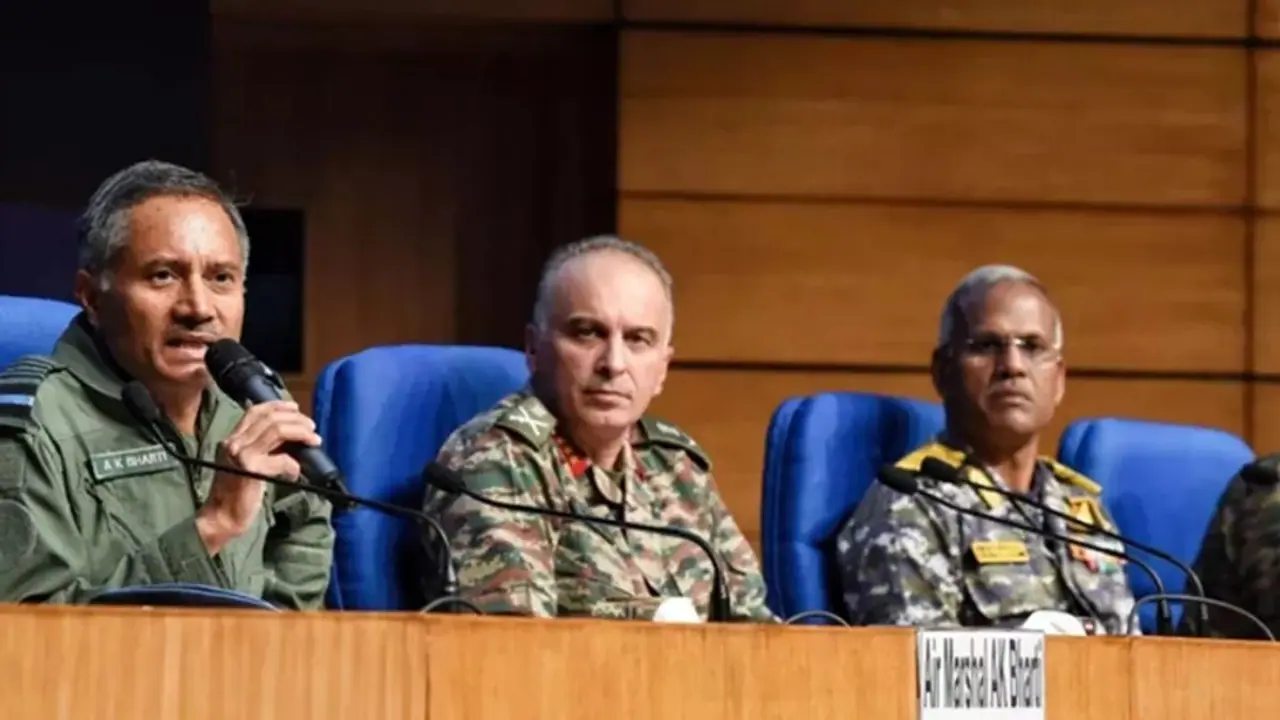
Senior Navy and Air Force commanders, together with top Director Generals of Military Operations (DGMOs), convened a news conference Monday to give further information regarding Operation Sindoor. Targeting nine terrorist bases in Pakistan and Pakistan-occupied Kashmir, the operation started early on May 7. Additionally, all later military responses against Pakistan were coordinated under the auspices of Operation Sindoor. Following a ceasefire agreement between the two countries, the briefing was given.
What are the key takeaways from May 12's briefing:
- Air Marshal AK Bharti stated that although India's main goal was to destroy terrorist infrastructure, Pakistan's military decided to defend these elements, forcing India to broaden its response. "We fought terrorists and the terrorist network, but the Pakistani military decided to back the terrorists, which escalated the fighting. He stated, "We decided to respond because it is unfortunate that the Pakistani military decided to step in and that for terrorists."
- The nation's defense capabilities were commended by the Air Marshal, who said, "Our battle-tested systems proved their worth in actual combat conditions." The performance of the native Akash air defense system was outstanding.
- "Numerous waves of drones and unmanned combat aerial vehicles employed by Pakistan were also thwarted by the indigenously developed soft and hard kill counter-UAS systems and the well-trained Indian Air Defence personnel," he stated.
- Air Marshal Bharti gave a thorough presentation at the briefing, highlighting the several targets the Indian Air Force has engaged in during Operation Sindoor. Among the armament systems employed by the military were Akash missiles. The Indian military showed the debris of a likely PL-15 air-to-air missile, which is of Chinese origin and was used by Pakistan during the attack on India. The wreckage of the Turkish-origin YIHA and Songar drones that were shot down by India has also been shown
- On warfare, Air Marshal AK Bharti said, "...This was a different kind of warfare and is bound to happen. God forbid, but if we fight another war, that would be completely different from this one. It is a cat-and-mouse game, and we need to be ahead of the curve to beat the adversary."
- “All our military bases, all our systems continue to remain fully operational and ready to undertake any future missions should the need so arise,” Bharti added.
- When asked if India hit Kirana Hills, Air Marshal AK Bharti said, "Thank you for telling us that Kirana Hills houses some nuclear installation, we did not know about it. We have not hit Kirana Hills, whatever is there."
- Vice Admiral AN Pramod said, "Effectively using multiple sensors and inputs, we are maintaining continuous surveillance to degrade or neutralise threats as they emerge or manifest to ensure targeting at extended ranges. All these are conducted under the umbrella of a comprehensive and effective layered fleet air defence mechanism that caters for all threats, be it drones, high-speed missiles or aircraft, both fighters as well as surveillance aircraft..."