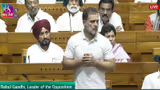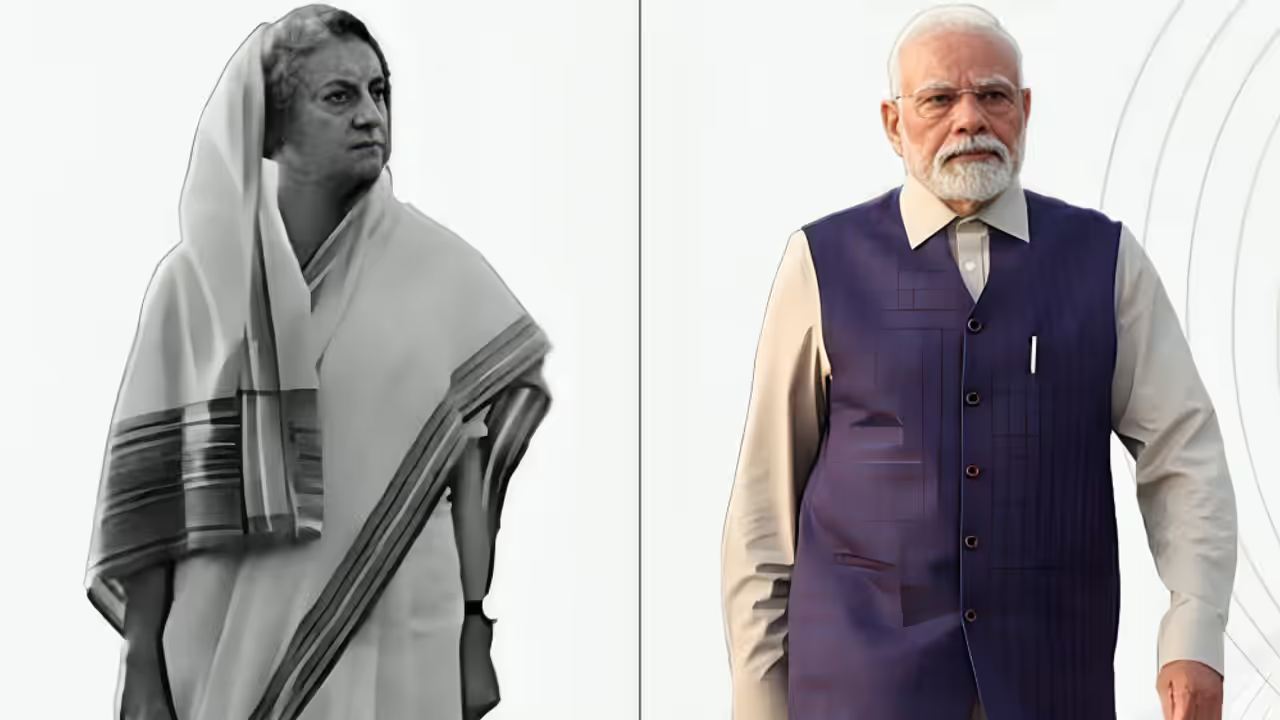
Declassified 1971 records of Indira Gandhi’s letter to Nixon resurface as Rahul Gandhi cites her leadership during the Lok Sabha debate on Operation Sindoor, reigniting discussions on political will in wartime.
During the heated Lok Sabha debate on Operation Sindoor on Tuesday, Leader of Opposition Rahul Gandhi launched a fierce critique of the government’s handling of the ongoing military operation. Accusing the Modi administration of lacking the “political will” to fully support the armed forces, he drew parallels to the 1971 Indo-Pak war under then Prime Minister Indira Gandhi.
“Rajnath Singh compared 1971 and Sindoor. I remind him there was political will in 1971. The Seventh Fleet was approaching India, but the PM then said, Do whatever you have to for Bangladesh. Indira Gandhi told General Manekshaw to take 6 months, 1 year—whatever time needed—for full freedom of action. The result: 1 lakh Pakistani soldiers surrendered, and a new country was formed,” Rahul Gandhi declared.
Related Articles

Rahul Gandhi further questioned the government’s military strategy, alleging that operational details were prematurely communicated to Pakistan.
“Rajnath Singh said Operation Sindoor began at 1:05 AM and that by 1:35 AM, India had already called Pakistan to inform them that we had hit non-military targets and that we did not want escalation… These are not my words. These are the words of India's defence minister,” he said.
Gandhi accused the government of “tying the hands” of the armed forces:
“If you want to use the Indian armed forces, you must have 100 per cent political will. You must give them full freedom of operation.”
He went further, claiming the Director General of Military Operations (DGMO) was told to seek a ceasefire within half an hour of the strike:
“At 1:35 in the night, you told Pakistan exactly what you were going to do – that we will not hit military targets, that we don't want escalation… That is not freedom of manoeuvre; that is surrender.”
Gandhi also linked the loss of Indian aircraft during the operation to “political constraints, not military shortcomings,” quoting India’s defence attaché in Indonesia, who claimed pilots were instructed not to attack Pakistani air defence systems.
Declassified Records Reveal Indira Gandhi’s 1971 Plea
Even as Rahul Gandhi extolled Indira Gandhi’s “iron will,” declassified US State Department records paint a more complex picture of her leadership during the 1971 crisis.
On December 5, 1971, just days after Pakistan launched a pre-emptive strike across India’s western frontier, Indira Gandhi sent an urgent letter to US President Richard Nixon, appealing for Washington’s intervention. She described the “tragic and intolerable ramifications” of the violence in East Bengal and the unprecedented refugee crisis of 10 million people in India.
Detailing Pakistan’s attacks, she wrote:
“I regret to inform Your Excellency that around 1730 hours (Indian Standard Time) on the 3rd of December, Pakistan launched a massive air and ground attack on our country all along the western border. Their aircraft bombed Srinagar, Amritsar, Pathankot, Uttarali, Ambala, Agra, Jodhpur and Avantipur. There has also been heavy shelling of the border cities and townships of Ambala, Ferozepur, Sulaimanki, Khemkaran, Poonch, Mehdipur and Jaiselmere. The attack against India was carefully organized and premeditated as is proved by the fact that the Pakistan army struck across the western borders of India stretching from Jaiselmere to Kashmir between 1500 hours and 1800 (I.S.T.).”
In her letter to Nixon, Indira Gandhi also highlighted the urgency of the situation:
“I am writing to you at a moment of grave peril and danger to my country and my people. The success of the freedom movement in Bangla Desh has now become a war on India due to the adventurism of the Pakistan military machine. It has imposed upon my people and my Government the imperative responsibility of safeguarding our security and territorial integrity. We are left with no other option but to put our country on a war footing. We have therefore declared an emergency for the defence of India. The grave consequences that should follow Pakistanʼs unprovoked attack on us all shall be the sole responsibility of the Government of Pakistan. We are a peace-loving people but we know that peace cannot last if we do not guard our democracy and our way of life. We are not fighting merely for our territorial integrity but for the basic ideals which have given strength to my country and on which Indiaʼs entire future depends.”
The most striking passage reveals her direct appeal for US diplomatic pressure on Pakistan:
“In this hour of danger the Government and the people of India seek your understanding and urge you to persuade Pakistan to desist forthwith from the policy of wanton aggression and military adventurism which it has unfortunately embarked upon. May I request Your Excellency to exercise your undoubted influence with the Government of Pakistan to stop their aggressive activities against India and to deal immediately with the genesis of the problem of East Bengal which has caused so much trial and tribulations to the people not only of Pakistan but of the entire sub-continent.”
A Historical Narrative Under Scrutiny
Rahul Gandhi’s portrayal of his grandmother as a fearless wartime leader who defied superpowers is complicated by her own words, which read more like a plea for Washington’s intervention than an act of defiance.
“Rahul Gandhi talks about political will — but in 1971, Indira Gandhi wrote to Nixon almost like a mercy plea, begging for US intervention while accepting American dominance. So what “political will” is @RahulGandhi referring to? The kind that wrote letters, not led wars? The kind that sought US approval instead of strategic action?” wrote one user on X.
Another user added, “The Congress ecosystem hides this well Indira Gandhi, on 5th Dec 1971 wrote a submissive letter to US President Nixon practically begging for restraint. That wasn’t strength it was fear-drenched flattery in the face of American pressure. The same party that boasts about 1971 conveniently forgets that their leader accepted US hegemony in writing.”
A third user remarked, “Stop the glorification circus! Indira Gandhi didn’t roar at America, she BEGGED Nixon in writing on 5 Dec 1971. That letter was no power play, it was a pathetic plea for mercy. This is the real history Congress hides!”
Rahul Gandhi’s challenge to Prime Minister Narendra Modi—“If Narendra Modi has even 50% of the courage of Indira Gandhi, he should say in the House that Donald Trump is lying about the ceasefire,” —has reignited debate over what “political will” truly means in times of conflict.
PM Modi: No country stopped India from taking action against terror
Meanwhile, Prime Minister Narendra Modi, responding to the two-day debate in the Lok Sabha on the Pahalgam terror attack and Operation Sindoor, delivered a sharp defence of India’s counter-terror operations and a stinging rebuke to the Congress. He emphasised that India acted with full international backing and unprecedented military precision, yet faced political opposition at home.
"No country in the world has stopped India from any action in its defence against terrorism. Only three countries spoke in favour of Pakistan at the UN," Modi said, highlighting the overwhelming global support for India’s military response.
He added that while the world rallied behind India, "it is unfortunate that the Congress did not support the valour of our soldiers. Congress leaders targeted me for political gains but their frivolous statements ended up discouraging our brave soldiers."
The prime minister praised the armed forces for executing Operation Sindoor with deadly precision and speed, claiming that Pakistani terror infrastructure had been severely crippled.
"Pakistani airbases hit by India are still in ICU and the masterminds of the April 22 terror attack are still having sleepless nights," Modi declared.
Revealing operational details, he said India showcased its growing military self-reliance:
"The world saw the strength of self-reliant India during Operation Sindoor. We destroyed terror sites deep inside Pakistan within 22 minutes to avenge the April 22 Pahalgam attack."
He added that Indian-made drones and missiles had exposed the “capabilities of Pakistani arms and ammunition,” setting a new benchmark for precision strikes.
Calling Out Pakistan’s Nuclear Bluff
Modi underlined that the strikes were carried out despite nuclear sabre-rattling from Islamabad.
"India called out Pakistan's nuclear bluff and showed the world that we will not bow down to nuclear blackmail," he said.
He further asserted that India’s operations now have a wide range:
"Our operations range from Sindoor to Sindhu (Indus Waters Treaty)... Pakistan knows they have to pay a huge price for any misadventure."
According to Modi, India’s decisive retaliation has changed the strategic equation: “Terror attacks were launched earlier and the masterminds of attacks knew nothing would happen, but now they know India will come for them.”
Foiling Pakistan’s Conspiracy Modi claimed the April 22 Pahalgam attack was a calculated attempt to incite internal unrest:
"It (Pahalgam attack) was a conspiracy to instigate riots in India and the country's unity foiled that attempt."
He characterised this Parliament session as a celebration of India’s military success:
"When I speak of this Parliament session being a Vijayotsav (celebration of victory), it is of destroying the headquarters of terror."
Full Trust in Armed Forces Reaffirming his government’s commitment to empowering the military, Modi said:
"We have complete trust in the capabilities of our armed forces and they were given a free hand to respond. The armed forces taught them such a lesson that the masters of terrorism are still losing their sleep over it."
The prime minister stressed that India’s retaliatory strikes sent a clear message: any attack on Indian soil would be met with swift and decisive action, and the era of inaction was over.