
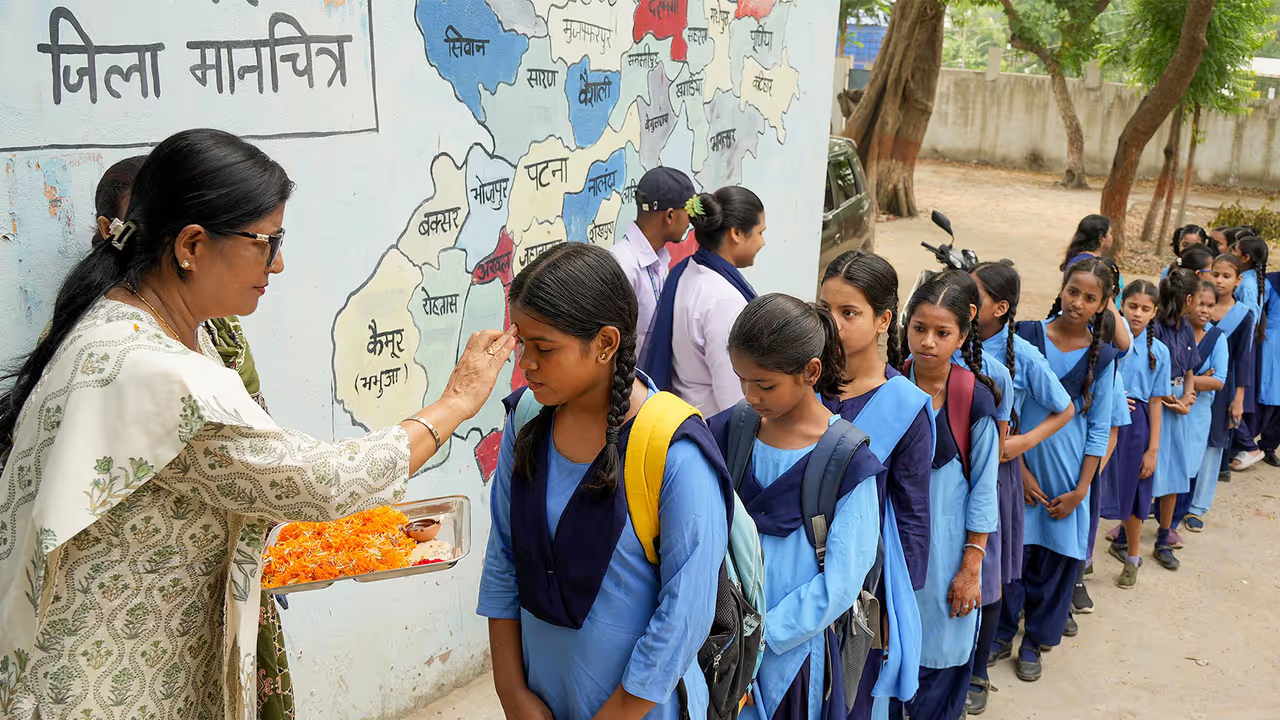
The government has implemented several transformative changes under the National Education Policy 2020 in both school and higher education, Minister of State for Education Sukanta Majumdar informed the Lok Sabha.
After the announcement of the National Education Policy 2020 (NEP 2020), several transformative changes have taken place both in school and higher education for its implementation, Minister of State for Education, Sukanta Majumdar, informed the Lok Sabha in a written reply on Monday.
School Education Initiatives
In School Education, minister informed several initiatives have been taken such as PM SHRI (PM Schools for Rising India) for upgradation of schools; Samagra Shiksha for providing quality education with an inclusive and equitable classroom environment for all children; National Initiative for Proficiency in Reading with Understanding and Numeracy (NIPUN Bharat) for ensuring foundational literacy and numeracy by Grade 3; Vidya-Pravesh-Guidelines for three-month play-based school preparation module; PM e-VIDYA to unify all efforts related to digital/online/on-air education to enable coherent multi-mode access to education.
Higher Education Reforms
In Higher Education, various initiatives/reforms have been carried out such as National Credit Framework (NCrF) and National Higher Education Qualification Framework (NHEQF) in conjunction with guidelines/regulations like Curriculum and Credit Framework for Undergraduate Programme; Multiple Entry and Exit in Academic Programme offered by Higher Education Institutions; Transforming HEIs into multi-disciplinary institutions; pursuing two academic programmes simultaneously; Automated Permanent Academic Account Registry (APAAR ID) of individual student which will act as lifelong identity to track their educational journey and achievements from, pre-primary to higher education; introduction of PM-Vidyalaxmi scheme to provide financial support to meritorious students inter-alia enabling collateral free, guarantor free loan through a simple, transparent and student-friendly and entirely digital application process, government said.
Expanding Access Through Digital and Flexible Learning
The ministry said for higher education, digital platforms such as SWAYAM, SWAYAM Prabha, e-PG Pathshala and the UGC e-resource portal provide students with access to quality academic content. The integration of the UGC e-resource portal with the Digital Seva Portal has further expanded access through Common Service Centres, particularly in rural areas, while also making selected content available in regional languages.
To expand flexible learning opportunities, 126 Higher Educational Institutions (HEIs) are offering about 802 Online Programmes, while 121 HEIs are offering around 1,699 Open and Distance Learning (ODL) programmes, it added.
To support skill development, the SWAYAM Plus portal has also been launched, focusing on upskilling and reskilling the workforce. More than 500 courses have been developed, curated from 89 industry partners across 17 sectors and offered in emerging areas such as AI, Data Analyst etc. So far, more than 6,00,000 students have registered on the platform, government said. (ANI)
(Except for the headline, this story has not been edited by Asianetnews Editorial staff and is published from a syndicated feed.)