
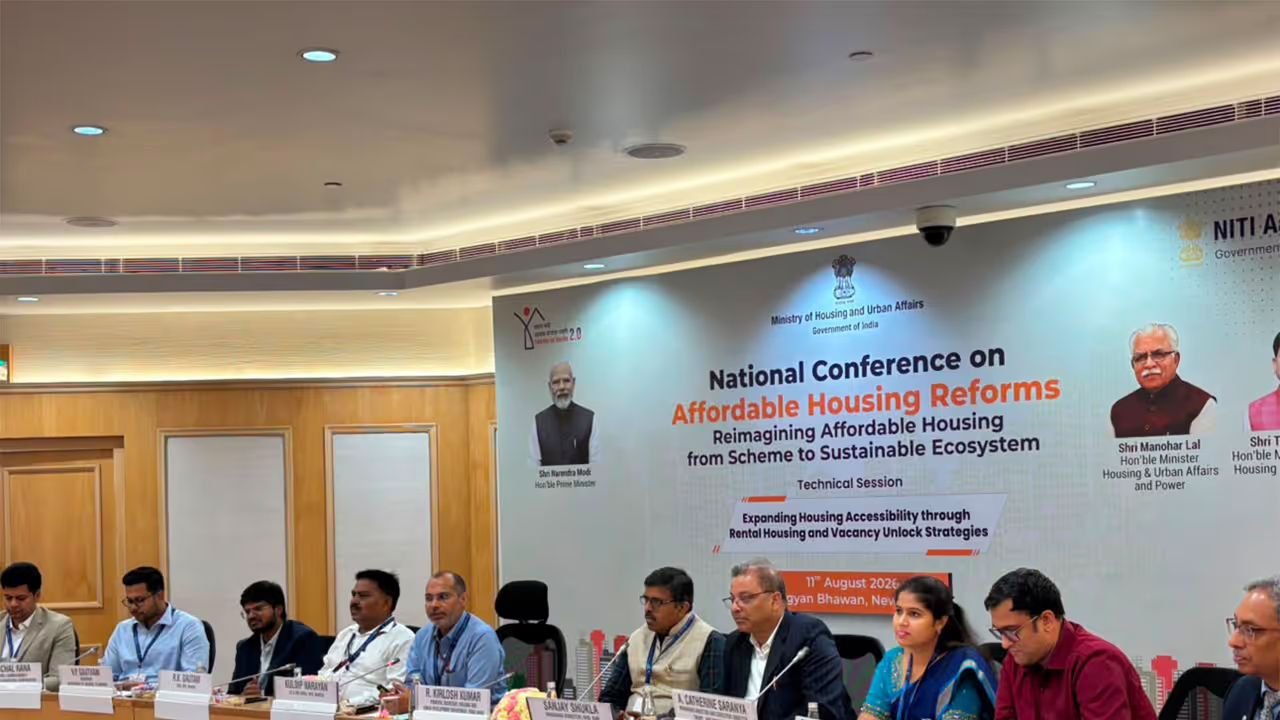
The Ministry of Housing and Urban Affairs held a conference in New Delhi to discuss affordable housing reforms. Experts focused on creating a sustainable ecosystem, stressing the need for land, planning, and financial reforms to move beyond a scheme-based approach.
The Ministry of Housing and Urban Affairs (MoHUA) organised a National Conference on Affordable Housing Reforms - "Reimagining Affordable Housing: From Scheme to Sustainable Ecosystem" on Tuesday at Vigyan Bhawan, New Delhi.
The Conference brought together senior policymakers, experts and representatives from States/UTsand key financial institutions to deliberate on reforms and innovative approaches for strengthening the affordable housing ecosystem.
The Conference was attended by Rajiv Gauba, Member, NITI Aayog, as Chief Guest, and Satendra Singh, Secretary, Department of Urban Development, Ministry of Housing and Urban Affairs (MoHUA), as the Guest of Honour.
The proceedings began with a welcome address and briefing on housing reforms by Kuldip Narayan, Joint Secretary & Mission Director (JS&MD), Housing for All (HFA), MoHUA. He said that the Conference has been convened to facilitate a focused exchange of experiences, best practices and reform initiatives among States/UTs and to collectively identify practical pathways for implementing reforms that are adaptable to different State contexts, according to the Ministry of Housing & Urban Affairs.
Land Reforms and Rental Housing
Addressing the audience, Rajiv Gauba emphasised the need for land and planning reforms to expand affordable housing at scale. He said that land supply and urban planning reforms are critical for expanding affordable housing in cities and stressed the need for measures to improve the availability of land for such projects. He suggested considering waiving land-use change fees for land dedicated to affordable housing and exempting affordable housing units from stamp duty to improve project viability and affordability.
Rajiv Gauba also highlighted the growing importance of rental housing and stressed the need to expand rental housing for migrant workers, young professionals, students and industrial workers, along with reforms in the tenancy framework. "Land is the most binding constraint in the housing sector and therefore, it has to be at the centre of the reform agenda," Rajiv Gauba said.
Calling for greater participation of the financial sector, Gauba emphasised the need for financial innovation and increased private capital in affordable housing. He said the report on affordable housing, prepared by NITI Aayog and the Ministry of Housing and Urban Affairs - "A Comprehensive Framework to Promote Affordable Housing" proposes a set of measures to address the constraints, with most of the implementation lying with State and municipal authorities. The State Government needs a whole-of-government approach to housing, he highlighted.
The recommendations include expanding planned urban areas and reserving at least 10 per cent of residential land as affordable housing zones in master plans. The report also proposes raising the permissible Floor Area Ratio (FAR) for such projects to the range of 5 or 6, promoting transit-oriented development, land pooling and transferable development rights, easing parking and density norms and creating land banks.
Shift from Schemes to Sustainable Ecosystem
The context setting was done by Anna Roy, Programme Director, Managing Urbanisation, NITI Aayog, who highlighted that affordable housing is fundamental to building inclusive, productive and resilient cities and added that as India's urbanisation gathers pace, the policy approach must evolve from implementing housing schemes to creating a comprehensive ecosystem that continuously supports the supply of affordable housing and expands housing choices for urban households, the release noted.
Affordable housing requires a supportive ecosystem where land, planning regulations, financing mechanisms, rental markets and institutional arrangements collectively enable the continuous creation of affordable housing. The focus must progressively shift from delivering individual housing projects to creating conditions that make affordable housing viable, accessible and sustainable over the long term, Anna Roy said, citing cities as engines of growth and stressing working on the ethos of cooperative federalism.
The Conference provided a platform for stakeholders to deliberate on the need to move beyond a scheme-centric approach towards a sustainable and enabling affordable housing ecosystem, with greater emphasis on policy reforms, institutional convergence, innovative financing mechanisms and effective implementation.
PMAY-U's Role and Future Roadmap
In his speech, Satendra Singh acknowledged the efforts of NITI Aayog and the Committee for developing a well-researched report "A Comprehensive Framework to Promote Affordable Housing" that adds significant value to ongoing housing and urban development efforts. He underlined that affordable housing is not merely a social necessity but also a powerful engine for economic growth, employment generation and sustainable urban development.
Singh further highlighted how, in the last decade, the Government has fundamentally reshaped the urban housing landscape through Pradhan Mantri Awas Yojana - Urban (PMAY-U). He mentioned, "The recommendations emerging from this Conference should serve as a roadmap for strengthening affordable housing policies and accelerating India's journey towards sustainable and inclusive urbanisation."
The deliberations focused on key reforms across land and urban planning, rental housing, vacancy unlocking, access to finance and other areas that can improve housing accessibility and financial viability. The conference aimed to facilitate a shift in the approach to affordable housing to developing a sustainable and integrated ecosystem.
The Conference also highlighted the significant progress made PMAY-U in expanding access to affordable housing and strengthening housing delivery systems across the country. Since its launch in 2015, PMAY-U has supported the construction and delivery of houses for eligible urban families, while promoting women's ownership, convergence with basic civic amenities and greater participation of States and Urban Local Bodies.
Building on these learnings, PMAY-U 2.0 seeks to support 1 crore additional eligible urban families through a demand-driven approach, with emphasis on diverse housing solutions, technology-enabled implementation, access to finance and stronger institutional partnerships. The Conference provided an opportunity to draw upon the experience of PMAY-U and PMAY-U 2.0 while exploring policy and institutional reforms required to create a sustainable, inclusive and financially viable affordable housing ecosystem, the release said.
Technical Sessions and State Participation
Three technical sessions were hosted during the Conference, covering critical dimensions of affordable housing reforms: Land and Urban Planning Reforms, Expanding Housing Accessibility through Rental Housing and Vacancy Unlock Strategies and Access to Capital - Demand and Supply Side: Making Affordable Housing Financially Viable The one-day conference also provided an opportunity for States to showcase their best practices, share experiences and lessons learned and explore approaches that could be adapted and scaled across different urban contexts.
The discussions fostered peer learning and cooperative federalism, with participating States sharing their reform initiatives and implementation experiences. The deliberations will further help in preparing a roadmap for housing sector reforms and share progress made in implementing these reforms. The roadmap is expected to provide a framework for sustained engagement, monitoring of reform measures and exchange of experiences among States.
The Conference reaffirmed the importance of collaborative and coordinated efforts among the Centre, States/UTs, financial institutions and other stakeholders to build a more accessible, inclusive and sustainable affordable housing ecosystem, the release said.
The National Conference on Affordable Housing Reforms also provided an opportunity to review the progress made by States, learn from successful reform initiatives and collectively identify practical strategies for accelerating implementation under PMAY-U 2.0. (ANI)
(Except for the headline, this story has not been edited by Asianet Newsable English staff and is published from a syndicated feed.)