
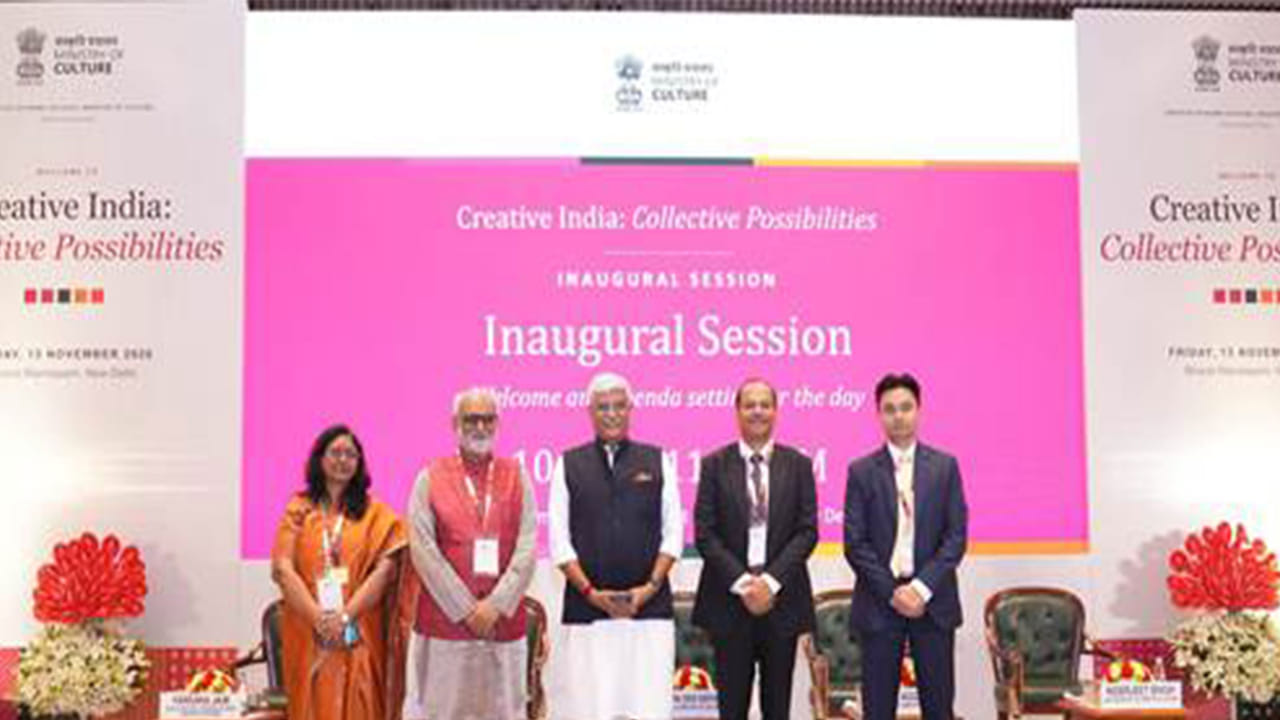
The Ministry of Culture launched the Creative India: Collective Possibilities conference to explore collaborative models for boosting India's creative economy, linking cultural heritage to sustainable growth and global opportunities.
Ministry of Culture Hosts Creative India: Collective Possibilities Conference
Ministry of Culture today organised "Creative India: Collective Possibilities", a conference on collaborative models for India's creative economy, at Bharat Mandapam, New Delhi. Inaugurated by Gajendra Singh Shekhawat, Union Minister for Culture, the Conclave brought together representatives of the Central and State Governments, the Ministry's institutions, industry, philanthropy, the creative community and international partners, to explore how India's cultural wealth can contribute more fully to growth, livelihoods and India's place in the world, according to the release.
"The creative power of India is its real power," said Gajendra Singh Shekhawat. "Ours is a living civilisation, whose creativity belongs to every region and every generation. As the world turns to an economy of ideas and imagination, our task is to connect this talent with opportunity, so that India's culture becomes a foundation of its prosperity and of its voice in the world."
"Government's role is to be a catalyst," said Vivek Aggarwal, Secretary, Ministry of Culture. "When the Ministry opens the door, and partners carry the work forward, our heritage becomes a living resource for communities, artists and enterprise alike. The Creative Economy Division has been created to build exactly these partnerships."
Setting the context, Inderjeet Singh, IAS, Joint Secretary (Creative Economy), placed culture at the heart of India's development agenda, from the Kashi Culture Pathway to the vision of Viksit Bharat. He described the Ministry's 43 organisations, from more than 3,600 protected monuments to museums, archives, Akademis and Zonal Cultural Centres, as the public infrastructure of India's creative economy. As custodian of India's heritage, collections and living traditions, he said, the Ministry offers a natural meeting point for the many sectors, enterprises and creators that draw on India's culture, according to the release.
Partnerships are already in motion. The National Culture Fund has completed 66 projects with 39 partners since 1996, and Adopt a Heritage engages partners at 66 monuments. The sacred Piprahwa relics returned home through a partnership with Godrej Industries Group; Sabhyata Foundation has brought cultural evenings to Purana Qila, and the India Pavilion at Venice 2026 was realised with the Nita Mukesh Ambani Cultural Centre and Serendipity Arts Foundation. A new MoU with Google Arts & Culture will carry India's heritage to audiences worldwide.
Four sessions, on Investing in Culture, Culture-Led Spaces, Culturepreneurs, and Technology and Communication, brought patrons, investors, heritage practitioners, designers, entrepreneurs and technology leaders into conversation. The deliberations explored trusted routes for philanthropy and private capital, monuments, museums and festivals as living destinations, pathways from livelihood to enterprise for artisans and designers, and new ways of carrying India's knowledge and narratives to the world on India's own terms.
The takeaways from the day will inform the Ministry's continued engagement with States, institutions and partners, in India and abroad. The Ministry envisages a common and evolving framework for India's creative economy, grounded in measurable outcomes, simpler facilitation and structured routes for capital into culture. Guided by the principle of convening, facilitating and enabling, the Ministry invited its partners, from State Governments and cultural institutions to industry, philanthropy, creators and the international community, to shape this framework with it and to work with its institutions in turning India's heritage and living traditions into lasting livelihoods, enterprise and global presence.








