
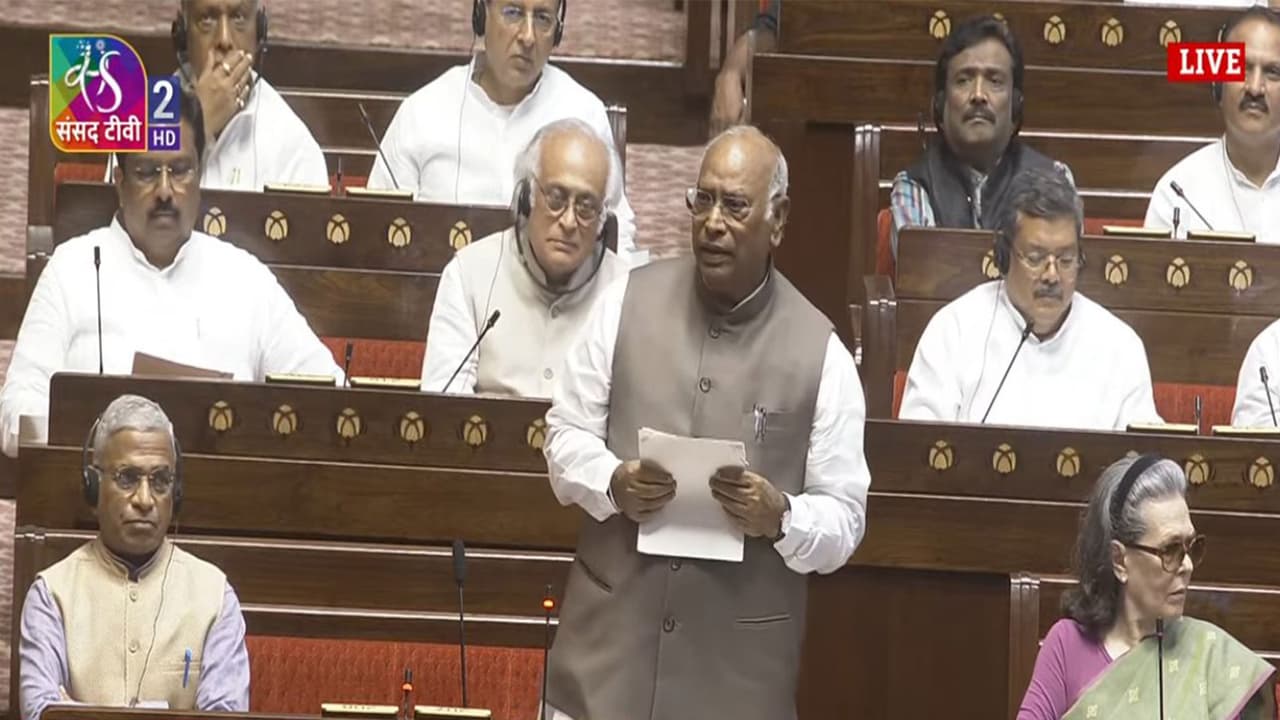
Leader of Opposition Mallikarjun Kharge attacked the Centre over repeated examination paper leaks, demanding a 'National Youth Employment Strategy' and a fixed annual examination calendar as reforms for the youth, during a Rajya Sabha debate.
Speaking in the Rajya Sabha on the Public Examinations (Prevention of Unfair Means) Amendment Bill, 2026, Kharge said repeated postponement of examinations, question paper leaks, delayed results and stalled recruitment processes were severely impacting the careers of young people, with many candidates crossing the age limit while waiting for recruitment to be completed. "Examinations are postponed, question papers are leaked, results are delayed, and recruitment processes remain stalled for years. As a result, the careers of young people come to a halt, and many candidates cross the age limit. Given this situation, we demand that an annual calendar be created for all examinations so that the government is held accountable," he said.
Calling for an employment strategy, he added, "Investment will only be meaningful for youth when it generates quality employment on a large scale. That is why we demand that the government present a 'National Youth Employment Strategy' before Parliament, clearly outlining how a policy and business environment oriented towards investment should be shaped in India, and incorporating all these aspects."
Kharge outlines four key demands
Kharge also demanded that the Centre fill in the vacancies in public sector jobs, especially the seats reserved for the Scheduled Castes and OBC candidates. He also sought a High Court-monitored probe into police action against protesters. "My demands are straightforward: First, there should be a fixed annual examination calendar in the country so that students do not have to face uncertainty. Second, an investigation into this matter should be conducted by a Supreme Court-appointed high-powered committee so that the truth comes to light and accountability is fixed. Third, all vacant positions in the public sector and government institutions should be filled through recruitment. Fourth, incidents related to law and order--such as lathi charges, dragging women, and beating up people and children--all these incidents should be inquired into under the supervision of the High Court," he said.
Questions effectiveness of new legislation
As Kharge raised the caste question and mentioned 'Manusmriti', members from the treasury benches raised objections and asked the Congress leader to authenticate his remarks. The Chair, CP Radhakrishnan, said that the statements would not go on the record.
Questioning the effectiveness of the proposed legislation, Kharge alleged that despite repeated paper leak incidents, no one had been convicted in such cases. "To date, no one has been convicted in a paper leak case. When the state of investigation and justice is like this, merely writing harsh punishments into law will not deliver justice. Every paper leak sends a message to students that their hard work has no value in the eyes of the government," he said.
Focus on NEET paper leak cases
Targeting the Centre over the handling of the NEET paper leak cases, the Congress leader alleged that the main accused in the 2024 NEET paper leak case, Sanjeev Mukhiya, had been given a clean chit. He further claimed that when the 2026 NEET paper leak case came up for hearing recently, the CBI's lawyer failed to appear during the first hearing. "Today the government talks about fast-track courts, but the main accused in the 2024 NEET paper leak, Sanjeev Mukhiya, was given a clean chit. The government makes big claims, but when the 2026 NEET paper leak case was scheduled for a hearing a few days ago, the CBI's lawyer failed to appear at the very first hearing," Kharge said.
On July 23, the Central Bureau of Investigation (CBI) said that its investigation into the NEET (UG) 2024 paper leak did not find any evidence to establish the involvement of Sanjeev Kumar, alias Sanjeev Mukhiya, in the theft of the question paper.
Referring to the NEET UG-2026 paper leak, Kharge claimed that the examination paper had been circulating 15 days before the test and accused the government of failing to act despite the existence of an organised network involved in examination malpractice. "The most recent example of the Modi government's failure is NEET UG-2026, in which more than 2.2 million children appeared for the exam. The paper was leaked, the exam was cancelled, and investigations revealed that the paper had been circulating in the market 15 days before the examination. An organised network embedded within the education system was openly operating across different states, yet the government remained asleep," he said.
Alleges ideological appointments in universities
Further, he alleged that the Centre staffed the Universities with people associated with the Rashtriya Swayamsevak Sangh (RSS). "Universities are not just places for granting degrees. They are centres for new ideas, scientific temper, research, health, and debate. A university campus is not meant for imposing a narrow ideology, blind faith, or any single ideology, but under the Modi government, RSS people are being stuffed into educational institutions. In the country's universities, the position of Vice Chancellor is being given only to people associated with the RSS," the Congress leader said.
Criticism of the Amendment Bill
Criticising the Bill, Kharge maintained that the proposed legislation was "incomplete." He argued that the ruling camp hastily brought the 2024 Act with a focus on politics, instead of reforms in the examination system. He said, "Today, two years later, why didn't you do the work you're doing now back in 2024? Because you had to focus on politics then. The Lok Sabha elections were right around the corner. Rahul Gandhi was consistently raising the issues of paper leaks and the future of the youth during the Bharat Jodo Nyay Yatra. If you had done this, you wouldn't have gotten the credit. Instead of reforming the examination system at that time, you hastily brought in a law that you're now having to amend just two years later. We welcome this Amendment Bill. But it is still incomplete."
Government defends the Bill
Union Minister Jitendra Singh moved the Public Examinations (Prevention of Unfair Means) Amendment Bill, 2026, in the Rajya Sabha after it was passed in the Lok Sabha by a voice vote following an extensive discussion yesterday. The Bill was taken up for discussion in the Upper House.
During his address, Singh said that the Bill is an extension of the earlier bill. He said that there is a deep sense of sensitivity and concern that Prime Minister Narendra Modi has time and again expressed for the youth of this country. The amendments in the bill reflect the government's willingness to "learn from experience" after the implementation of the 2024 anti-paper leak law, Singh said. "In the wake of the recent sequence of events, PM Modi lost no time to declare that nobody will be allowed to jeopardise the students' future. There is a zero tolerance policy. This legislation seeks to make the law more stringent. It is my humble request to all leaders in the house to help pass the bill. I know by now most of the content of the bill is known to you," the minister said.
Stricter punishments proposed
The Bill, meanwhile, proposes to enhance the punishment for persons resorting to unfair means by increasing the term of imprisonment to not less than five years, extendable up to ten years, as against the existing provision of imprisonment for a term of not less than three years, extendable up to five years. The maximum fine is also proposed to be enhanced from Rs 10 lakh to Rs 50 lakh. For organised examination-related crimes, the Amendment Bill proposes to increase the minimum term of imprisonment from five years to seven years, extendable up to ten years, while enhancing the maximum fine from Rs 1 crore to Rs 10 crore. The Bill also empowers the Centre to constitute a Special Task Force and establishes Special Fast Track Courts for examination-linked offences. (ANI)
(Except for the headline, this story has not been edited by Asianet Newsable English staff and is published from a syndicated feed.)