
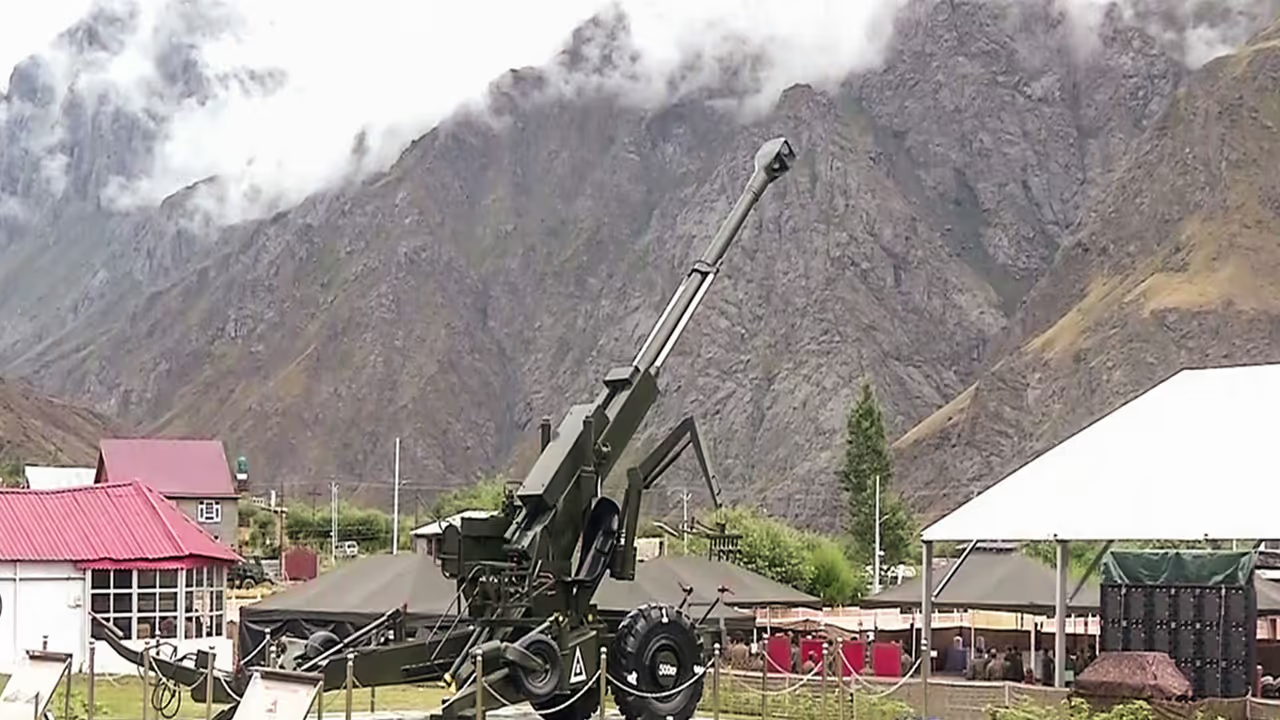
On the 27th Kargil Vijay Diwas, war heroes Havaldar Kamal Deen and Subedar Amreek Singh recall their experiences. Deen recounts killing infiltrators in disguise, while Singh details the intense battle for Tiger Hill and the injuries they sustained.
On the occasion of the 27th Kargil Vijay Diwas, Kargil War hero and retired Havaldar Kamal Deen of the 18 Jak Rifles Regiment of the Indian Army recalled his experience during the 1999 Kargil War.
'We Chased and Killed Them': A Hero's Account
Recalling an encounter with infiltrators on Sunday, Kamal Deen said, "Three of our men were slightly injured, while we managed to kill two or three of theirs. The militants were trying to flee; the infiltrators were dressed in civilian clothes, wearing kurtas, and had discarded their guns, attempting to escape along a canal."
"We chased them down and killed them. Later, with the help of the Air Force and other support, they were eliminated. We killed ten or twelve of them right there," he told ANI. Recalling the injuries he suffered during the operation, Kamal Deen said, "Immediately after, we were airlifted to the base hospital by helicopter. I have a fracture in my arm. I was hit by two bullets; I also took hits to my legs."
The Battle for Tiger Hill
Speaking to ANI, another Kargil War hero and retired Subedar Amreek Singh of the 8 Sikh Regiment of the Indian Army recalled his experience of the 1999 Kargil War and the battle to capture Tiger Hill.
Initial Advance and Casualties
"When I joined the Army, I was posted to Pathankot in 1995. After completing my tenure there, I moved out on May 6, 1999. In the Drass sector, we were assigned a specific task; we were told that some intruders had infiltrated the area, so we prepared our equipment and weapons and moved out. As we reached, heavy artillery fire from the Pakistani side began raining down on us," Singh said.
Recalling the mission to capture Tiger Hill, he said, "Our battalion was assigned the task of capturing Tiger Hill. On May 21, while Delta Company was advancing in broad daylight, we came under enemy fire. We halted there, but suffered casualties during the night; one officer and four soldiers laid down their lives in the line of duty."
"We were trying to recover the body of our officer. Our company remained in the area, establishing small defensive positions, until we received our next task," he added.
Final Assault and Aftermath
Recalling the operation to clear Tiger Hill, Singh said, "Around July 5, we received a task to clear Tiger Hill. A plan was devised, and the task was assigned to the 8 Sikh unit to approach from the rear and cut off the enemy's route. We moved out on the night of July 4. By the morning of July 5, we had positioned ourselves behind Tiger Hill. Just as the first light of dawn broke, we spotted two enemy lines approaching. We cut their lines and accomplished our mission."
Singh further recalled the counter-attack launched by the enemy, saying, "The situation became intense; it was a fierce close-quarters battle. We kept fighting and advancing, delivering a crushing response. Half an hour later, another wave of attacks came; we suffered some casualties. They advanced, but, initially, we couldn't tell if they were militants or regular Pakistan Army officers. I sustained severe injuries: two bullets in my legs and a blow to my head. To this day, I receive disability pension as a battle casualty."
"Eventually, men came from the rear, picked me up, and carried me out; I reached the lower base the next day. I asked for food, as I was famished and parched. I can never forget the harrowing journey and the extreme hardships I witnessed there. Afterwards, I was taken to hospital," he said.
Operation Vijay: A Day of Remembrance
Kargil Vijay Diwas, observed annually on July 26, is a day of profound significance for every Indian. It commemorates the bravery, sacrifice, and unwavering determination of the Indian armed forces during the Kargil War of 1999. On this day, we pay tribute to the valiant soldiers who laid down their lives to protect our nation's sovereignty and integrity.
The conflict that came to be known as the Kargil War began in May 1999 when intruders stealthily crossed the Line of Control and occupied Indian posts on towering ridges. Their sinister aim was to sever National Highway 1A, the vital artery connecting Srinagar to Leh. But they underestimated the will of a nation. India responded with Operation Vijay, a mission that combined meticulous planning, steely determination, and the indomitable spirit of its soldiers. For more than two months, our forces fought inch by inch across the harshest terrain, until every intruder was driven out and every post restored to Indian control. (ANI)
(Except for the headline, this story has not been edited by Asianetnews Editorial staff and is published from a syndicated feed.)