
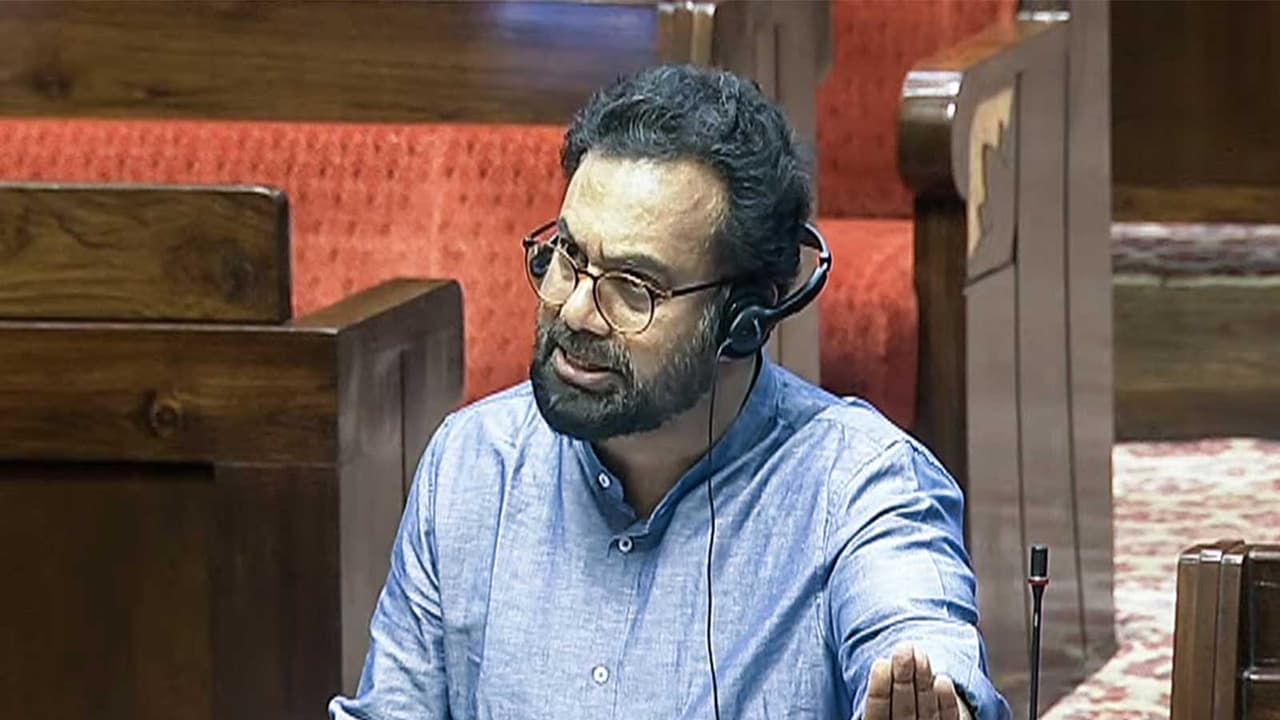
CPI(M) MP John Brittas has objected to the introduction of 'The Prevention of Insults to National Honour (Amendment) Bill, 2026' in the Rajya Sabha, calling it "constitutionally untenable" for equating the National Song with the National Anthem.
CPI(M) MP John Brittas has submitted a formal notice to the Chairman of the Rajya Sabha under Rule 67, raising a strong objection to the introduction of 'The Prevention of Insults to National Honour (Amendment) Bill, 2026'. In his letter to the Rajya Sabha Chairman, Brittas termed the proposed legislation "constitutionally untenable", arguing that it seeks to grant the National Song a status that the framers of the Constitution intentionally withheld.
'Bill Constitutionally Untenable'
"The Bill is constitutionally untenable, as it seeks to confer upon the National Song a statutory status and penal protection consciously withheld by the Constitution and by Parliament itself. Though the Statement of Objects and Reasons relies upon the statement made by Dr. Rajendra Prasad on 24 January 1950, it suppresses the crucial constitutional context in which that statement was made. He had expressly stated that the Constituent Assembly had consciously decided not to adopt a formal resolution on the matter," the letter stated.
The Rajya Sabha MP further contended that the Bill selectively interprets history, stating, "Consequently, the statement remained as a Presidential statement and never acquired the force of a constitutional provision or a decision of the Constituent Assembly. The Bill selectively relies upon one part of that statement while disregarding the constitutional settlement deliberately arrived at by the framers."
Dr. Brittas highlighted that the distinction between the National Anthem and the National Song was a result of exhaustive deliberation. "The Constituent Assembly, after nearly three years of exhaustive deliberations, consciously refrained from placing the National Song and the National Anthem on the same constitutional footing. Had the framers intended both to enjoy identical legal consequences, they would have expressly so provided. The proposed legislation attempts to alter that carefully evolved constitutional understanding through ordinary legislation, thereby defeating the intent of the framers," he wrote.
Ignoring Historical Consensus
Raising the issue of national consensus regarding the song 'Vande Mataram', the CPI(M) leader noted, "The Bill also ignores the historic national consensus evolved, after considering objections from various sections of society, that only the first two stanzas of Vande Mataram would be used at national occasions. That carefully negotiated consensus formed the basis of the subsequent constitutional understanding and reflected the plural character of the Republic."
Inconsistent with Fundamental Duties
Brittas also argued that the Bill is inconsistent with Article 51A(a) of the Indian Constitution, which outlines Fundamental Duties. "The proposal is equally inconsistent with the constitutional scheme embodied in Article 51A(a). While the Constitution expressly makes it a Fundamental Duty of every citizen to respect the Constitution, the National Flag and the National Anthem, it does not impose any corresponding constitutional obligation in respect of the National Song. Parliament cannot, through ordinary legislation, indirectly create a penal obligation in an area where the Constitution itself consciously refrained from doing so," he asserted.
Contradicts Settled Legislative Position
Closing his objection, the MP pointed out that the current legislative framework has been settled for over five decades. "When Parliament enacted the Prevention of Insults to National Honour Act, 1971, it deliberately confined penal protection under Section 3 to the National Anthem. Parliament, fully conscious of the constitutional position and the historical status of Vande Mataram, did not extend criminal liability to the National Song. The present Bill seeks to overturn that settled legislative position after more than five decades without any demonstrable constitutional necessity," the letter concluded (ANI)
(Except for the headline, this story has not been edited by Asianetnews Editorial staff and is published from a syndicated feed.)