Nearly sixty years ago, as India and Pakistan clashed on the Western Front, an unlikely alliance between Indian and US intelligence took shape against China.
Nearly sixty years ago, as India and Pakistan clashed on the Western Front, an unlikely alliance between Indian and US intelligence took shape against China. With fears mounting over Beijing’s fledgling nuclear program, strategists in Washington and New Delhi hatched a daring covert mission for a nuclear-powered surveillance device.
According to the EurAsianTimes, the origins of this operation trace back to a cocktail party in Washington, where then-US Air Force Chief Curtis LeMay raised alarms about China’s secretive nuclear tests in the barren salt flats of Xinjiang. To gain an unobstructed view across the Tibetan plateau, the plan was to plant a nuclear-powered monitoring device atop one of the Himalayan giants.
India, still reeling from its bruising 1962 war with China, didn’t need much persuading. Veteran Indian mountaineer Manmohan “Mohan” Singh Kohli was recruited. Kohli had served as an advisor for high-altitude warfare during the Sino-Indian conflict. Alongside him, a handpicked team of 14 American and 4 Indian elite climbers was assembled, forming a mountaineering dream team.
Related Articles

Kohli’s initial training in the US revealed CIA wanted the device installed at an altitude exceeding 27,500 feet — targeting Kanchenjunga, the world’s third-highest peak. But Kanchenjunga, sacred to locals and notoriously treacherous, was deemed unfit for the mission. Kohli proposed alternatives — Trisul, Nanda Kot, and Kamet — but none met the CIA’s altitude criteria or strategic requirements.
Eventually, a compromise was struck — the mission would target Nanda Devi, the revered “Blessed Goddess” standing 25,645 feet high.
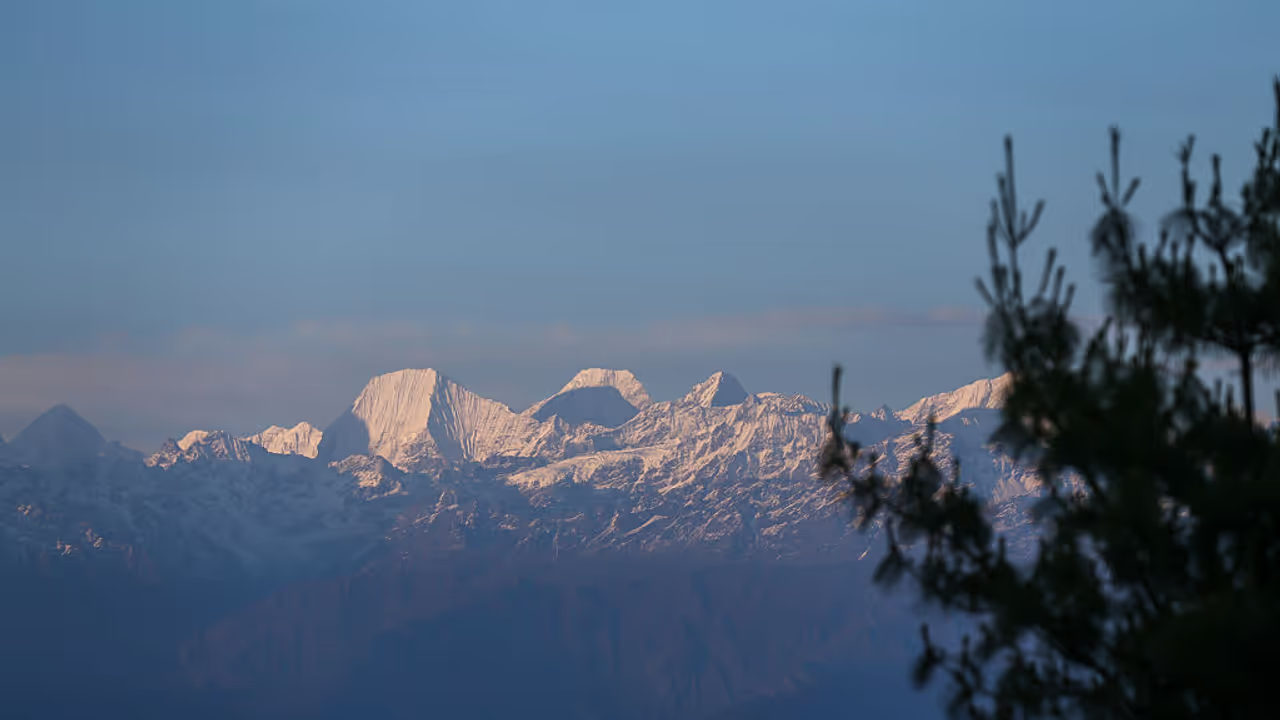
Nanda Devi, a towering sentinel of the Himalayas, is not just a sacred peak, it forms a vital natural buffer shielding the fertile Gangetic plains from Tibet’s icy winds. Its unique geography, encircled by a 70-mile natural barrier and accessible only through a narrow western gorge, made it a natural fortress.
The Atomic Payload
The nuclear-powered surveillance device consisted of four primary components: two metal-encased transceivers labeled B1 and B2 to transmit data, a six-foot-tall antenna for intercepting Chinese telemetry, and the SNAP 19C thermoelectric generator.
The SNAP, fueled by 1,734 grams of plutonium, was designed to produce 40 watts of continuous power for two years. Encased in a mushroom-like structure with 45 aluminum fins to dissipate heat, the SNAP was both an engineering wonder and an environmental time bomb.
But fate, and the mountains, had other plans.
Disaster on the Peak
In 1965, as the team approached Camp-IV on Nanda Devi, they were ambushed by unforgiving weather. With safety paramount, they stashed the precious device in a mountain cavity, secured it meticulously, and abandoned the summit attempt — planning to return the following year.
When they did, in 1966, the equipment had vanished.
Only a few wires remained where a plutonium-powered generator once lay. Panic gripped both Delhi and Washington. A high-level emergency meeting was convened between India’s Intelligence Bureau (IB) and the CIA. The device, with a potential lifespan of 100 years, was lost — somewhere within the sacred heart of the Himalayas.
In a 2018 interview, Kohli warned, “The life of the device is about 100 years, and there are still about 40 years left. If it goes into the Rishi Ganga, the water can get very contaminated, and more people would get affected, even die. But once it goes to the main Ganga, there would be quite a lot of dilution, and some people might suffer, but it would not lead to fatalities…”
He added that the heat from the plutonium would cause the device to sink deep into the glacier until it struck bedrock, remaining lodged, unmoved — and unfound.
Operation Hat
Despite the catastrophe at Nanda Devi, the mission wasn’t scrapped. In 1967, a second attempt — codenamed ‘Operation Hat’ — led to the successful installation of a similar device on Nanda Kot. Though the climbers dug a platform and activated the generator, it too failed within a year. Kohli led another expedition only to find that the SNAP’s heat had melted a massive eight-foot pit in the snow.
This time, the CIA wasn’t taking any chances. The device was promptly extracted and flown off the mountain.
For over a decade, the operation remained a tightly guarded secret until 1977, when ‘Outside’ magazine blew the lid off the Himalayan nuclear saga, triggering global shock and concern over a lost plutonium device in the Himalayas.