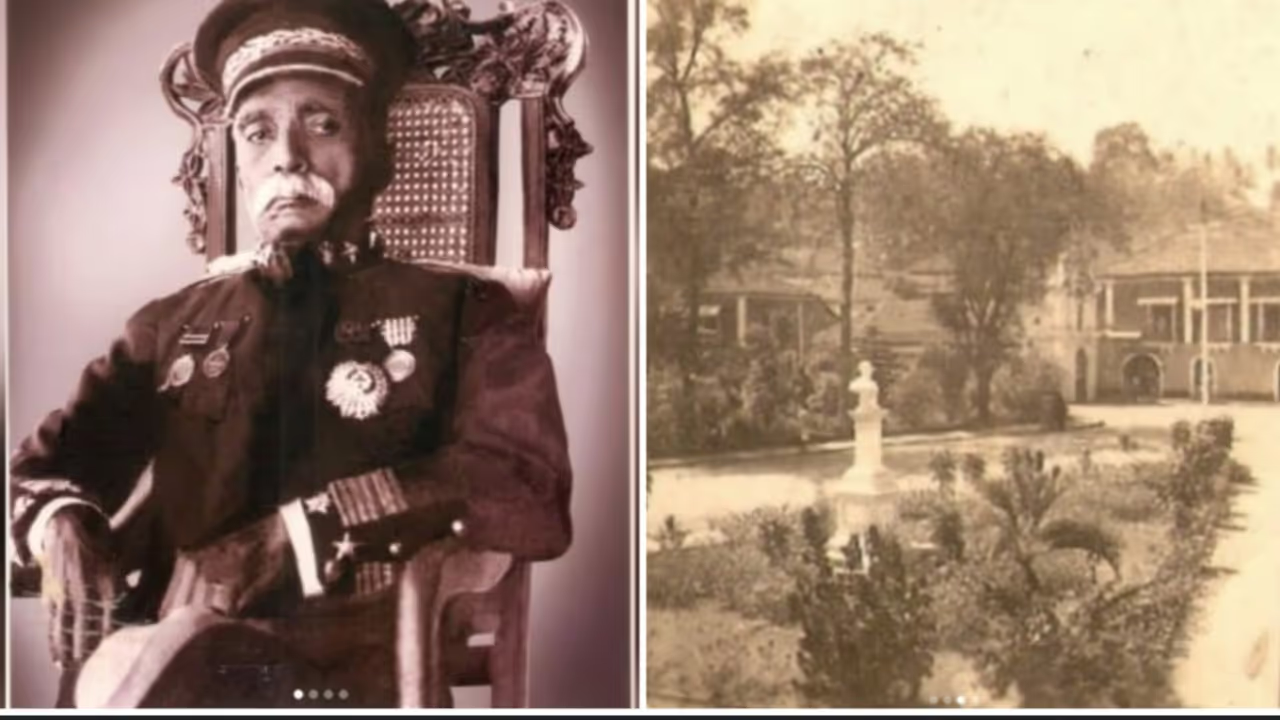
Born on 9 July 1854, Miguel Caetano Dias rose from this humble agrarian world to become one of Goa’s most formidable medical minds — the man who helped the state vanquish the deadly Bubonic Plague.
In Goa lies the serene island of Santo Estêvão, or St Estevam once famed for its luscious okra. Locals lovingly called it Juvem, but its legendary produce earned it another name: Shakecho Juvo, the ‘isle of vegetables’, celebrated for its long, pale-green, seven-ridged ladyfingers.
Amid the island’s hardworking farming families lived Manuel Francisco Dias and Escolástica Fernandes e Dias, to provide for their five children. Yet, one son dared to dream beyond the plough and fields. Born on 9 July 1854, Miguel Caetano Dias rose from this humble agrarian world to become one of Goa’s most formidable medical minds — the man who helped the state vanquish the deadly Bubonic Plague.
“This dream was rather outlandish at the time, and a very daring ambition to hold,” recalls Dr Luis Dias, Miguel’s great-grandson. With the newly established Medical School of Goa still in its infancy, Miguel’s aspirations demanded that he leave Portuguese-occupied Goa and pursue studies either in Bombay or Lisbon. But dreams cost money — and the Dias family had almost none.
Related Articles

“Many sacrifices had to be made so that my great-grandfather could travel to Lisbon to study… all his family could offer as a reward was a watermelon. That’s how impoverished the family was,” Dr Luis says.
Goa’s First Native ‘General’
With the support of his brother, João Vicente Santana Dias, Miguel enrolled in the Faculty of Medicine at the University of Lisbon, graduating with distinction in 1882. His brilliance, however, came at the expense of relentless struggle — he couldn’t afford textbooks, and many were written in French, not Portuguese. So Miguel first learnt French and then copied entire medical texts by hand, a treasure that the Dias family still preserves across continents.
After shining in his studies, Miguel was posted to Mozambique, where rudimentary medical infrastructure forced him to perform life-saving surgeries with minimal tools. In 1888, he returned to Goa, which lagged behind British India in healthcare. He became Director of Health Services and was conferred the military title of ‘General’ — the highest rank in the Portuguese medical cadre, making him the first and only Goan native to ever receive the honour.
The Man Who Helped Defeat the Plague
As Director of the Medical School, Dr Miguel earned admiration as both a physician and surgeon. He performed several pioneering procedures, including the state’s first successful appendectomy — at a time before antibiotics, anaesthesia, or reliable antiseptic practices. “Remember, this was a time before antibiotics… So if you opened the internal cavity, there were higher chances of infection,” Dr Luis notes.
His finest hour came during the Bubonic Plague of 1908. Through rigorous sanitary campaigns, modern medical initiatives, and his refusal to discriminate between rich and poor, he dramatically reshaped Goa’s public health landscape. His pioneering work earned him prestigious Portuguese honours, including the revered Cavaleiro, Official e Comendador da Real Ordem Militar de S. Bento de Aviz.
Dr Miguel also played a crucial role in saving the Medical School of Goa from closure after a damning 1897 inspection. While official credit went to Miguel Bombarda, historical evidence shows the earliest arguments were penned by Dr Miguel himself:
“The Medical Surgical School of Nova Goa… assists with the demands of African colonisation at little cost for the treasury… this school has been useful not only for Portuguese India, but also to the remaining colonies…”
Despite belonging to a socially divided era, Dr Miguel — a Christian of modest origins — carved his path through sheer merit and perseverance. He championed modern European vaccination methods, pushing back against local myths that vaccines could “pollute the body”.
Goan journalist and anti-colonial activist Luis de Menezes Bragança described him as someone who, even in greatness, remained profoundly grounded:
“He remained always the same - simple, ingenuous, unaffected before the great and the small…”
Dr Luis recounts similar family stories: how Miguel, during a felicitation event, spoke not of himself but of his father; or how he once defended a vegetable seller being harassed, yelling from his balcony, “I’m a bhendekar too, come deal with me first.”
Fulfilling his last wish, when Dr Miguel passed away on 26 July 1936, he was laid to rest not in Panjim — the city where he built his illustrious career — but in his beloved native village. A bust erected during his lifetime still stands in Panjim, adorned with medals honouring the man who helped purge the plague and revolutionise Goa’s medical system.
(This article has been curated with the help of AI)