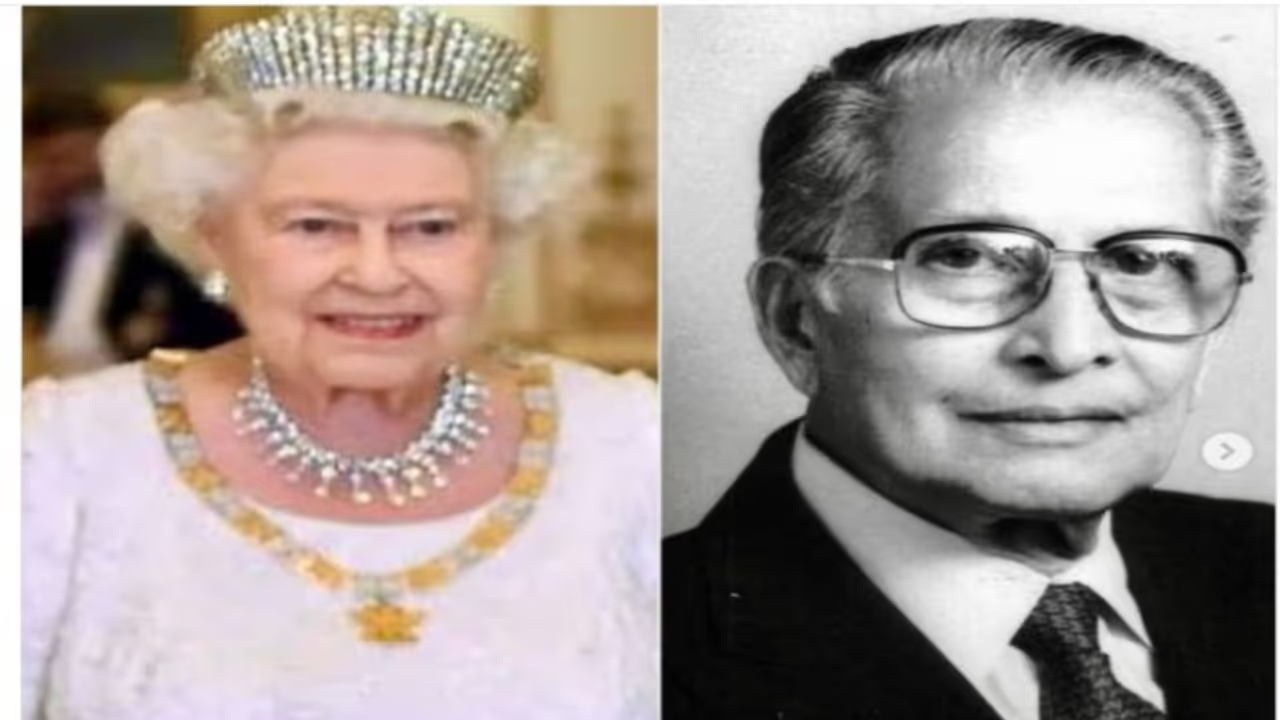
Ambaji Shinde from Goa created intricate pieces worn by Queen Elizabeth II, Elizabeth Taylor, Oprah Winfrey, Madonna, the Maharaja of Baroda, Nizam of Hyderabad, and many other notable names across the world.
Designing jewellery was never part of Ambaji Shinde’s original plan. Life, however, had other designs. The untimely death of his father pushed him into the world of jewellery, as he sought to support his younger siblings. What began as a duty to family soon blossomed into an extraordinary journey that would see Shinde become one of the most celebrated jewellery designers in the world.
Shinde’s unmatched skill, visionary design sense, and unique fashion statement translated into creations that became the envy of royalty and celebrities alike. His masterpieces adorned the likes of Queen Elizabeth II, Elizabeth Taylor, Sophia Loren, Oprah Winfrey, Madonna, the Maharaja of Baroda, the Nizam of Hyderabad, King Farouk of Egypt, Sheikh Ibn Saud of Saudi Arabia, and many more.
It was Harry Winston, the New York gemologist and philanthropist revered as the ‘King of Diamonds’, who recognised Shinde’s brilliance and hired him in 1962. Winston famously dubbed him the ‘Jewel behind the Jewel’. Today, more than 5,000 of Shinde’s sketches continue to educate aspiring designers at the Gemological Institute of America, while over 100,000 of his designs are preserved by the Winston Estate.
Related Articles

“These archives not only create an important link to preserve our heritage, but often provide that creative spark that we use to ignite new interpretations of Harry Winston jewels for the next generations. For example, we have recently launched a brand new collection, called Ultimate Adornments by Harry Winston. The 40-piece collection will explore different costumes and adornments from around the world, and has been directly inspired by the archival drawings of Shinde and his incredible sketches of Caftan inspired necklaces,” Frederic De Narp, CEO of Harry Winston, told Mint in 2011.
Roots in ,Goa
Born in 1918 in Mapusa, a town nestled around Mount Alto in Goa, Shinde’s father, Venkatesh, a bangle-maker, inspired his early creativity. Limited resources, however, forced young Shinde to scavenge discarded carbon papers from a local police station just to trace his designs. Recognising his talent, one of his teachers recommended that he study Textile Design at the prestigious J J School of Arts in Mumbai during the 1930s.
Shinde’s life took a pivotal turn after his father’s death. With a diploma in hand but responsibilities at heart, he joined the jewellery firm of Narauttam Bhau Jhaveri. Despite having no prior experience, his impressive sketches won him the job. Under the mentorship of Nanubhai, Shinde mastered carving, arranging gems, and the intricate art of jewellery design.
By 1938, Shinde had secured his first royal commission for Maharaja Sayajirao Gaekwad of Baroda, and similar opportunities soon followed. After marrying in 1940, he left his initial position to work alongside his mentor at Nanubhai Jewelers, spending the next two decades refining his craft.
Drawing inspiration from the ordinary, Shinde infused glamour into his designs. He created turban pins, pear ropes, and coronation jewels for royals like the Maharajas of Porbandar and Dhar and the Nizam of Hyderabad. He also incorporated religious symbols and traditional Indian motifs, bridging heritage with elegance.
Redefining Royal Jewellery
Traditionally, jewels were symbols of power, wealth, and prestige. Shinde revolutionised this notion by designing lighter, elegant pieces for royals during international visits, blending Western minimalism with Indian grandeur. One iconic creation in 1946 featured over 1,200 diamonds in a dazzling white sari worn by the third wife of Aga Khan III during the 60th anniversary of his reign.
The post-independence decline of aristocracy in India and the Partition could have dimmed Shinde’s prospects, but he adapted. With Nanubhai acquiring gems from dismantled royal collections, Shinde transformed them into exquisite necklaces, rings, and bracelets that would soon captivate the global elite.
In 1959, Shinde seized an opportunity with Harry Winston in New York, bringing his Indian roots to the Western jewellery world. Despite leaving behind an ailing wife and six children, he embraced a modest lifestyle, living in a one-bedroom apartment for over 30 years while creating masterpieces that dazzled the world.
His designs, blending India’s ornate traditions with Winston’s elegant simplicity, mesmerised connoisseurs. “Shinde’s ability to examine the world around him, derive new inspirations and translate this into exceptionally beautiful jewellery designs. In particular...he was able to blend the ornate, romantic style of his native India, with the elegant simplicity of classic Harry Winston designs,” Frederic De Narp said.
“Ambaji Shinde’s Indian roots infuse so many of his creations. They manifest not only in his design aesthetic but also in his mastery & knowledge of stones and the deep mysteries that are embedded in each gem. Every creation is like a homage to the land of his birth,” says Dr Usha Balakrishnan, curator and art historian.
Among his celebrated works were a 69.42-carat pear-shaped diamond necklace purchased by Richard Burton for Elizabeth Taylor in 1969, the Centennial Tiara featuring seven rare diamonds valued at $43 million in 1990, and the Wreath Necklace with 150.24 carats of diamonds, worn by Gwyneth Paltrow at the Oscars in 1999.
Till his retirement in 2001, Shinde’s creations continued to sparkle with unique style and intricate patterns. He died in 2003 at the age of 85 in New York.
The Winston Estate sums up Shinde’s unparalleled talent, “While a customer may have had trouble visualising how a finished piece would look, Shinde had no such difficulty. With several strokes on the paper, [he] could draw a jewel and make it sparkle off the page.”
(This article has been curated with the help of AI)