
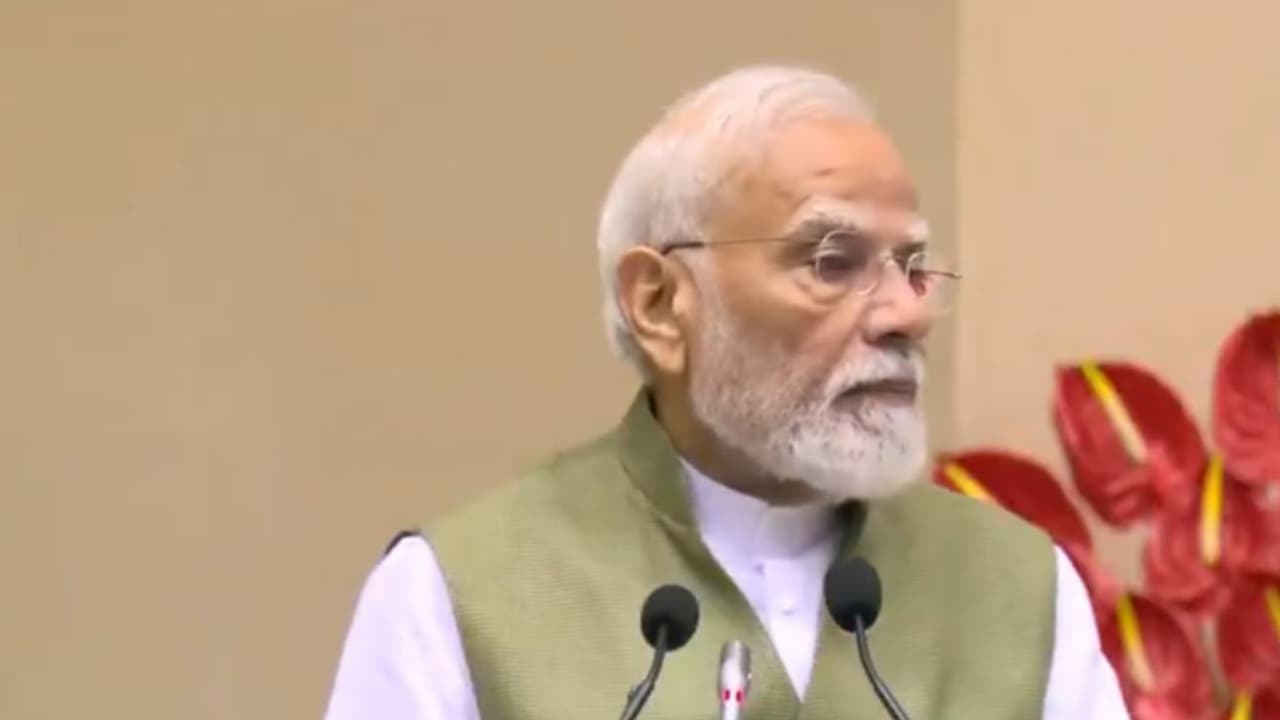
PM Modi stated India's solar capacity has grown from 2 GW to over 160 GW in 12 years. He highlighted schemes like PM Surya Ghar for rooftop solar and PM-KUSUM for solar pumps, which have helped reduce 20 crore tonnes of carbon emissions.
Prime Minister Narendra Modi on Saturday highlighted India’s expansion in clean energy, saying the country’s solar energy capacity has increased from around 2 GW 12 years ago to more than 160 GW today.
Speaking at the International Conference on “The Future of Environment and Climate Dynamics” in Delhi, PM Modi said India had also expanded the use of rooftop solar, solar pumps, LED bulbs and other energy-efficient technologies as part of its efforts to reduce carbon emissions.
Government Schemes Boosting Solar Adoption
“Twelve years ago, India's solar energy capacity was around 2 Gigawatts. Today, that capacity has surpassed 160 Gigawatts,” PM Modi said. He said the government had launched the PM Surya Ghar: Muft Bijli Yojana to turn households into hubs of solar power generation, adding that rooftop solar panels had been installed in more than 50 lakh homes under the scheme.
According to recent government data, more than 50 lakh households had benefited from rooftop solar installations under the scheme by August 2026, with 14.8 GW of rooftop solar capacity commissioned. PM Modi said the government had provided financial assistance of up to approximately Rs 80,000 per household under the scheme.
He also highlighted the Pradhan Mantri Kisan Urja Suraksha evam Utthaan Mahabhiyan (PM-KUSUM), saying solar pumps had been installed on the farms of around 30 lakh farmers. The Prime Minister said India had also completed the “One Nation, One Grid” project and distributed LED bulbs to millions of households to promote energy efficiency. “Through solar energy alone, India has successfully prevented approximately 20 crore tonnes of carbon emissions,” he said.
Expansion Beyond Solar Energy
PM Modi said India’s clean energy expansion was not limited to solar power and highlighted growth in other sectors. “Alongside solar energy, India has achieved significant milestones in other clean energy sectors as well. Over the past 12 years, the country's wind energy capacity has tripled. Hydro energy capacity has seen substantial growth, and the nation is now rapidly advancing its nuclear energy generation,” he said.
He also referred to the development of technologies aimed at enabling cleaner utilisation of existing energy resources, including coal gasification.
Advancements in Clean Mobility
The Prime Minister said India was also advancing hydrogen-based mobility, noting the launch of the country’s first hydrogen train, which he described as marking a new phase in clean mobility.
He further highlighted the growth of electric vehicles in the country, saying their number had increased nearly 950-fold over the past 12 years.
PM Modi also raised the issue of debates surrounding nuclear energy projects, saying that some of those who speak about environmental protection also approach courts against nuclear projects when the government seeks to expand them.
The Prime Minister’s remarks came as India continues to expand renewable energy capacity and household-level clean energy adoption. Government data shows installed solar capacity had reached 164.59 GW by July 31, 2026, up from around 2.8 GW in 2014.
Under the PM Surya Ghar scheme, the government aims to support rooftop solar installations in one crore households, with the programme having crossed the 50-lakh household milestone in 2026. (ANI)
(Except for the headline, this story has not been edited by Asianet Newsable English staff and is published from a syndicated feed.)