
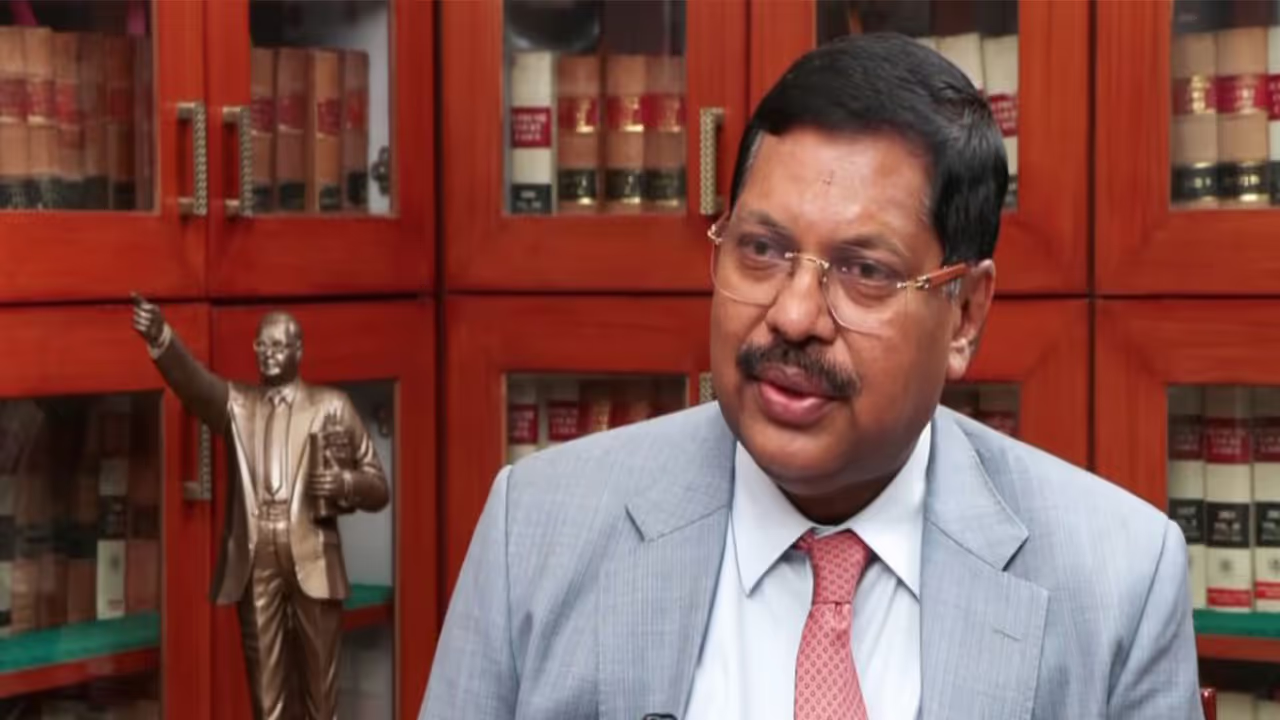
Former CJI BR Gavai highlighted the vital role of an independent Bar in protecting constitutional democracy and citizens' rights, urging lawyers to have the courage to defend institutional integrity, especially when silence is convenient.
Former Chief Justice of India BR Gavai has said that an independent Bar plays a vital role in protecting constitutional democracy and citizens' rights, stressing that lawyers must have the courage to defend institutional integrity "when silence is convenient."
Addressing the Bar Association of Sri Lanka on the topic "Role of the Independent Bar in protecting the constitution and the citizens," Justice Gavai said the Bar and the Bench are complementary institutions and together uphold accountability in a democracy. He observed that the independence of the Bar is not merely a professional privilege but a constitutional necessity, as it ensures citizens get fearless legal representation and enables the state to be held accountable through constitutional challenges.
Historical Role of the Bar
Praising the history of the Bar Association of Sri Lanka, the former Chief Justice said the institution has earned public trust by consistently standing for justice, constitutionalism and citizens' rights. He noted that the Association had shown the courage to take principled stands during difficult constitutional moments in Sri Lanka.
Justice Gavai said that throughout history, lawyers have shaped societies beyond courtrooms. Referring to India's freedom movement, he highlighted the contributions of lawyer-leaders such as Mahatma Gandhi, B. R. Ambedkar, Jawaharlal Nehru and Sardar Vallabhbhai Patel in shaping constitutional and social change.
Landmark Developments and Judicial Independence
The former CJI also referred to landmark constitutional developments in India, including the Supreme Court's judgment in Kesavananda Bharati v. State of Kerala, where arguments by noted jurist Nani Palkhivala led to the evolution of the basic structure doctrine limiting Parliament's power to amend the Constitution.
Recalling the Emergency period, Justice Gavai mentioned the dissent by Justice HR Khanna in the ADM Jabalpur v. Shivkant Shukla case and said Bar Associations across the country had defended judicial independence by protesting against his supersession.
He further noted that lawyers in India have expanded access to justice through public interest litigation. Referring to cases brought by MC Mehta and DK Basu, Justice Gavai said lawyers have actively shaped constitutional rights relating to environmental protection and safeguards against custodial abuse.
The former Chief Justice also referred to the Supreme Court's 2024 judgment on the demolition of properties of accused persons, where the Court held that the executive cannot act as "prosecutor, judge and executioner" simultaneously. He said punitive action without due process is incompatible with constitutional governance.
Conclusion: A Vigilant Bar for the Future
Concluding his address, Justice Gavai said constitutional democracies across the world require an "independent, vigilant and engaged Bar," particularly at a time when legal systems are facing challenges arising from digital governance, migration, environmental degradation and transnational crime. (ANI)
(Except for the headline, this story has not been edited by Asianet Newsable English staff and is published from a syndicated feed.)