
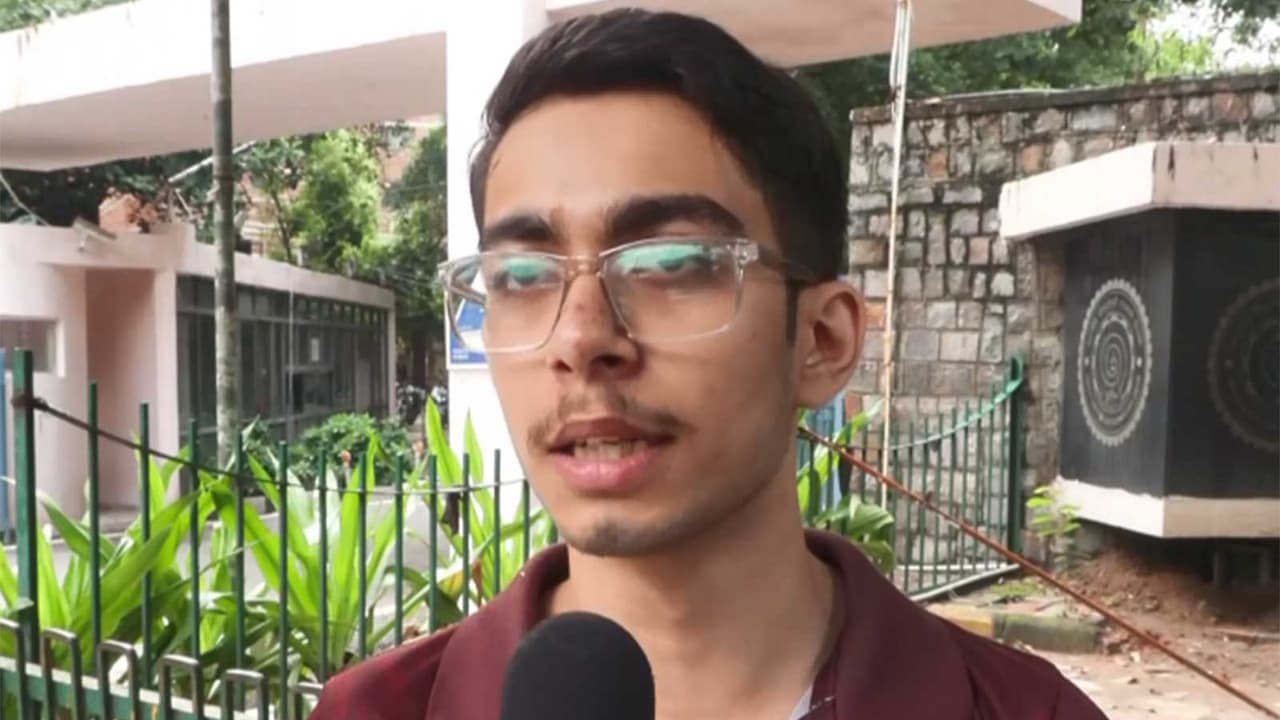
An IIT Delhi student alleges the protest over Rishikesh Kumar's death is being politicised by outside influences from other universities like JNU, causing disunity and diverting focus from systemic reforms and student welfare.
A second-year BTech student at IIT Delhi, Saksham, on Wednesday said students are opposed to the "politicisation" of the ongoing protest over the death of 31-year-old MSc student Rishikesh Kumar, alleging that outside political influences are beginning to affect the unity of the agitation. "There is an issue with the active discourse; people within the system with political agendas are trying to steer this in a different direction. They want the process to drag on--with hearings and calls for resignations--without any actual change happening on the ground," Saksham told ANI.
'Outside Political Influences Affecting Unity'
Saksham said students want the protest to remain focused on student welfare and systemic reforms at IIT Delhi, and alleged that political mobilisation influenced by other university campuses was "gradually creeping in".
"This mobilisation and politicisation is gradually creeping in, influenced by JNU. The students are quite angry about this because this is an IIT Delhi protest--not one belonging to JNU, DU, or anywhere else--and we don't want outside influences dictating what should happen or how things should proceed," he said.
Saksham also objected to what he described as caste-based and partisan remarks during the protest, saying students did not want the agitation to become a platform for political factions. "Especially given that casteist remarks were made yesterday. Students are strongly opposed to the politicisation stemming from the rivalry between the 'Left lobby' and the 'Right lobby'. They do not want any political agenda propagated here, nor do they want slogans or posters associated with any specific political faction," he said.
"However, the influence coming from JNU has started causing some issues; students are becoming angry, and the unity that existed during the protests is beginning to waver," he added.
Protest Demands and Call for Systemic Reforms
Saksham's remarks came a day after All India Students' Association (AISA) president Neha Bora extended support to the protesting students and described Rishikesh Kumar's death as an "institutional murder", alleging that systemic pressure was responsible. The student leader criticised the high-stakes, centralised examination model, stating it forces intense pressure and isolation onto young scholars.
Kumar died on August 22 after falling from the sixth floor of the Lecture Hall Complex (LHC) at IIT Delhi. Police have said that no suicide note was recovered and that the circumstances surrounding his death are being investigated.
Students at IIT Delhi have been protesting since Kumar's death, demanding an independent probe, financial assistance for his family, resignation of the Dean of Student Welfare and systemic reforms in the institute's student welfare and mental health support mechanisms.
Saksham earlier told ANI that students were seeking "systemic reform" rather than merely administrative resignations, arguing that repeated inquiries and changes in officials had not resulted in concrete changes on the ground.
"The reality is that every time an incident occurs, the administration simply claims that an investigation will be conducted and a committee will be set up. Every time, the same cycle repeats: a committee is formed, a report is submitted, everything goes on paper, but nothing concrete changes on the ground," he had said.
He has also called for an independent and dedicated Mental Health Cell at IIT Delhi to ensure that students facing mental health difficulties have a separate mechanism to seek support and have their grievances addressed.
IIT Delhi Forms External Inquiry Committee
Meanwhile, the chairperson proposed for the external inquiry committee constituted by IIT Delhi to probe Kumar's death, former Uttarakhand DGP Ashok Kumar, has recused himself from the panel, citing prior commitments, sources at IIT Delhi confirmed to ANI.
A new chairperson will be announced soon, sources added.
The proposed five-member External Inquiry Committee, announced by IIT Delhi Director Prof Rangan Banerjee, included Ashok Kumar, AIIMS New Delhi psychiatry department head Prof Pratap Sharma, two student representatives and the institute's Registrar, who was to serve as secretary and convenor.
Some protesting students had objected to the proposed composition of the committee and demanded that it be headed by a former High Court judge.
IIT Delhi has said the external committee will examine the circumstances leading to Kumar's death and identify further measures required to strengthen student support systems. The institute has also proposed appointing an external ombudsperson to address student grievances that remain unresolved through existing internal mechanisms.
According to IIT Delhi, Kumar joined the institute in July 2025 and was residing in a hostel on campus. The institute said he received counselling and treatment support in July and August and that his requests to withdraw from the second and third semesters were approved.
The institute has also said it is extending financial support to Kumar's family through contributions from faculty, students and staff. (ANI)
(Except for the headline, this story has not been edited by Asianet Newsable English staff and is published from a syndicated feed.)