
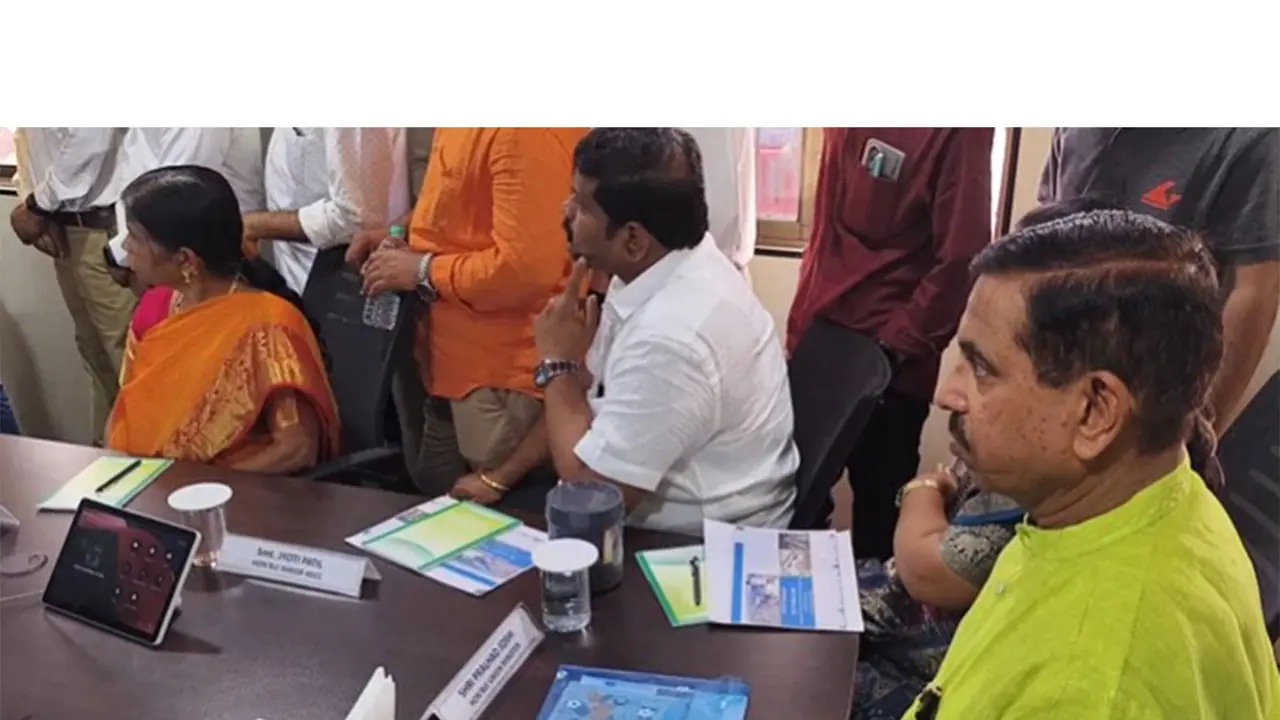
Pralhad Joshi inspected Hubballi's waste-to-charcoal plant by NTPC's NVVN, set for public use by 2027. It will be South India's first, creating over 200 jobs. The project converts dry waste into charcoal to support waste management.
Hubballi's Waste-to-Charcoal Initiative
Union Minister of New and Renewable Energy Pralhad Joshi on Friday inspected a waste-to-charcoal unit run by NTPC Vidyut Vyapar Nigam Limited (NVVN), a subsidiary of NTPC, in Hubballi and said the initiative aims to convert dry waste into charcoal to support cleaner cities and better waste management, with operations to be open for the public by 2027.
During the visit, the Minister said, speaking to the media, the project will create employment opportunities and will be the first such facility in South India. "The facility will be fully operational for the public by 2027. NVVN will spend around ₹11 crore annually on maintenance. The project is expected to create more than 200 jobs and will be the first such unit in South India to start operations in the state," the Minister said.
Joshi said the pilot project has shown positive results and a larger expansion plan is already underway. "The initiative converts dry waste into charcoal to make the city garbage-free. The pilot has been successful and work is underway on a ₹157-crore project to produce charcoal from dry waste. The plant can convert about 200 tonnes of dry waste into charcoal daily; roughly 250 tonnes were processed into charcoal over the past 72 hours," he said.
Joshi added that the project is expected to be fully operational for public use by 2027 and will also support industrial requirements. "The charcoal produced from dry waste will be supplied to Kudagi thermal power plant and brick-manufacturing units. About 20% of the power requirement is met from the grid, and the remaining will be run using gas generated during waste processing," he said.
India's Solar Manufacturing Growth
Earlier this month, Joshi said India is likely to become self-sufficient in solar cell manufacturing within a year, highlighting the rapid growth of the country's renewable energy and domestic manufacturing capacities.
Speaking during a fireside chat at an event marking two years of the PM Surya Ghar: Muft Bijli Yojana, Joshi said India's solar manufacturing ecosystem has expanded significantly over the past decade.
Referring to the growth in solar installations, the minister said, "The 2.65 gigawatt was the total installed capacity in India. Now it is 150 plus gigawatt as far as solar alone, I am speaking." He said the expansion in renewable energy capacity prompted the government to focus on domestic manufacturing. "That's why we thought of promoting manufacturing in India. Almost the module manufacturing capacity was very, very limited. If my memory serves me right, I think it is four or five gigawatts, and today it is nearly about 175 gigawatts. And our cell capacity has increased to about 30 gigawatts, nearly," Joshi said. (ANI)
(Except for the headline, this story has not been edited by Asianet Newsable English staff and is published from a syndicated feed.)