
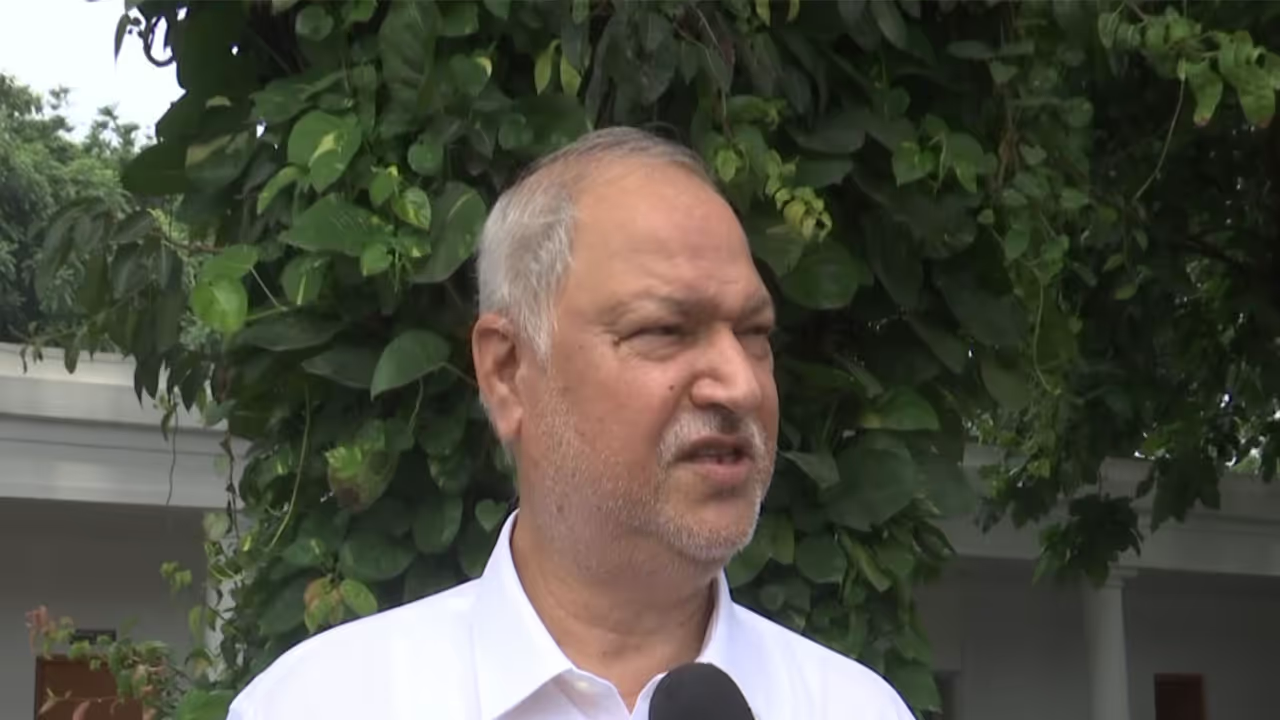
Congress leader Shakeel Ahmad Khan backed wearing hijabs in schools as 'individual freedom'. His comments came after the Allahabad HC dismissed a student's plea, upholding a school's right to enforce a uniform dress code for discipline and uniformity.
Hijab a matter of individual freedom: Congress
Congress leader Shakeel Ahmad Khan on Tuesday addressed the Allahabad High Court judgment on the hijab in schools issue, asserting that if someone wishes to wear a hijab, headscarf, or veil to cover their head, there should be no restriction in educational institutions, and this matter should be considered a part of individual freedom.
Speaking to ANI, Ahmad emphasised that an individual's choice and freedom should be considered alongside institutional rules in schools. "These observations may be valid, but why does this issue arise in the first place? I would like to view the hijab issue in the context of the ghoonghat. In this country, it is traditional for women to draw a veil over their faces; it is a customary practice. And if someone wishes to wear a hijab, a headscarf, or a veil to cover their head, there should be no restriction on doing so. It is a matter of individual freedom. As for the argument that schools have their own rules and regulations, the individual's choice and freedom should be considered alongside those rules," said Khan.
Allahabad High Court's Ruling
Khan's remarks came after the Allahabad High Court dismissed a petition filed by a minor student of a school in Prayagraj. The petitioner had sought permission to wear a Hijab additionally along with the prescribed school dress code while attending classes. The decision was delivered by a division bench comprising Justice J J Munir and Justice Indrajit Shukla.
The petitioner student had passed her High School (Class 10) from the same school and sought admission into Class 11. She claimed that she had been wearing a scarf over her school uniform since Class 6 and no objection had ever been raised. In support of her claim, she presented her ID cards and group photographs from Classes 8, 9, and 10 to the court. However, at the time of admission to Class 11, the school management stated that wearing a scarf was a violation of the dress code and refused her admission on those grounds.
The student's counsel argued that wearing a scarf is a part of the freedom of expression under Article 19(1)(a) of the Constitution and is linked to her dignity and bodily autonomy. It was further argued that wearing a scarf is part of her religious practice, and preventing her from doing so violates her fundamental rights under Articles 14 and 19(1)(a).
However, the counsel appearing for the State Government and the CBSE stated that the school is a private unaided institution that does not fall under the direct control of the state. Determining a uniform is a matter of policy for the school administration, aimed at maintaining uniformity among students. They argued that there is no violation of the fundamental right to religious freedom.
The High Court stated that as long as a dress code is uniform, made in good faith, non-discriminatory, and aimed at maintaining discipline and institutional identity, the determination of the uniform falls primarily within the jurisdiction of the school.
The court clarified that even if the student had been wearing a scarf in lower classes without hindrance, it does not grant her a permanent or enforceable right to compel the school to change its uniform policy. The court remarked that the previous lack of objection could have been due to laxity, negligence, lack of will, or mere courtesy, but the "principle of estoppel" does not apply when the school later decides to strictly enforce its rules.
The High Court observed that the school's authority to set a dress code is entirely justified, and those seeking changes in it should change their mindset rather than the dress code.
BJP supports court's decision
Following the Allahabad High Court judgment, Senior Advocate and BJP National Spokesperson Nalin Kohli emphasised that the ruling essentially seems to have pronounced its judgment on the settled law by the Supreme Court regarding what constitutes an essential practice of religion.
Speaking to ANI, Kohli said that a school not established by a minority or a religious organisation is a secular school, where the focus will naturally remain on imparting education as per the prescribed syllabus and adherence to a uniform dress code. "The Allahabad High Court's judgment essentially seems to have pronounced its judgment on the settled law by the Honorable Supreme Court on what an essential practice of religion is. Additionally, in a school that is not established by a minority or any religious organization, that means it is a secular school. The focus will obviously be on education and the imparting of education as per the prescribed syllabus, and on a uniform that has to be worn. Now, if a family or a child believes that they would like to protect their religious identity or follow their religious tenets, they can certainly go and study in a school established by their own religion because Article 26 of the Constitution provides the right to minorities to run their own educational institutions. But it can't be imposed on a secular institution," said Kohli. (ANI)
(Except for the headline, this story has not been edited by Asianetnews Editorial staff and is published from a syndicated feed.)