
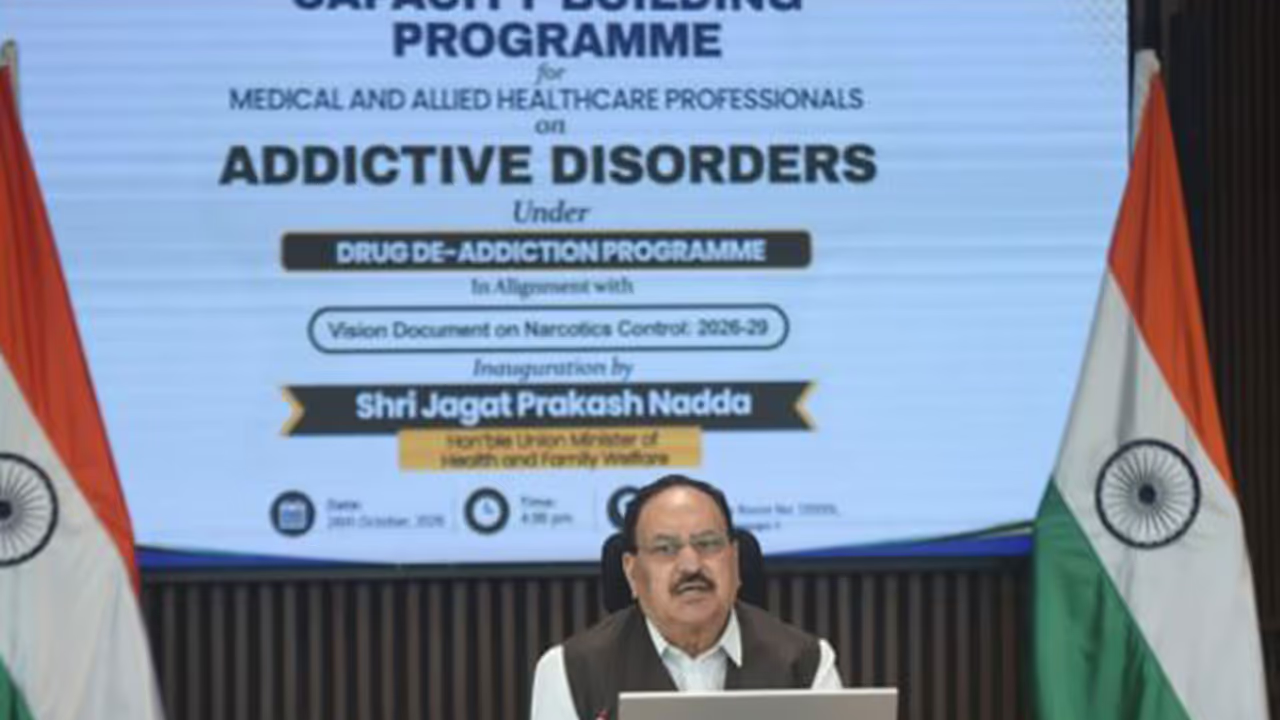
Union Health Minister JP Nadda launched a national capacity-building programme for healthcare professionals to enhance drug de-addiction services and support the government's goal of achieving a Nasha Mukt Bharat by 2029 through expert training.
Launch of Capacity Building Training Programme
Union Minister of Health and Family Welfare JP Nadda today launched the Capacity Building Training Programme for Medical and Allied Healthcare Professionals engaged in drug de-addiction services at Kartavya Bhawan-1, New Delhi. The programme was launched in hybrid mode in the presence of the Secretary, Ministry of Health and Family Welfare, and senior officers from the Ministries of Health and Family Welfare, Social Justice and Empowerment, and Home Affairs. The programme aims to strengthen the capacity of healthcare professionals involved in the prevention, identification, assessment, treatment and management of substance use disorders across the country, said a release.
Addressing the gathering, Union Minister for Health and Family Welfare Nadda congratulated the team for developing a comprehensive capacity-building programme with a structured implementation plan, incorporating online and offline training for doctors, medical officers, nurses, counsellors and other healthcare professionals. He appreciated the phased approach to training, which envisages collaboration among regional and national institutions, followed by the expansion of capacity-building activities across States and Union Territories.
Commitment to a Nasha Mukt Bharat
The Union Health Minister reiterated the government's commitment, under the leadership of Prime Minister Narendra Modi, to achieving the goal of a Nasha Mukt Bharat by 2029. He emphasised that addressing substance abuse disorders requires a coordinated, whole-of-government approach, with different Ministries and departments working in synergy towards clearly defined objectives. Nadda observed that fragmented efforts and the functioning of different departments in silos had created gaps in coordination and service delivery. He noted that the Vision Document on Narcotic Control: 2026–2029, unveiled by Union Home Minister and Minister of Cooperation Amit Shah, represents a coordinated effort to address these gaps by defining the responsibilities and targets of various Ministries and departments. He stressed that effective implementation would require sustained inter-ministerial coordination and collective accountability.
Strengthening Treatment and Collaboration
Highlighting the role of the Ministry of Health and Family Welfare, Nadda stated that strengthening treatment services and building the capacity of healthcare professionals and de-addiction centres are central to the Ministry’s contribution to this national endeavour. He also underscored the importance of supporting de-addiction facilities under the Ministry of Social Justice and Empowerment through appropriate training, institutional strengthening and adequate financial resources. The Minister emphasised that the response to substance abuse disorders must extend beyond treatment to encompass prevention, enforcement and coordinated action against drug trafficking. He highlighted the importance of collaboration with law enforcement agencies, border-management authorities and other relevant stakeholders to address the challenge comprehensively.
Training Framework and Implementation
Dr Anju Dhawan, Professor and Chief, National Drug Dependence Treatment Centre (NDDTC), AIIMS, New Delhi, delivered a presentation outlining the implementation of the capacity-building programme for healthcare professionals engaged in the treatment of substance use disorders. She highlighted the Ministry of Health and Family Welfare’s mandate under the Vision Document on Narcotics Control (2026–2029), particularly the focus on strengthening treatment services and building the capacity of medical and paramedical personnel. She explained that the programme would be conducted through six institutions under the Drug De-Addiction Programme (DDAP), with NDDTC, AIIMS serving as the coordinating centre. The curriculum covers different substances, including alcohol, cannabis, opioids, sleeping tablets and inhalants, along with the management of substance use disorders among specific groups, including women and adolescents.
The training programme will be conducted through six Central Government institutions under the Drug De-addiction Programme (DDAP): the National Drug Dependence Treatment Centre (NDDTC), AIIMS, New Delhi, located in Ghaziabad; the National Institute of Mental Health and Neurosciences (NIMHANS), Bengaluru; the Postgraduate Institute of Medical Education and Research (PGIMER), Chandigarh; the Central Institute of Psychiatry (CIP), Ranchi; Dr. Ram Manohar Lohia Hospital, New Delhi; and AIIMS Bhubaneswar. NDDTC, AIIMS will coordinate the overall implementation of the capacity-building initiative.
(Except for the headline, this story has not been edited by Asianetnews Editorial staff and is published from a syndicated feed.)
