
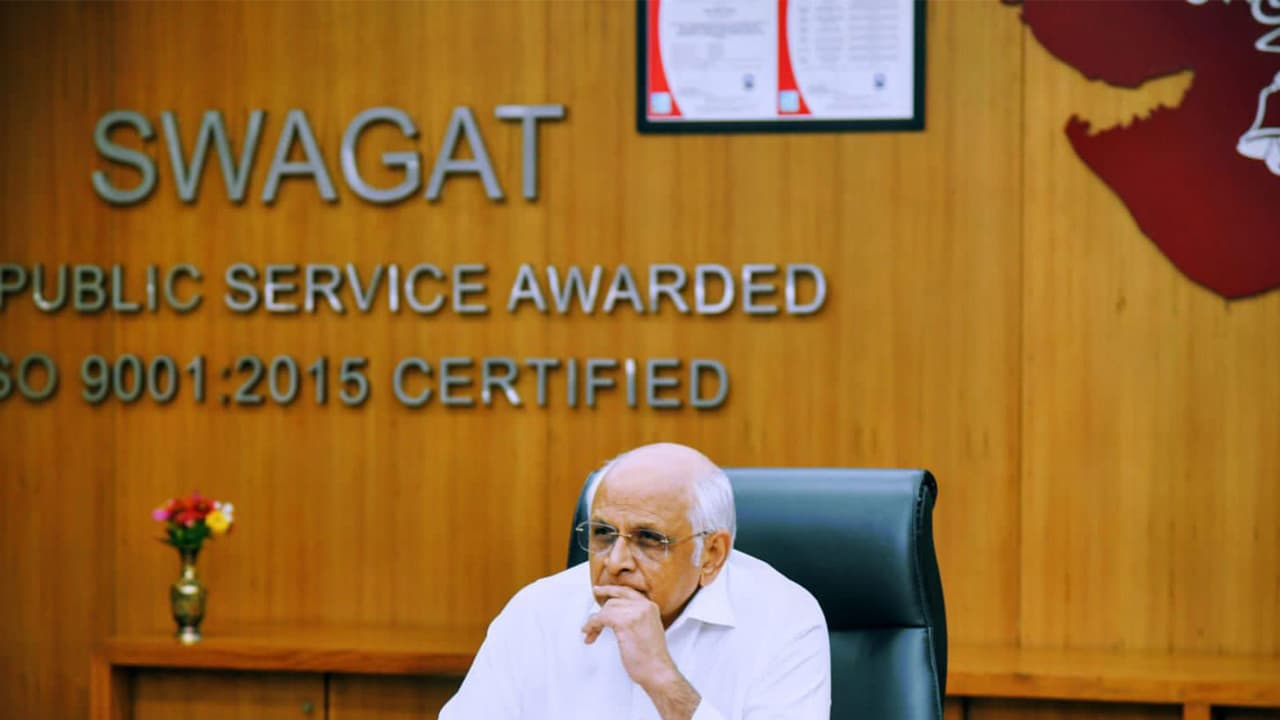
Launched by Narendra Modi in 2003, Gujarat's SWAGAT program has achieved a 99.10% positive grievance resolution rate. Now managed by CM Bhupendra Patel, it has evolved into SWAGAT 2.0 with a mobile app and auto-escalation system.
To bridge the gap between citizens and the government by making maximum use of the potential of technology, the then Gujarat Chief Minister Narendra Modi launched the SWAGAT (State Wide Attention on Grievances by Application of Technology) programme on April 24, 2003. The objective of this programme was simple yet powerful: to enable citizens to present their grievances directly before the highest levels of the government without fear, delay, or procedural obstacles. The scope of the SWAGAT online programme has expanded to districts, talukas, and villages.
This initiative, launched by the Prime Minister, is today being effectively managed by Gujarat Chief Minister Bhupendra Patel. Since 2003, for the past 22 years, the SWAGAT platform has been strengthening the trust of Gujarat's citizens in the state government. This is evident from the fact that 99.10 per cent of the applications received on this platform over the last 22 years have been positively resolved.
SWAGAT 2.0: A Modernized Approach
The SWAGAT programme launched by the Prime Minister was designed as an active and people-centric platform. Now, under the leadership of the Chief Minister, the SWAGAT platform has evolved in line with time and technology. Under the guidance of the Chief Minister, the SWAGAT 2.0 Auto Escalation Matrix system was implemented across all districts and all departments of the state on December 25, 2024, along with the launch of the SWAGAT online mobile application. Notably, this system was implemented as a pilot project on December 25, 2023, on the occasion of 'Good Governance Day' for the Revenue and Panchayat Department and the Patan and Kheda districts. After the launch of the pilot project, out of a total of 21,540 applications, 90 per cent were qualitatively resolved within the stipulated time frame. As the pilot project proved successful, SWAGAT 2.0 was launched across all districts on the next Good Governance Day, that is, December 25, 2024.
Automatic Escalation and Monitoring
The modern SWAGAT system is built around an automatic escalation framework, which ensures that grievances do not remain pending at any level. In SWAGAT 2.0, time limits are defined to ensure qualitative resolution of citizens' issues within a specified period. The applicant's representation is sent online to the officer directly responsible for grievance redressal. The concerned officer is required to take necessary action within the stipulated time frame. Applicants are also kept informed about the status of their grievances through SMS at every stage, from registration to final resolution.
If the concerned officer fails to resolve the grievance within the stipulated time frame, the complaint is automatically escalated to the login of the next higher-level officer upon expiry of the time limit. The higher authority is then required to resolve the grievance, and it is mandatory for the superior officer to do so. Only after verification that the representation has been satisfactorily and appropriately resolved is it considered finally disposed of. Furthermore, if the applicant is not satisfied with the action taken on their grievance, they can provide feedback and escalate their complaint to the next higher-level officer. It is noteworthy that these applications are also closely monitored by the Chief Minister's Office.
With the objective of ensuring the timely disposal of applications received on the portal, various monitoring dashboards have been prepared. In addition, a performance dashboard has also been developed to assess the performance of officials. Based on these dashboards, information is obtained regarding the types of representations received in higher numbers in different districts, as well as the kinds of policy-level changes required based on representations received from various districts of the state.
Policy Impact and Real-World Solutions
It is noteworthy that many policy-level decisions have been taken through the SWAGAT programme, mainly including important decisions related to farmers, land acquisition, students, encroachment on gauchar land (pasture land), re-survey matters, and policing.
Case Study: Resolving a Decades-Old Issue
Through the SWAGAT programme, a decades-old issue of farmers in Moddar village of Kutiyana taluka in Porbandar district was resolved. Due to the absence of a bridge over the Sukhbhadar river between Moddar and Pasavari, farmers had to travel an extra 15 km for the past 40 years to reach their fields. In this regard, the applicant, Shri Lakhmanbhai Navghanbhai Modedara, had made representations at the taluka and district levels, after which the issue reached the State SWAGAT. The applicant highlighted the difficulties faced by 118 farmers in carrying out daily agricultural activities on 3,600 bighas of land due to the absence of a bridge. After hearing the representation, the Chief Minister instructed the Secretary, Roads and Buildings Department, and the Collector, Porbandar, to immediately complete the bridge and road works. As a result, a minor bridge, culverts, and a three-kilometre road will be constructed between Moddar and Pasavari at a cost of Rs. 9 crore.
A Model for Other States
To gain an understanding of the SWAGAT online grievance redressal programme, delegations from the offices of Secretaries of the Government of India as well as Chief Ministers' Offices of various states such as Uttar Pradesh, Uttarakhand, Tripura, Madhya Pradesh, Chhattisgarh, and Andhra Pradesh have visited the SWAGAT unit. They sought an understanding of the system with a view to implementing a similar facility in their respective states. (ANI)
(Except for the headline, this story has not been edited by Asianet Newsable English staff and is published from a syndicated feed.)