
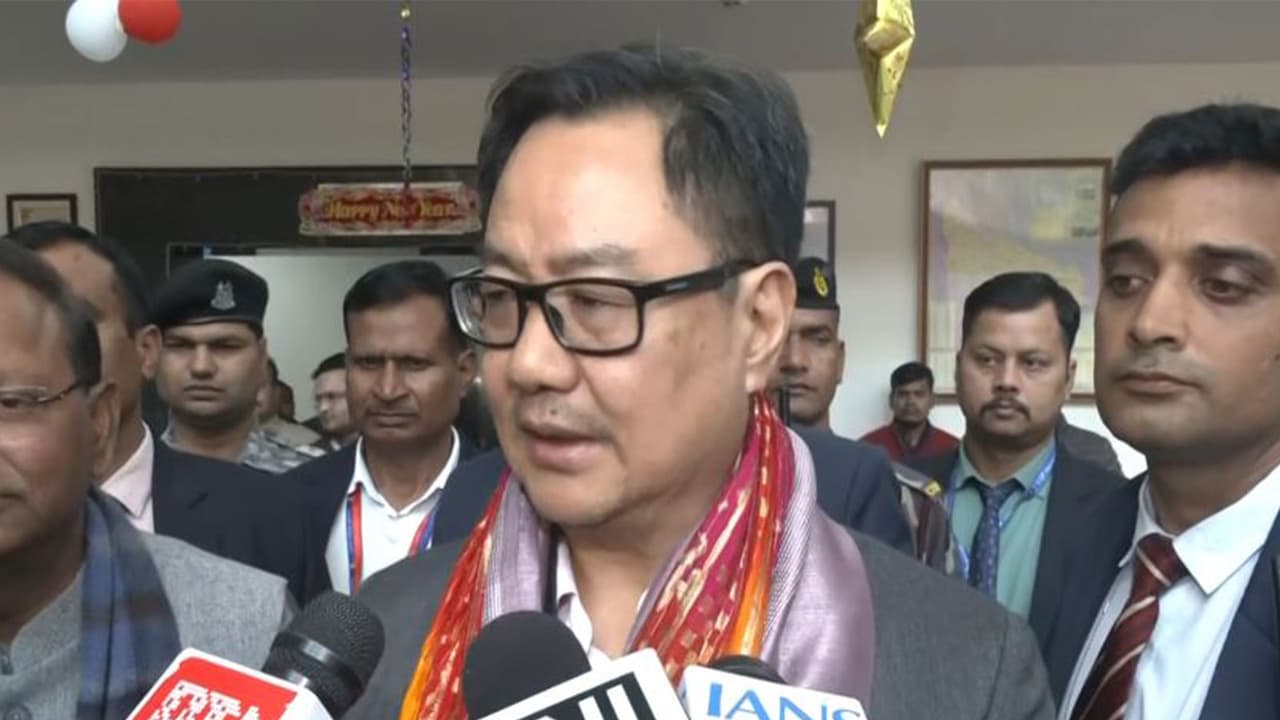
Union Minister Kiren Rijiju is in UP to promote the Viksit Bharat G-RAM G act, which increases rural wage employment to 125 days. The Congress opposes the bill's new 60:40 Centre-State fund-sharing model, which it says is a rollback.
Govt to Inform UP Villages on Viksit Bharat G-RAM G Act
Union Parliamentary Affairs Minister Kiren Rijiju on Tuesday said the government aims to inform every village in Uttar Pradesh about the benefits of the Viksit Bharat G-RAM G act.
Speaking to the reporters in Lucknow, Rijiju said, "We have a meeting in which the senior leaders of the state. We will have discussions on the Viksit Bharat G-RAM G bill also. This is a historic bill, and we need to inform everyone in every village about the benefits of this new bill. UP is the largest state in India, and if VB G RAM G Bill becomes a success here, it will become successful in the entire country." Rijiju is in Lucknow to participate in events related to the VB G RAM G act.
Key Provisions of the Act
VB G RAM G act guarantees 125 days of wage employment per rural household, up from the existing 100 days, for adult members willing to undertake unskilled manual work.
New Fund-Sharing Model
As per Section 22 of the Act, the fund-sharing pattern between the Central Government and the State Governments will be 60:40, while for the North Eastern States, Himalayan States, and Union Territories (Uttarakhand, Himachal Pradesh, and Jammu and Kashmir), it will be 90:10.
Congress Opposes New Legislation
The Congress party had announced a nationwide 'MGNREGA Bachao Sangram' from January 10 to February 25, opposing the VB G RAM G Act.
Earlier in the day, Congress MP KC Venugopal sharply criticised the VB G RAM G act, stating that the right to employment has been taken away through the new legislation. Venugopal was addressing a gathering in Thiruvananthapuram, where he pointed out that under the old law, the Centre had to bear 100% of the wage component; however, under the new amendment, the Centre will bear only 60%, with the remaining 40% to be borne by the state. "The employment guarantee scheme is the largest employment-providing programme the world has ever seen. Through the new amendment, the very right to employment has been taken away. Under the old law, the Centre had to bear 100% of the wage component. As per the new amendment, the Centre will bear only 60%, and the remaining 40% has to be borne by the state," Venugopal said. (ANI)
(Except for the headline, this story has not been edited by Asianet Newsable English staff and is published from a syndicated feed.)