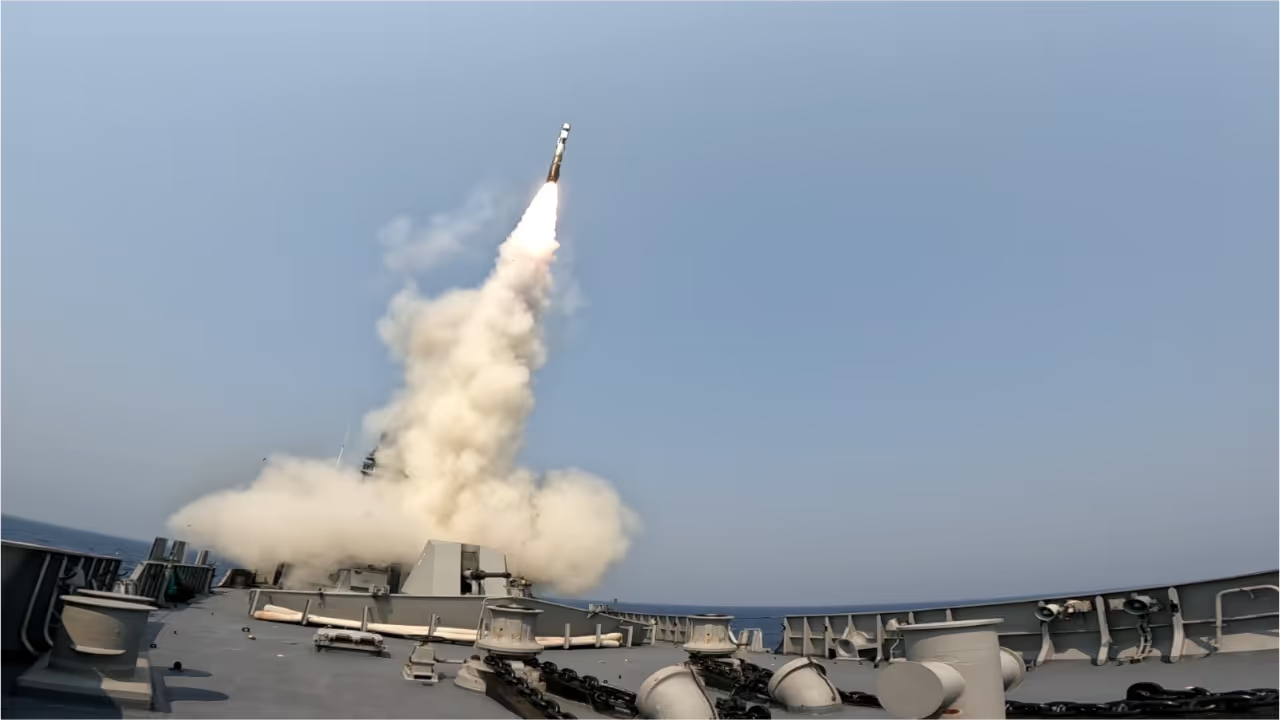
India has signed a BrahMos missile deal with Vietnam and is nearing a similar agreement with Indonesia. The moves strengthen India's defence exports, deepen strategic ties in Southeast Asia, and reshape regional security dynamics.
New Delhi: Defence Secretary Rajesh Kumar Singh on Saturday confirmed that India has signed a Brahmos supersonic cruise missile deal with Vietnam and is on the verge of closing a similar agreement with Indonesia.
Speaking at the 23rd Shangri-La Dialogue in Singapore, Rajesh Kumar Singh said: “My understanding is that with both Indonesia and with Vietnam, the deal is in the final stages. In fact, for Vietnam, I understand that it has already been signed, probably not publicly announced, but it’s already been signed.”
He told a panel at the forum hosted by the International Institute for Strategic Studies (IISS).
Related Articles

The confirmation, made before an audience of defence ministers, military chiefs, and strategists from across Asia and the West, arrives at a moment of heightened maritime tension in the South China Sea and underscores the speed at which India has transformed from the world’s largest arms importer into a credible, sought-after defence exporter.
The Deal: What We Know
The Vietnam agreement, valued at approximately ₹5,800 crore, is among Hanoi’s largest defence acquisitions in recent memory. The package is understood to include shore-based coastal missile batteries, an initial supply of missiles, training, and long-term logistics support. Vietnam’s military has also signalled interest in air-launched variants of the system for future procurement.
The deal follows Vietnamese President To Lam’s state visit to India earlier this month, during which both governments reviewed their ‘Enhanced Comprehensive Strategic Partnership’.
The BrahMos discussions had been building since March, when a delegation from the Society of Indian Defence Manufacturers visited Hanoi to explore procurement opportunities.
Negotiation At Final Stage With Indonesia
Indonesia’s negotiations, though not yet concluded, are described as being in the final stages. A Joint Defence Industry Cooperation Committee has been set up between New Delhi and Jakarta, covering technology transfer, joint research and development, and supply-chain integration.
Prior to them, the Philippines have already been operating Brahmos missiles since 2024.
What It Means For India
The strategic and economic implications for India are layered and consequential.
On the commercial front, India’s export of defence platforms attained a record high of about USD2.76 billion in 2024-25. It is an increase of over 12 percent from the previous year.
The BrahMos deals with Vietnam and Indonesia alone would add well over $1 billion to that figure, pushing India closer to its stated target of ₹50,000 crore in defence exports by 2030.
But the significance runs deeper than revenue. For decades, India absorbed the geopolitical cost of being the world’s top arms importer – dependent on Russia, France, Israel, and the United States for everything from fighter jets to submarines. The BrahMos export programme marks the beginning of a structural reversal: India is now the one offering advanced precision weapons technology to others, on its own terms.
This is not incidental. Post-Operation Sindoor in May 2025, India’s defence-industrial capacity has acquired new strategic legitimacy. The demonstration of domestic precision-strike capability during that operation lent BrahMos — and Indian defence manufacturing more broadly – a credibility that no marketing campaign could replicate.
For India, securing the Vietnamese and Indonesian contracts is not just a commercial achievement – it is validation of an entirely new strategic identity.
The China Factor
Apart from India, the prospect of three ASEAN members equipped with Brahmos supersonic anti-ship missiles represents a meaningful challenge to China’s maritime coercion playbook in the South China Sea.
For India, the BrahMos diplomacy also serves a purpose at home. The 2020 Galwan clash and subsequent standoffs along the Line of Actual Control injected a new urgency into India’s strategic posture toward China. Expanding India’s influence in Southeast Asia – Beijing’s near abroad – through defence partnerships is one way New Delhi signals to Beijing that pushback has consequences beyond the Himalayas.
What Comes Next?
Malaysia and Thailand are also understood to be in various stages of discussion about BrahMos acquisition, which would extend the arc further. If those talks conclude, BrahMos would be deployed by a majority of the littoral states along the South China Sea.