
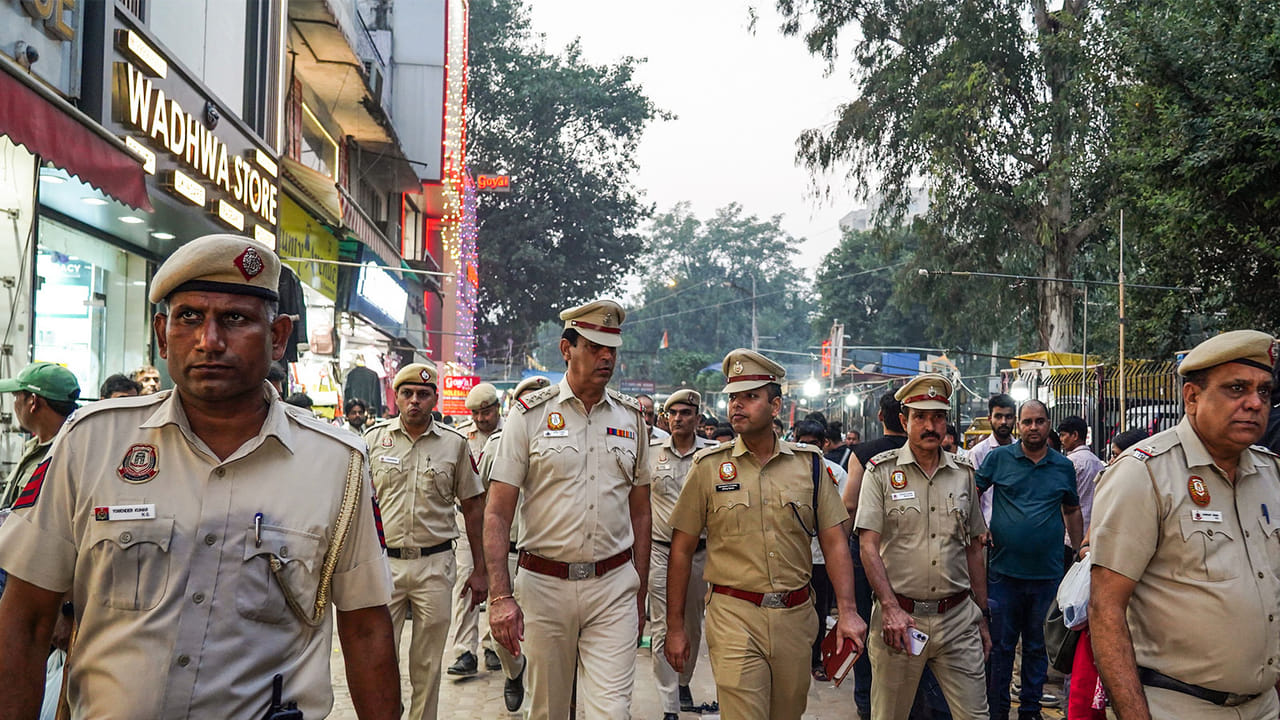
Following Amit Shah's directive, Delhi Police is implementing a three-month action plan to improve women's safety, featuring 6,000 new CCTV cameras, increased patrolling, faster emergency responses, and intensified community outreach programs.
Delhi Police Enhances Women Safety With New Action Plan Measures
New Delhi [India], November 16 (ANI): As part of measures to strengthen women's safety, the Delhi Police has installed over 6,000 CCTV cameras in public parks and identified 19,822 dark spots for surveillance. The measures have been taken following directions from Union Home Minister Amit Shah and according to details of the three-month action plan.
Shah had issued directions during a meeting at the Delhi Police Headquarters on October 24 to formulate a three-month action plan focusing on women's safety, citizen security, victim assistance and effective prosecution. As part of the plan, audits of 1,635 public parks have been completed, with boundary walls, fencing and lighting systems being reinforced. The police have also initiated work to ensure that fencing and boundary walls in all parks are completed by January 26, 2027. Gates and regular patrolling have achieved 100 per cent coverage in 503 large parks, while the deployment of Police Control Room (PCR) vehicles outside public parks is also being ensured.
On the technology front, the response time of the Emergency Response Support System (ERSS) 112 has been reduced from 11 minutes and 53 seconds to 8 minutes and 2 seconds. A total of 178 Pink Scooties are currently engaged in patrolling, averaging 7.4 hours of duty per scooty. Additionally, 35 all-women PCR vans have been deployed. Female personnel currently constitute 17.3 per cent of the Delhi Police force, with a target to increase their representation to 25 per cent by 2030. The action plan also includes strengthening assistance facilities for women. Around 308 walk-in complainants visit 125 Pink Booths daily, while 24-hour Women Help Desks are operational at airport, railway and metro police stations. Every district also has an Anti-Human Trafficking Unit.
Under the 'Shishtachar' campaign, 17,387 drives have been conducted, resulting in action against 1,24,010 individuals. The Delhi Police has also intensified community outreach programmes at working women's hostels, co-educational schools and colleges, and girls' hostels to raise awareness and strengthen confidence in police assistance. According to the action plan, around 15.9 lakh citizens have been reached through 22,662 outreach programmes. Additionally, 5.7 lakh participants have attended self-defence programmes, while 3.4 lakh have participated in child safety initiatives.
Around 3,514 visits are conducted every week at girls' schools, hostels, colleges and working women's hostels. These include 1,869 visits by beat staff and 882 by Station House Officers (SHOs). Intensive joint patrolling involving regular police personnel, traffic police and PCR units is also being carried out under the supervision of senior officers. On the prosecution front, 25 special courts are currently operational, while 37 additional courts are being established to expedite trials in crimes against women. From January 2026 to October 31, a total of 1,225 rape and Protection of Children from Sexual Offences (POCSO) cases were registered, with charge sheets filed in 81 per cent of them. Compliance with the two-month deadline for filing charge sheets stood at 94 per cent. In 2025, charge sheets were filed in 99 per cent of rape and POCSO cases, according to the details. The process of appointing Special Public Prosecutors, including experienced women advocates, for sensitive cases has also been initiated. In cases involving unidentified accused, the average time between registration of an FIR and filing of the charge sheet was 59 days. Charge sheets were filed within 44 days in the Noida Bus Case and 29 days in the Swaroop Nagar Blind Murder Case. Meanwhile, the Delhi Police is developing Standard Operating Procedures (SOPs) to establish a scientific framework for filing bail cancellation petitions against habitual sexual offenders. DNA testing has also been made compulsory in all cases under the provisions of the Bharatiya Nagarik Suraksha Sanhita (BNSS), and such tests are being conducted across cases, according to the action plan. (ANI)








