
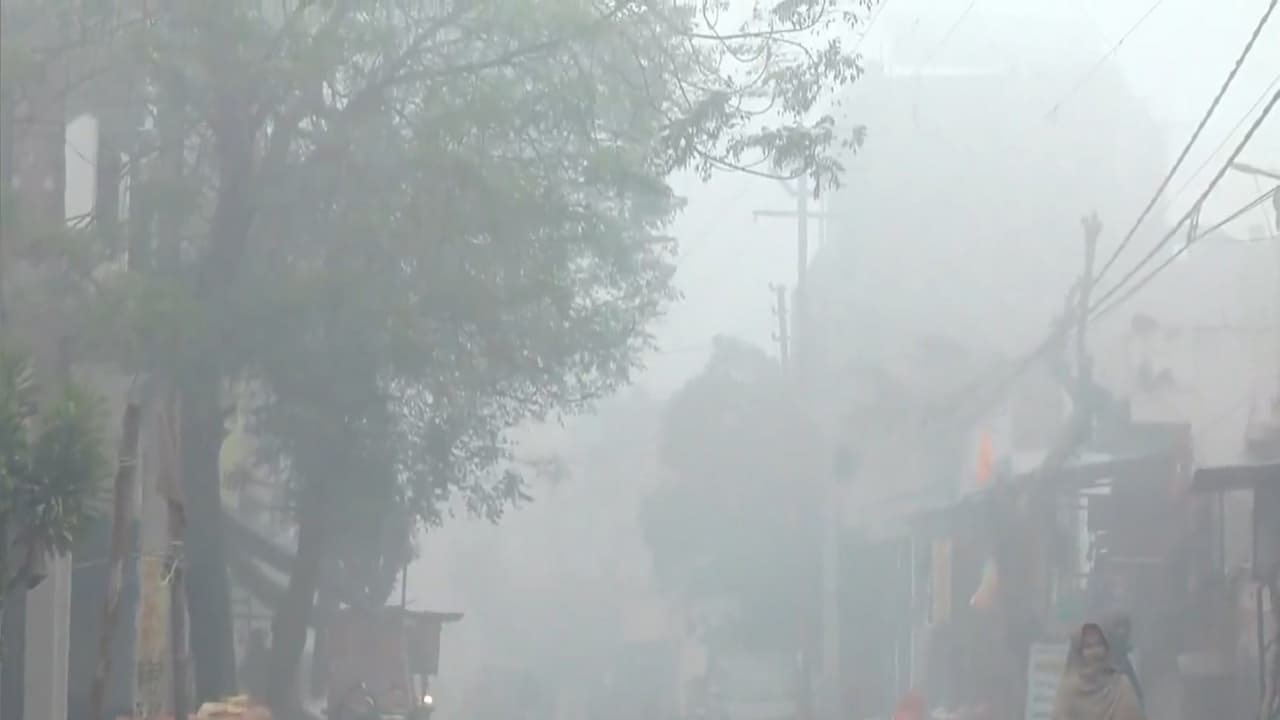
Delhi faces a dual crisis with 'severe' air quality prompting GRAP 4, and a harsh cold wave sweeping North India. Temperatures plummet in Moradabad, Agra, J&K, and Mount Abu, with dense fog disrupting flights in the national capital.
A toxic layer of smog has engulfed Delhi, prompting the invocation of GRAP 4 in the national capital. The Air Quality Index (AQI) around AIIMS Hospital stands at 443-447, falling into the 'Severe' category, according to the Central Pollution Control Board (CPCB). The situation worsened further as a cold wave brought temperatures plummeting. In Moradabad, Uttar Pradesh, residents lit bonfires to warm themselves as the India Meteorological Department (IMD) forecasted minimum temperatures to drop to 8°C.
Widespread Cold Wave Grips North India
The cold wave has also affected Agra, where a thin layer of fog engulfed the Taj Mahal. In Jammu and Kashmir, the cold wave persists in villages and hilly areas of Anantnag, with temperatures dropping to sub-zero levels. Despite the chill, tourists are enjoying the scenic beauty of Dal Lake in Srinagar. "The weather is quite chilly here, as the morning was extremely cold. We went out around Dal Lake at night, and it was quite a pleasant experience," said Sandeep, a tourist from Uttar Pradesh.
Record Lows in Mount Abu
Meanwhile, Mount Abu in Rajasthan has experienced temperatures as low as -5°C. A local told ANI, "Look at the cold of Mount Abu, with so much ice formed. The temperature here is -5 °C... Our hands are trembling from the cold. This weather has persisted for the last three days... Previously, such cold used to occur in November or December, but due to climate changes, it's happening in January..."
Delhi's Dual Crisis: Severe Pollution and Dense Fog
Meanwhile, the national capital, Delhi, continued to grapple with a severe air pollution crisis, with air quality remaining in the 'severe' category. The Air Quality Index (AQI) was recorded at 439 at 7 am on Sunday, according to data released by the Central Pollution Control Board (CPCB). "The situation worsened overnight, with the AQI recorded at 432 at 10 pm on Saturday, placing it in the 'severe' category, before deteriorating further by early Sunday morning," the report said.
As cold wave conditions continued to prevail in the national capital, dense fog enveloped large parts of Delhi on Saturday morning, leading to reduced visibility and delays in several flights at Indira Gandhi International (IGI) Airport. Passengers have been advised to check flight statuses with their respective airlines before heading to the airport, as foggy conditions are likely to impact operations intermittently. The India Meteorological Department reported a slight improvement in the minimum temperature, which stood at 7 degrees Celsius on Saturday morning, compared to 4 degrees Celsius recorded on Friday. Despite the marginal rise, visibility remained low during the early hours, affecting road, rail, and air traffic movement across the city.
Kashmir Under Cold Spell
A cold wave also continued to grip Kashmir on Sunday, with temperatures plunging below freezing in several parts of the Valley. Srinagar recorded a minimum temperature of minus 4.7 degrees Celsius, according to the India Meteorological Department.
As per the IMD forecast, Srinagar city is expected to record a maximum temperature of 11 degrees Celsius and a minimum of minus 5 degrees Celsius on Sunday. In Jammu city, the maximum temperature is likely to be around 20 degrees Celsius, while the minimum is expected to settle at 5 degrees Celsius. The forecast said, "mainly clear sky becoming partly cloudy towards evening or night" for Srinagar city.
AQI Classification Explained
As per AQI classification, readings between 0 and 50 are considered 'good', 51 to 100 'satisfactory', 101 to 200 'moderate', 201 to 300 'poor', 301 to 400 'very poor', and 401 to 500 'severe'. (ANI)
(Except for the headline, this story has not been edited by Asianet Newsable English staff and is published from a syndicated feed.)