
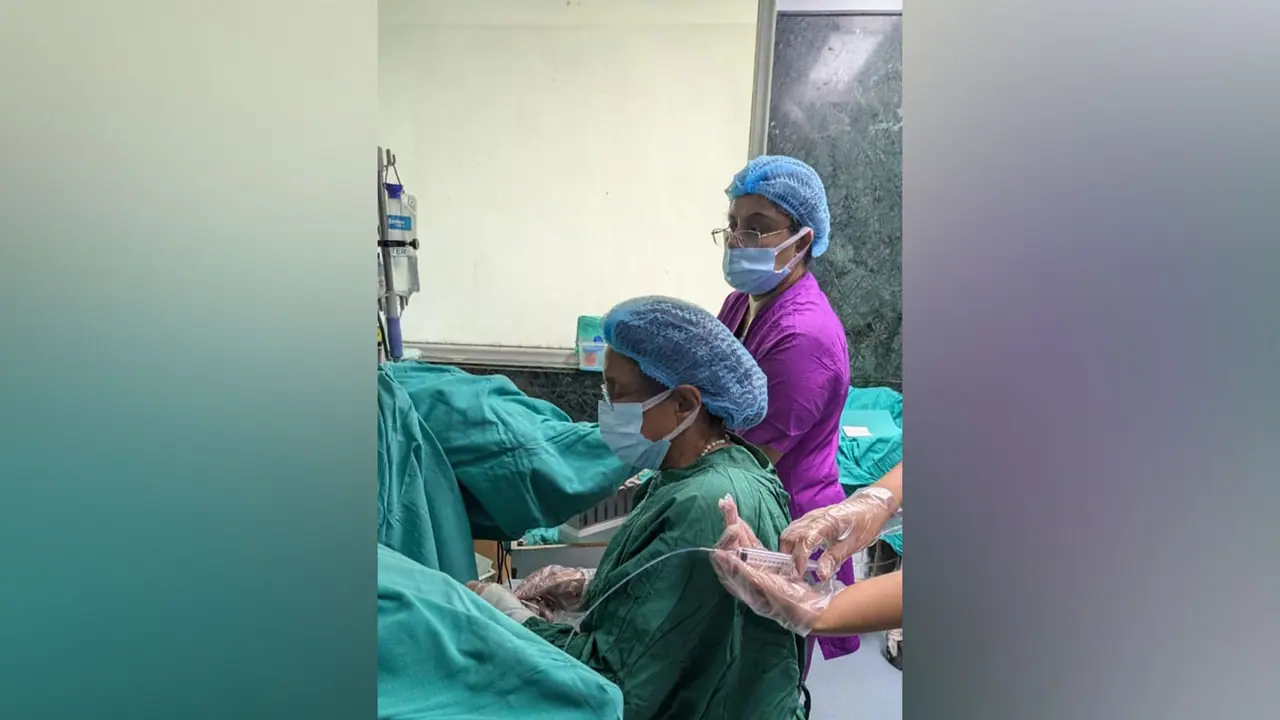
Doctors in New Delhi have achieved two successful live births by treating severe Asherman's Syndrome with umbilical cord-derived stem cells. The pioneering procedure offers new hope to women suffering from this difficult cause of infertility.
In a significant breakthrough in reproductive medicine, doctors at a private hospital in New Delhi have reported two successful live births after treating severe Asherman's Syndrome using umbilical cord-derived stem cells, offering new hope to women suffering from one of the most difficult causes of infertility.
The pioneering work has been carried out by the Centre of IVF and Human Reproduction in collaboration with the Department of Biotechnology and Research at the hospital. The research is part of an ongoing clinical trial registered under the hospital's research cell, supported through intramural funding.
What is Asherman's Syndrome?
According to research, Asherman's Syndrome is a condition in which the uterine cavity becomes partially or completely blocked due to severe intrauterine adhesions. This often occurs after repeated dilatation and curettage procedures, infections, or uterine surgeries. In severe cases, the uterus becomes so damaged that carrying a pregnancy becomes nearly impossible.
The Innovative Stem Cell Procedure
To address this challenge, doctors used mesenchymal stem cells derived from Wharton's jelly of the umbilical cord, a source known for its high regenerative potential, easy availability, low immunogenicity, and non-invasive collection.
In this innovative procedure, umbilical cord-derived mesenchymal stem cells (UC-MSCs) were injected directly beneath the endometrium under hysteroscopic guidance using an IVF ovum pick-up needle. Stem cells were injected sub-endometrially directly into the basal layer, which is responsible for the regeneration of the uterine lining. The procedure avoids the use of scaffolds or biomaterials used in earlier global studies. It is technically simpler and more targeted, potentially improving regenerative outcomes.
Clinical Trial and Initial Success
According to the research team, this is the first reported case from India and among the first globally to use this specific technique. The pilot clinical trial has 10 patients enrolled, all suffering from severe refractory Asherman's Syndrome. So far, 2 patients have successfully delivered healthy babies. Eight patients remain under follow-up and evaluation
Case 1: A 39-Year-Old Woman
A 39-year-old woman with severe uterine adhesions, which developed after miscarriage treatment, underwent stem cell therapy. Following improvement in menstrual flow and endometrial thickness, embryo transfer resulted in a healthy male baby delivered at 35 weeks, weighing 2.0 kg.
Case 2: A 40-Year-Old Woman
In case 2, A 40-year-old woman with recurrent pregnancy loss and severe intra-uterine adhesions underwent the procedure. After uterine regeneration and embryo transfer, she delivered a female baby via LSCS at 31 weeks, weighing 1.8 kg.
Doctors observed significant improvement after stem cell therapy, including increased endometrial thickness, better menstrual flow, and reduced intrauterine adhesion scores. These improvements enabled successful frozen embryo transfer and pregnancy.
A New Hope Beyond Surrogacy
Severe Asherman's Syndrome often leaves women with very limited reproductive options, frequently leading to surrogacy or adoption. With strict regulations governing surrogacy in India, this regenerative approach using umbilical cord stem cells may provide a promising fertility-restoring solution for women with otherwise untreatable uterine damage.
Future Outlook
The research is currently being conducted as a registered clinical trial at Sir Ganga Ram Hospital with 10 patients enrolled, of which two have already achieved live births. Researchers believe that if the ongoing trial continues to produce positive results, stem cell therapy could become a transformative treatment for refractory Asherman's Syndrome worldwide. (ANI)
(Except for the headline, this story has not been edited by Asianet Newsable English staff and is published from a syndicated feed.)