
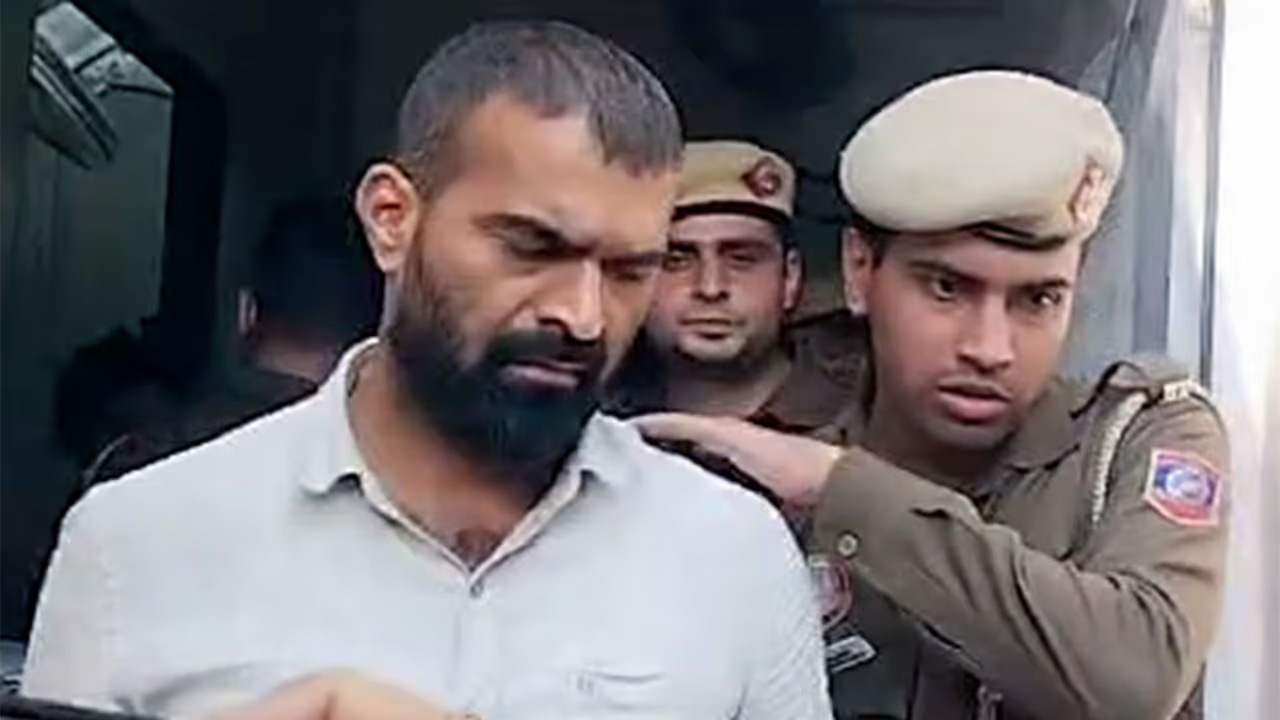
A Delhi court granted 5-day police custody to 4 Indian Youth Congress workers, rejecting their bail pleas. The court ruled that the right to protest is not absolute and is subject to reasonable restrictions for public order and decency.
Right to Protest Not Absolute, Court Rules
While granting 5 days police custody of 4 Indian Youth Congress workers, Delhi's Patiala House Court on Saturday rejected the contention that by organising a protest, they exercised their constitutional right. The Court said that though the right to protest is fundamental to democracy, it is not absolute and it cannot be against public order and decency. It is subject to certain reasonable restrictions.
"The right to protest and dissent is fundamental to democracy, enshrined under Article 19(1)(a) and (b) of the Constitution. However, it is not absolute and subject to reasonable restrictions under Article 19(2) and (3) for sovereignty, public order and decency," the court observed. The court dismissed the contention and rejected the bail pleas. Accused persons remained in police custody till February 25.
Citing Supreme Court Precedents
While granting the police custody, the court referred to the Supreme Court judgement in Anti CAA NRC protest at Shaheen Bagh case. The Supreme Court had observed, "The right to protest is part of fundamental freedoms under Articles 19(1)(a) & (b), but cannot extend to causing grave inconvenience to commuters, public ways cannot be indefinitely occupied, rights of protesters must be balanced with rights of others under Article 21, protests must be at designated places even with permission." The Court had deprecated indefinite blockades emulating colonial-era curbs, stressing that democratic dissent differs from anarchy.
The court rejected the contention and said that the contention that the accused's actions constitute protected dissent under Articles 19(1)(a) and 19(1)(b) of the Constitution merits rejection. "While the right to freedom of speech and expression, including peaceful assembly and protest, forms the cornerstone of democratic discourse, it remains circumscribed by reasonable restrictions imposed by law in the interests of sovereignty and integrity of India, security of the State, friendly relations with foreign States, public order, or decency, as enshrined under Article 19(2) and (3)," the court said. The Supreme Court has consistently held that such rights cannot be exercised in a manner that encroaches upon the fundamental rights of others or disrupts public tranquillity.
Police Allege Pre-Planned Conspiracy
Delhi Police has alleged that the accused persons, in a pre-planned conspiracy, gathered wearing T-shirts inscribed with the slogan "India US Trade Deal Compromised," raised provocative and anti-national slogans, created public disorder, obstructed and assaulted police officials in discharge of official duties, resulting in injuries to ASI Shiv Kumar, ASI Subhash and HC Sanjeet, it is corroborated by MLC.
The court noted that the investigation officer (IO) emphasised that the accused executed a pre-planned act to malign the Government and India's image before foreign delegates at an international summit, which involved assault on public servants. It is alleged that accsued orchestrated a premeditated intrusion into the high-security precincts of Bharat Mandapam during the AI Summit 2026, a premier international conclave hosting global delegates and dignitaries. It is further alleged that accsued persons donned provocative T-shirts bearing offensive slogans such as "India US Trade Deal Compromised," vociferously raised incendiary chants, obstructed public servants in the execution of their duties, and perpetrated physical assaults causing grievous injuries to police personnel.
"Such conduct palpably transcends the ambit of legitimate dissent, metamorphosing into a blatant assault on public order. It imperils not merely the event's sanctity but also the Republic's diplomatic image before foreign stakeholders, rendering it wholly unprotected by constitutional safeguards," JMFC Ravi said.
Bail Denied Citing Gravity, Flight Risk, and Tampering Concerns
On the point of bail, the court said that the prayer is liable to be rejected as premature and untenable at this nascent investigative juncture. The court considered the precondition of bail, namely gravity of Allegations, apprehension of evidence tampering and flight risk.
The court said, " the offences implicate grave threats to public order and state security at an international forum, attracting penalties exceeding three years under Sections 121/612 BNS, warranting stringent scrutiny."
The court also said that the accused belonged to remote locales across Bihar, Uttar Pradesh, and Telangana, pose a high risk of absconding, further heightened by early investigation findings suggesting external conspiracy links. "Thirdly, the probe reveals multiple absconding associates, heightening tampering perils, digital footprints, financial trails, and co-accused disclosures," the court said. (ANI)
(Except for the headline, this story has not been edited by Asianet Newsable English staff and is published from a syndicated feed.)