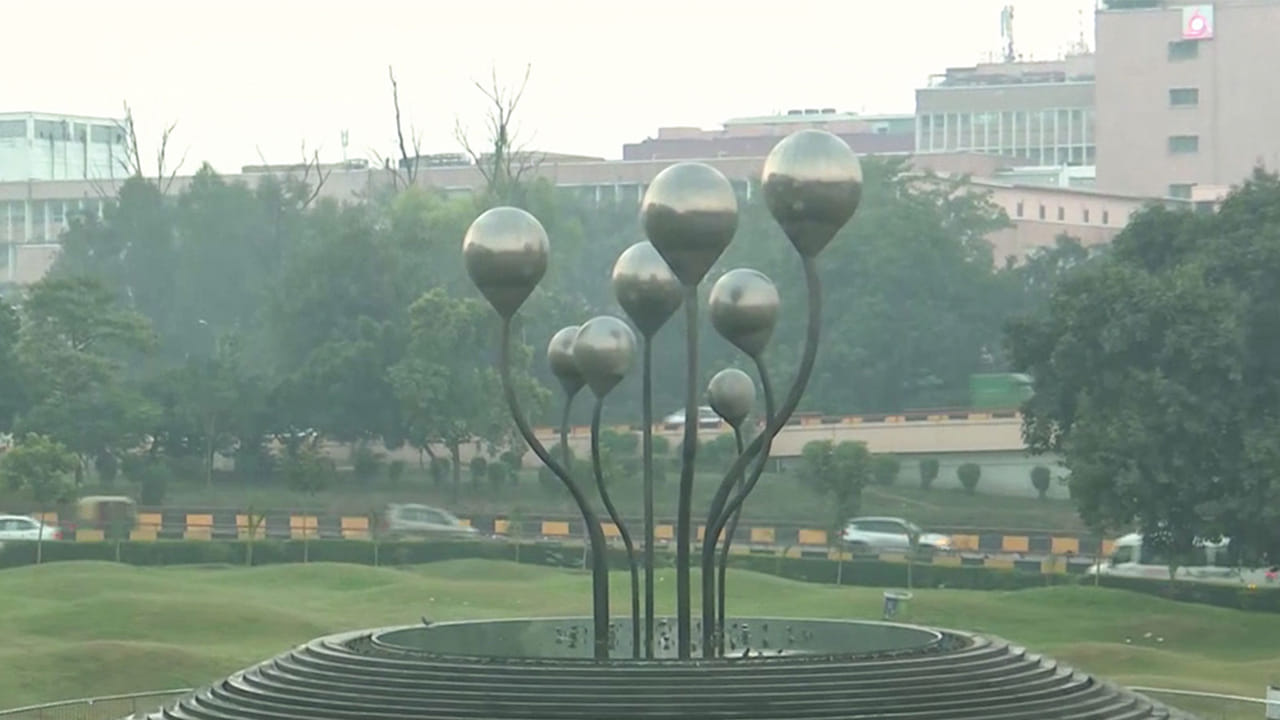
Delhi's air quality has plunged into the 'Severe' category, prompting the Supreme Court to suggest restricting vehicles to BS-VI norms. The CAQM has also mandated a 15-20 percent pollution reduction target for Delhi-NCR by 2027.
New Delhi [India], November 29 (ANI): Delhi's air quality deteriorated on Sunday morning, with the Air Quality Index (AQI) slipping into the 'Severe' category at several monitoring stations across the national capital. Chandni Chowk recorded the highest AQI of 428, while AIIMS registered an AQI of 404, according to data from the Central Pollution Control Board (CPCB). The average AQI in Delhi stood at 329 at 8:05 am, placing the overall air quality in the 'Very Poor' category. The AQI around AIIMS was recorded at 404 at 7:05 am, categorised as 'Severe', while Connaught Place recorded an AQI of 300 at 6:50 am, falling under the 'Poor' category. Among the other monitoring stations, Sirifort recorded an AQI of 405, while CRRI Mathura Road registered 394. Chhawla reported an AQI of 390, followed by Commonwealth Sports Complex at 376, Aya Nagar at 377, Punjabi Bagh at 375, Pusa (IITM) at 368, JNU at 367 and NSUT Jaffarpur at 361. Other areas also reported elevated pollution levels, with IGI Airport (T3) recording an AQI of 345, Shadipur 343, IGNOU-Maidan Garhi 341, Ghummanhera 327, Talkatora Garden 318, Nangloi and Jharoda Kalan 312 each, and Karala 309, placing it in the 'very poor' category. Burari recorded an AQI of 306, while Badarpur registered 305. Mandir Marg and Connaught Place reported 300 each, followed by Tikri Kalan at 293, Maidan Garhi at 290, Pusa (DPCC) at 271, NSIT Dwarka at 271 and Vasundhara Enclave at 242. According to the CPCB classification, an AQI between 0 and 50 is considered 'Good', 51-100 'Satisfactory', 101-200 'Moderate', 201-300 'Poor', 301-400 'Very Poor' and 401-500 'Severe'.
Meanwhile, the Supreme Court on Monday indicated that it may consider restricting vehicles operating in Delhi-National Capital Region (NCR) to those complying with Bharat Stage-VI (BS-VI) emission norms as part of measures to combat worsening air pollution in the region. A Bench comprising Chief Justice of India Surya Kant and Justices Joymalya Bagchi and V Mohana made the observations while hearing a matter concerning air pollution in the national capital. "We are clear we will allow only BS-VI vehicles in Delhi, if not NCR," the Bench remarked. The Bench also suggested an alternative arrangement for the supply of essential commodities, proposing the establishment of warehouses at Delhi's borders where goods could be unloaded and subsequently transported into the city using smaller battery-operated or other non-polluting vehicles.
Separately, the Commission for Air Quality Management (CAQM) has introduced district-level action plans, setting a mandatory minimum target of 15 per cent reduction, with the potential to reach 20 per cent, in annual average air pollution levels across Delhi-NCR for 2027. The Commission has written to the governments of Delhi and other NCR states, calling for comprehensive Annual Action Plans for 2027 at the State, District and Municipal Corporation levels. The plans aim to shift the focus from listing pollution-control activities to achieving measurable outcomes through defined targets, timelines, monitoring parameters and ground-level accountability. Earlier, CAQM began assessing and ranking Delhi and neighbouring states on their performance in implementing pollution-control measures. Its 2026 report card, covering progress up to October, highlighted gaps in several areas, including industrial inspections, waste management, public transport and pollution-monitoring infrastructure. (ANI)