
Congress accuses the Centre of 'damage control' after Rahul Gandhi's Great Nicobar visit, saying the govt's clarification on the mega project ignores key ecological, tribal, and financial concerns raised by experts and local communities.
The Congress on Sunday accused the Centre of going into "damage control mode" following Leader of Opposition Rahul Gandhi's recent visit to Great Nicobar Island, alleging that the government's clarification on the mega infrastructure project fails to address key ecological, tribal, and financial concerns.
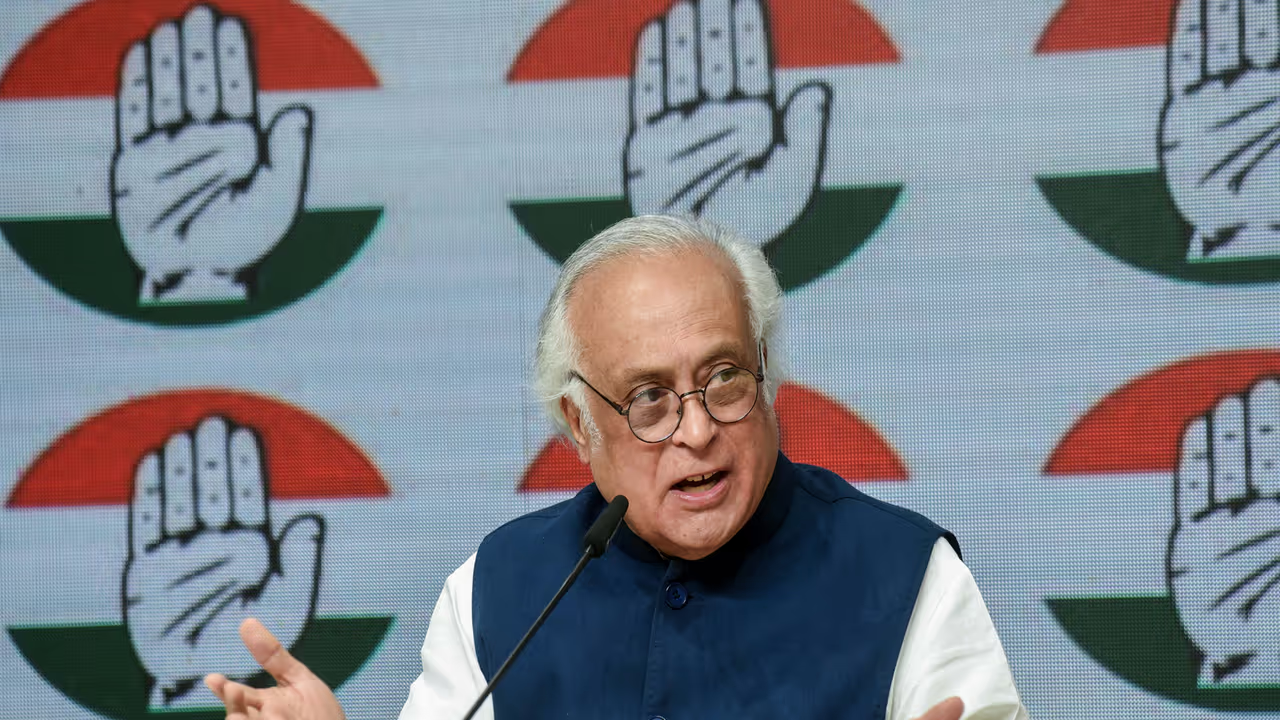
In a detailed statement, Senior Congress leader Jairam Ramesh said the government's May 1 press note on the Great Nicobar Island Development Project sidesteps serious objections raised by local communities, environmental experts, and civil society groups. Rattled by @RahulGandhi’s visit to Great Nicobar Island on April 28, 2026, the Modi Govt issued a press release on the project and is now diverting attention away from the impending ecological disaster. Here is our detailed response to that press note of May 1, 2026. pic.twitter.com/6yeHEovgrj — Jairam Ramesh (@Jairam_Ramesh) May 3, 2026
"The Modi Government, clearly in damage control mode after the hugely impactful visit of the Leader of the Opposition in the Lok Sabha, Rahul Gandhi to Great Nicobar on April 28, issued a press note on the Great Nicobar Island Development Project three days later. This press note does not address any of the serious concerns that have been raised on it by local affected communities, environmentalists, anthropologists, academics, civil society experts and other professionals These concerns had already been conveyed in detail by me to the Union Minister of Environment, Forests & Climate Change on September 10, 2024 and in a follow-up on September 27, 2024," Ramesh said in a statement.
Environmental Concerns Raised
Ramesh argued that the government's claim that only a small percentage of the Andaman and Nicobar Islands' total land area is being used is "misleading," stressing that Great Nicobar is ecologically distinct and globally significant. He highlighted that several new species have been discovered in the region in recent years, underscoring its rich and largely unexplored biodiversity.
"Great Nicobar is a treasure house where new species are still being discovered. Nearly 50 new species - including birds, snakes, geckos, and crabs - have been described by Indian scientists in just the last 5 years from Great Nicobar. These are unexplored forests with several more unknown species bound to emerge," he said in a statement.
Raising environmental concerns, the Congress leader pointed to the proposed port site at Galathea Bay, describing it as an ecologically sensitive zone and a crucial nesting ground for endangered leatherback turtles. He alleged that regulatory classifications were altered to facilitate construction and flagged what he termed inconsistencies in official data on the number of trees to be felled for the project.
Rahul Gandhi Alleges Land Grabbing
Earlier on Wednesday, Congress MP Rahul Gandhi alleged large-scale land grabbing, claiming that tribal rights and environmental safeguards were being undermined amid the Great Nicobar Project. The Raebareli MP added that settlers and tribal people were not getting proper compensation.
Speaking to reporters in Vijayapuram, Gandhi said, "Your land is being taken away from you and being given to Adani and other big businessmen. The Forest Rights Act isn't being implemented there. Settlers and tribals aren't getting proper compensation. quietly, India's heritage is being stolen. We'll try to change perception and tell countrymen what's happening here, and try to protect the people of the Andaman and Nicobar Islands."
The Great Nicobar Project Explained
The Great Nicobar Project seeks to transform Great Nicobar into a strategic maritime and economic hub by leveraging its proximity (about 40 nautical miles) to the East-West shipping route and reducing dependence on foreign transhipment ports keeping in view the defense and National Security purpose. It includes major infrastructure components: a 14.2 million twenty foot equivalent unit( MTEU) International Container Transshipment Terminal, a Greenfield International Airport (4000 Peak Hour Passengers-PHP)., a 450 MVA gas-solar power plant, and a planned township.
The Great Nicobar Project is fully aligned with the Shompen Policy of 2015 and the Jarawa Policy of 2004, which mandate that large-scale development proposals prioritize the welfare and integrity of Particularly Vulnerable Tribal Groups (PVTGs) and follow a structured consultation process, government said in an official statement earlier this week. (ANI)
(Except for the headline, this story has not been edited by Asianet Newsable English staff and is published from a syndicated feed.)