
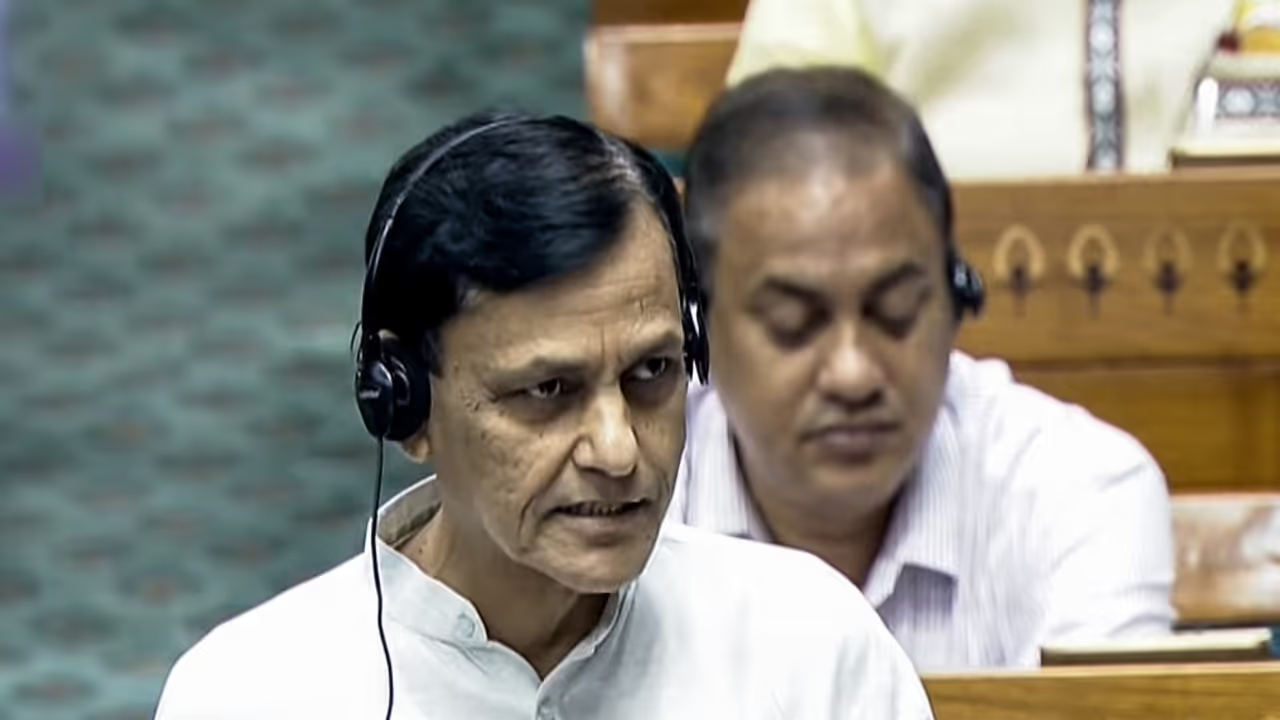
The Centre has constituted a Multi-Sectoral Central Team (MSCT) to scientifically assess the increasing frequency and intensity of cloudbursts, flash floods, landslides and extreme rainfall events in Himachal Pradesh, MoS Home Nityanand Rai said.
Centre forms team to study extreme weather in Himachal Pradesh
Minister of State for Home Affairs Nityanand Rai on Tuesday said the Centre has constituted a Multi-Sectoral Central Team (MSCT) to scientifically assess the increasing frequency and intensity of cloudbursts, flash floods, landslides and extreme rainfall events in Himachal Pradesh.
Responding to a question by BJP MP Rajeev Bharadwaj in the Lok Sabha, Rai said in a written reply that the team comprises experts from the National Disaster Management Authority (NDMA), Central Building Research Institute (CBRI), Roorkee, Indian Institute of Tropical Meteorology (IITM), Pune, Indian Institute of Technology (IIT), Indore and other concerned agencies.
"In view of the increasing frequency and intensity of incidents of cloudbursts, flash floods, landslides and extreme rainfall in Himachal Pradesh, a Multi-Sectoral Central Team (MSCT) has been constituted," Rai said.
He said inputs from the India Meteorological Department (IMD), Central Water Commission (CWC) and Geological Survey of India (GSI) have also been incorporated into the assessment.
According to the Minister, the team has been tasked with undertaking a scientific assessment of the causes behind increasing extreme weather events in the state, analysing geographical and ground conditions in the worst-affected areas, examining data received from various agencies and recommending long-term measures to minimise the impact of such disasters.
Climate change contributing to extreme events
Rai said assessments by weather experts, scientific institutions and state authorities indicate that climate change is contributing to an increase in the intensity and frequency of extreme rainfall events in the Himalayan region.
"Assessments provided by weather experts, scientific institutions and State authorities indicate that, as a consequence of climate change, the intensity and frequency of extreme rainfall events are increasing in the Himalayan region," he said.
He further said accelerated snowmelt and moraine instability contribute to off-season slope failures and high runoff in high-altitude zones.
The response comes amid growing concerns over extreme weather events in Himachal Pradesh and other Himalayan states, where cloudbursts, flash floods and landslides have caused significant damage to infrastructure and affected communities.
Vibrant Villages Programme
In another response, Rai said 1,954 villages across 15 states and two Union Territories have been identified for comprehensive development under the Vibrant Villages Programme-II (VVP-II).
He said 184 villages in Rajasthan have been selected under the programme, including 66 villages in Barmer and Jaisalmer districts.
The Centre has approved VVP-II as a Central Sector Scheme with a total outlay of Rs 6,839 crore till the financial year 2028-29. The programme focuses on livelihood generation, road connectivity, energisation, village infrastructure, healthcare, financial inclusion, youth skill development, tourism, education and telecom connectivity.
Urban Flood Risk Management Programme
Rai also informed the Lok Sabha that the Centre has approved the Urban Flood Risk Management Programme (UFRMP) for 18 cities under its two phases. Phase-I covers Ahmedabad, Bengaluru, Chennai, Hyderabad, Kolkata, Mumbai and Pune with a financial outlay of Rs 3,075.65 crore, while Phase-II covers 11 cities, including Jaipur, Lucknow, Patna, Guwahati, Indore and Thiruvananthapuram, with an outlay of Rs 2,444.42 crore.
"The projects being implemented under UFRMP are expected to significantly improve stormwater conveyance, reduce flooding and waterlogging, enhance road connectivity, and increase the resilience of the drainage network in the cities," Rai said.
He added that the NDMA has prepared a Monitoring and Evaluation Framework for the programme and periodic meetings are being held to review implementation.
Other announcements
Rai also said that 238 Acts enacted by Punjab and seven Acts enacted by Haryana are presently applicable in Chandigarh.
He further clarified that no proposal is currently under consideration to constitute a Development or Advisory Territorial Council in Dadra and Nagar Haveli and Daman and Diu. (ANI)
(Except for the headline, this story has not been edited by Asianet Newsable English staff and is published from a syndicated feed.)