
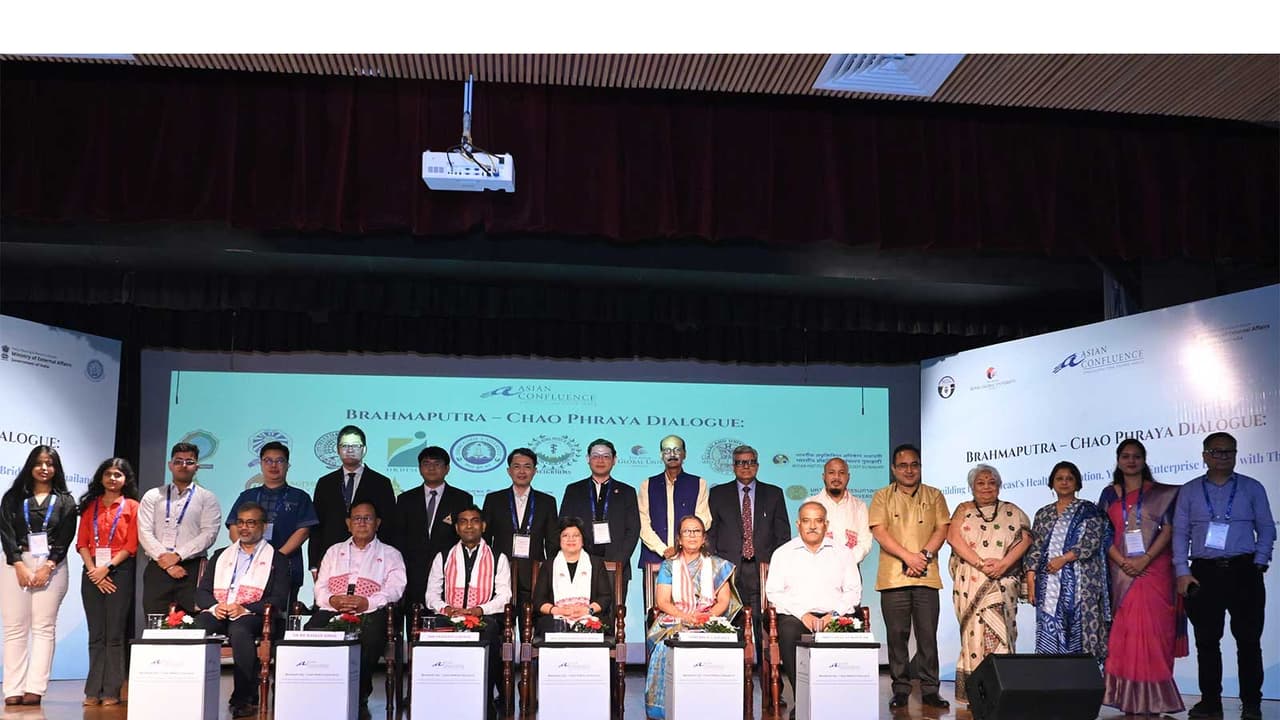
The Brahmaputra-Chao Phraya Dialogue in Guwahati and Shillong brought together diplomats from India and Thailand to explore new avenues for bilateral cooperation, focusing on translating regional policy into actionable initiatives for India's Northeast.
The Brahmaputra-Chao Phraya Dialogue, held across Guwahati and Shillong on September 22 and 23, brought together senior diplomats, policymakers and academics from India and Thailand to explore new avenues for bilateral cooperation with a focus on India's Northeast region.
The two-day dialogue aimed to translate regional policy into actionable initiatives in bilateral trade, education and development, with participants emphasising the need to move beyond formal agreements and focus on implementation through institutional exchanges and on-ground cooperation.
Organised by think tank Asian Confluence in collaboration with the Ministry of External Affairs, India, and Thailand's Ministry of Foreign Affairs, the summit was co-hosted by Assam Royal Global University and the Meghalaya Institute of Governance.
Guwahati Dialogue: Focus on Human Capital and Youth
The first day of the dialogue in Guwahati focused on human capital, healthcare, education and youth entrepreneurship. Participants highlighted the importance of youth engagement, institutional partnerships and direct exchanges between educational institutions to support local economic growth.
The opening sessions were chaired by former MEA Secretary Ambassador Riva Ganguly Das and attended by Urasa Mongkolnavin, Director-General, Department of South Asian, Middle East and African Affairs, Thailand's Ministry of Foreign Affairs; Sabyasachi Dutta, Executive Director, Asian Confluence; former Minister of State for External Affairs and Education R K Ranjan Singh; Additional Secretary (South) in the Ministry of External Affairs Prashant Agrawal; Assam Higher Education Secretary Narayan Konwar; and representatives of academic institutions.
"We must move beyond MoUs to meaningful implementation through on-ground visits and institutional exchanges," participants noted during the opening sessions.
Shillong Discussions: Connectivity and Strategic Partnerships
The dialogue moved to Shillong on September 23, where discussions centred on strategic partnerships in the Bay of Bengal region and strengthening connectivity between India and Thailand.
Key recommendations discussed during the second day included the development of direct air corridors and regional transit links, joint initiatives in clean energy, green manufacturing and disaster management, and city-to-city and province-level partnerships to promote trade and tourism.
Participants also discussed aligning shared interests through regional platforms such as the Bay of Bengal Initiative for Multi-Sectoral Technical and Economic Cooperation (BIMSTEC) and the Indian Ocean Rim Association (IORA).
Northeast's Strategic Role in Act East Policy
India's Northeast holds strategic importance for the country's Act East policy, owing to its geographic proximity to Southeast Asia. Enhanced connectivity and institutional cooperation with Thailand are expected to support regional trade, cultural exchanges and people-to-people ties.
Future Outlook and Sustained Engagement
Asian Confluence has been facilitating engagement between India and Thailand since 2018 through its Brahmaputra-Chao Phraya Initiative and the NADI platform. The think tank said it would continue working to strengthen cooperation in trade, culture and innovation between the two regions.
The dialogue concluded with an emphasis on converting policy recommendations into concrete initiatives through sustained engagement among governments, institutions, businesses and civil society.
(Except for the headline, this story has not been edited by Asianetnews Editorial staff and is published from a syndicated feed.)
