
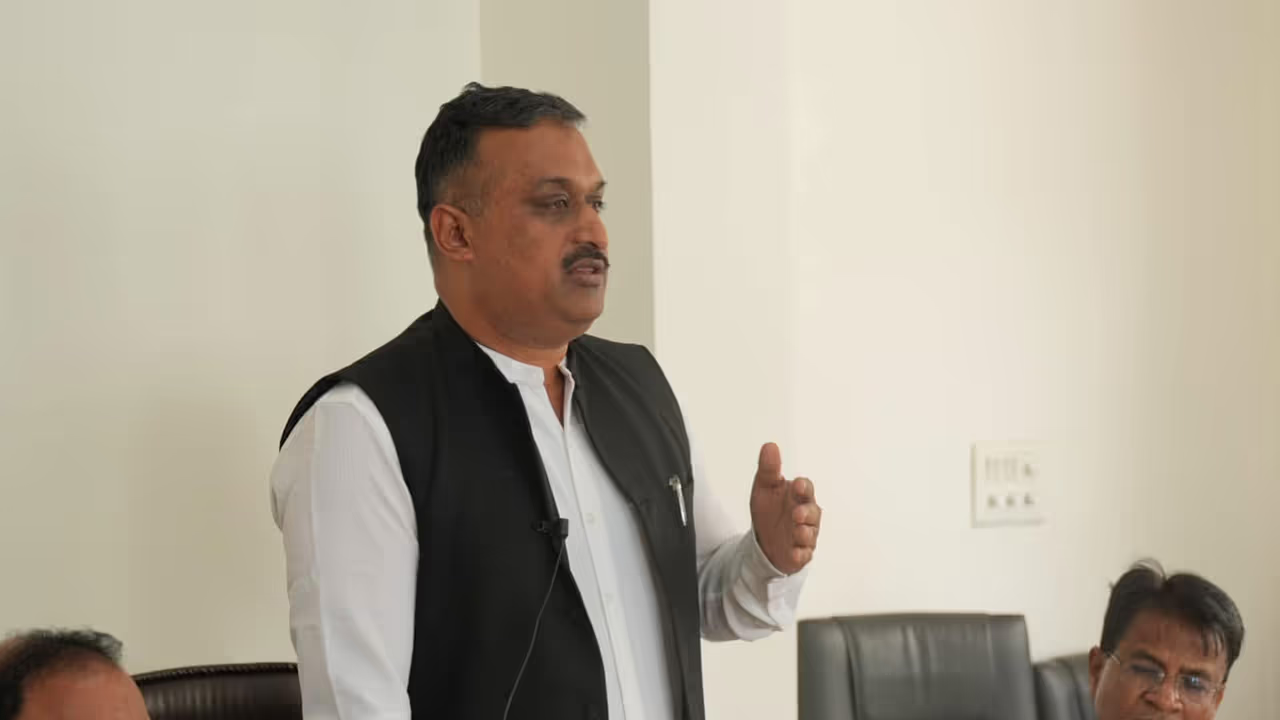
KPCC VP Syed Ahmed Hussain defended the Mekedatu project, citing Bengaluru's water crisis. He said it aligns with a Supreme Court ruling, doesn't violate pacts with Tamil Nadu, and is a necessary supplement to other water conservation measures.
Karnataka Pradesh Congress Committee (KPCC) Vice President and Water Satyagraha convenor Syed Ahmed Hussain has defended the Mekedatu project, saying Bengaluru's drinking water needs must be given the "highest priority" and that the project does not violate Karnataka's obligations to Tamil Nadu.
Responding via a letter to actor and activist Chetan Ahimsa's letter to Senior Congress leader and Leader of Opposition (LoP) Lok Sabha Rahul Gandhi on the proposed Mekedatu project, Hussain said the debate on Mekedatu should be guided by "constitutional principles, scientific evidence and the realities of Bengaluru's growing water crisis" and not political speculation.
Mekedatu Backed by Supreme Court Judgment
Referring to the Supreme Court judgment dated February 16, 2018, Hussain said the apex court awarded Karnataka an additional 14.75 TMC on account of groundwater availability in Tamil Nadu and 4.75 TMC specifically for drinking and domestic purposes, including Bengaluru. The Court also observed that drinking water must be placed on a "higher pedestal", he noted.
"Following the modification of the 2007 tribunal award, Karnataka is entitled to 284.75 TMC. Karnataka's obligation to release 177.25 TMC at Biligundlu remains unchanged. Mekedatu alters none of these allocations," Hussain wrote. He added that subsequent legal challenges to Mekedatu were dismissed as premature, with the Supreme Court stating technical evaluation must be left to expert authorities.
Bengaluru's Documented Water Crisis
Hussain said Bengaluru's water shortfall is "documented, not speculative". The city requires roughly 2,600 million litres daily and falls short by approximately 500 million litres every day, even after combining Cauvery supply and groundwater.
The Cauvery water dispute is a long-running inter-state river water-sharing conflict with Karnataka and Tamil Nadu being the principal parties. The dispute revolves around how the waters of the Cauvery River should be shared, particularly during years of low rainfall. The issue resurfaced amid developments concerning the Mekedatu balancing reservoir project, proposed by Karnataka. It has been a major point of friction between the two states, with Tamil Nadu traditionally opposing it on the grounds that it would affect the flow of water downstream.
"As of early 2024, nearly 7,000 of the city's roughly 14,700 borewells had stopped yielding water. Central government assessments classify every groundwater unit in Bengaluru Urban and Bengaluru Rural as over-exploited," Hussain said. During the 2023-24 drought, the four reservoirs the city depends on -- KRS, Harangi, Hemavathi and Kabini -- fell so low that officials calculated barely enough water remained to reach the following monsoon.
Project Details and Government Stance
The Mekedatu project is designed for 4.75 TMC of use against a reservoir capacity of 67.16 TMC, with around 400 MW of generation, at an estimated cost of ₹9,000 to ₹14,000 crore. CM DK Shivakumar has stated Karnataka will build it within its own territory at its own cost and will assist Tamil Nadu during deficient rainfall.
Addressing Environmental and Social Impact
Addressing environmental concerns, Hussain said the total land requirement is approximately 5,252 hectares, of which 4,996 hectares is submergence -- including 3,182 hectares from Cauvery Wildlife Sanctuary and 1,870 hectares of reserve forest. Five villages -- Sangama, Kongedoddi, Madavala, Muthathi and Bommasandra -- fall within the submergence zone.
Displacement in Proportionality
He compared this to larger projects like Sardar Sarovar and Narmada Sagar to argue for "proportionality". "At Mekedatu, displacement is confined to five villages, with no resettlement crisis of remotely comparable scale," he said, contrasting it with projects that displaced an estimated 400,000 people.
A Path to Water Security and Environmental Protection
Hussain said he supports expansion of rainwater harvesting, treated wastewater reuse and groundwater recharge, but noted these "cannot close a 500 million litre daily gap on their own. Mekedatu is a necessary supplement to those measures, not a substitute".
He also called for "an independent, transparent technical review of the sanctuary's biodiversity, including the grizzled giant squirrel population, with genuine mitigation built into the project design". "We are not asking Karnataka to choose between environmental protection and drinking water security. Responsible public policy must achieve both," Hussain said.
(Except for the headline, this story has not been edited by Asianetnews Editorial staff and is published from a syndicated feed.)