
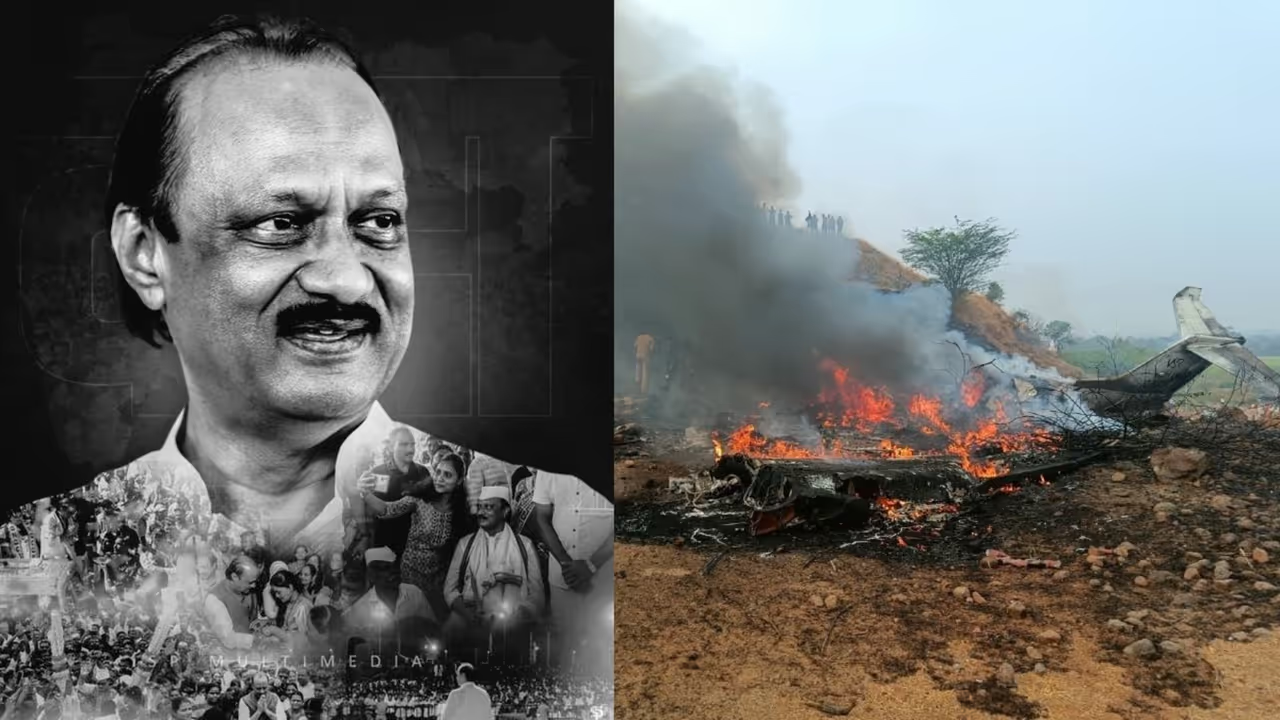
Aviation experts say Baramati plane crash that killed Ajit Pawar may have been avoided if airport had instrument landing system. Visibility was marginal, forcing pilots to rely only on visual cues. The aircraft made 2 landing attempts before crashing
The tragic plane crash at Baramati on Wednesday morning has raised serious safety questions after Maharashtra Deputy Chief Minister and Nationalist Congress Party chief Ajit Pawar lost his life along with four others. The chartered aircraft crashed during landing, killing everyone on board. As the nation mourns, aviation experts have said the accident may have been avoided if the airport had better landing guidance systems.
The incident has now become the focus of a detailed investigation by the Aircraft Accident Investigation Bureau (AAIB). Experts have urged authorities to protect every piece of evidence at the crash site, warning that even small disturbances could affect the final findings.
What experts say about the runway
Retired pilot and aviation expert Ehsan Khalid told PTI Video that Baramati airport’s runway itself was not unsafe. He explained that the runway is suitable for mid-size business jets such as the Learjet 45, which was involved in the crash.
Related Articles

He said the aircraft did not crash because of the runway’s length or condition. Instead, the crash happened before or just outside the runway area. According to him, the real concern was the absence of an Instrument Landing System (ILS), which helps pilots land safely during poor or marginal visibility.
“If the runway had been equipped with ILS or other instrument-based landing systems, this crash could have been avoided,” Khalid said.
Marginal visibility a key factor
According to Khalid, visibility at the time of landing was described as “marginal”. This means the conditions were not clear enough for easy visual flying, but also not bad enough to force a diversion to another airport.
“It was not clear skies, and it was not severe weather either,” he said. “It was not pure visual flight conditions.”
Without ILS, pilots at Baramati have to rely fully on visual contact with the runway. In such conditions, even experienced pilots get very limited support from cockpit instruments.
Two landing attempts before the crash
Initial information suggests the aircraft tried to land once, then aborted the attempt and went around for a second approach. This is known as a “go-around” and is a standard safety procedure if pilots feel the landing is unsafe.
However, experts said it is still unclear why the first landing attempt was aborted. Khalid explained that there is no confirmed information yet on whether the pilot failed to see the runway, faced unstable flight conditions, or experienced weather or technical issues.
“The first approach was a missed landing. The second approach is when the accident happened,” he said.
Questions about cockpit conditions
Captain Sumit Kapoor, who was flying the aircraft, had more than 15,000 hours of flying experience. Khalid described him as a gentle and highly skilled pilot.
Despite his experience, Khalid told News Agency PTI that it is impossible to know what exactly happened inside the cockpit at that moment.
“I do not know what the conditions were in the cockpit,” he said. “It could have been weather, visibility, or even a technical issue. I do not want to guess.”
He added that there is no clear evidence yet to say whether a technical failure played a role.
No survivors, black box crucial
Since there were no survivors, investigators will rely heavily on the aircraft’s black boxes. These include the Cockpit Voice Recorder (CVR) and the Flight Data Recorder (FDR).
These devices record pilot conversations, system warnings, flight speed, altitude, and aircraft movements. Experts say these recordings will be critical in understanding the final moments before the crash.
The Directorate General of Civil Aviation (DGCA) is also expected to have already secured all technical and maintenance documents related to the aircraft.
Importance of technical clearance
Khalid said that aircraft used for VIP travel usually undergo strict technical checks. Investigators will now verify whether any technical issues existed before the flight that were not reported to the pilot.
“They will check if there was any deficiency in the aircraft at the time of dispatch,” he said.
If any fault was present and not disclosed, it could become a major part of the investigation.
Concerns over crash site handling
Another aviation expert, Sanjay Lazar, expressed concern over visuals showing people standing close to the wreckage. He warned that this could harm the investigation.
He said the crash site should be immediately sealed and protected.
“I just hope they sanitise the area and ensure nobody tampers with evidence,” Lazar told PTI.
He stressed that even small debris pieces could provide vital clues.
Aircraft considered very safe
Lazar also said that the Learjet 45 is considered an extremely safe aircraft and that Baramati airport is generally well equipped.
He refused to speculate on the cause of the crash and said conclusions should only be drawn after decoding the black boxes.
“I don’t even know if the pilot issued a mayday call or if it happened suddenly,” he said.
Highly trained pilots fly VIPs
Lazar pointed out that pilots assigned to carry chief ministers and deputy chief ministers are highly trained professionals. He added that the weather appeared bright and sunny, making the incident even more difficult to explain at this stage.
“That is why we need to wait for facts,” he said.
The AAIB has begun its probe, and teams are expected to examine the wreckage, black box data, air traffic communication, weather reports, and airport facilities.
Experts agree that only a careful and unbiased investigation will reveal the true cause of the crash.
(With inputs from agencies)

